Skip to content
BETA

Menu

Account

Language

Practical Thailand guides

Practical Thailand guides

Step-by-step guidance for planning a trip, a longer stay or a move to Thailand.

  • Travel

    A forest-monastery cave complex where a meditating monk once shared space with a tiger, and a staircase of some 1,260 uneven steps that turns a temple visit into a genuine climb.

    2 min read

    Krabi: Wat Tham Suea (Tiger Cave Temple) and a demanding hilltop visit

    Travel

    Krabi: Wat Tham Suea (Tiger Cave Temple) and a demanding hilltop visit

    Last reviewed: 16 July 2026 Written by Ricardo Santos

    Kirandeep Singh Walia / Pexels

    A forest-monastery cave complex where a meditating monk once shared space with a tiger, and a staircase of some 1,260 uneven steps that turns a temple visit into a genuine climb.

    A monk, a cave, a tiger

    In 1975, vipassana forest monk Ajahn Jamnian Seelasettho came to meditate in a cave about 8km northeast of Krabi town. He stayed, a community grew around him, and the site became a working forest monastery where monks' dwellings (kuti) are built directly into the cliffside and karst cavities. Ajahn Jamnian went on to become one of Thailand's most respected meditation teachers.

    Where the name comes from

    Accounts differ. Some say a real tiger lived in the cave and was regularly seen by the meditating monk. Others point to claw marks shaped like a tiger's paw on the cave walls, or the cave's own silhouette, said to resemble a giant feline footprint. No version is officially settled — which is part of the site's appeal.

    A little-known fact: an open-air ossuary

    At the base of the staircase, the complex doubles as an informal archaeological site. Human skeletons and decorated skulls are displayed at several points — a memento mori teaching tool common to Thai forest-monastery tradition, meant to underline the body's impermanence. Ancient stone tools, pottery shards and carved Buddha footprints uncovered on site are also on view. Monkeys, meanwhile, have colonised the lower stairway.

    The climb: 1,237 steps, or closer to 1,260

    Signage states 1,237 steps, but a rebuilt section has pushed the actual current count closer to 1,260, with irregular risers, some over 30cm high. The summit sits at roughly 278 metres elevation (some sources cite up to 309m). Allow 45 minutes to 1.5 hours up depending on fitness, and about the same coming down — budget 2-3 hours in total including the lower cave complex.

    Practical information

    Entry is free, with donation boxes placed around the site. Standard Thai temple modesty rules apply: shoulders and knees covered. The site is generally open from early morning (around 7-8am) to dusk (roughly 6pm), though cave and summit access can close earlier — worth confirming locally. Wat Tham Suea sits about 8km northeast of Krabi town, roughly 20-30 minutes by car or taxi from Ao Nang.

    Sources

  • Travel

    Nine generations of Thai kings visited this waterfall and left their monogram carved in the rock — today it remains one of the few corners of Koh Phangan untouched by the Full Moon Party.

    3 min read

    Than Sadet, Koh Phangan: the royal waterfall nine kings carved into stone

    Travel

    Than Sadet, Koh Phangan: the royal waterfall nine kings carved into stone

    Last reviewed: 18 July 2026 Written by Ricardo Santos

    Photo by ArtHouse Studio / Pexels

    Nine generations of Thai kings visited this waterfall and left their monogram carved in the rock — today it remains one of the few corners of Koh Phangan untouched by the Full Moon Party.

    A waterfall the monarchy made sacred

    Than Sadet takes its name (literally "royal waterfall") from repeated visits by the Thai royal family, from King Rama V's reign in the late 19th century through more recent visits by Rama IX: at least nine monarchs or royal family members had their royal initials carved into the rock across its successive pools, a practice that gave this stream a near-sacred status rare for a simple jungle waterfall. Those carvings, still visible today on several boulders along the trail, turn the hike into something both natural and historical.

    A chain of pools, not one single fall

    Contrary to the image of one dramatic single cascade, Than Sadet is actually a chain of pools and small falls stretched over more than a kilometre of forest stream, each offering different swimming conditions depending on seasonal flow — some upper pools, more isolated, are reached only after roughly thirty minutes' walk from the main pool accessible by car. This tiered layout explains why most rushed visitors only see the first pool, leaving the upper sections noticeably quieter.

    Access: via the east coast road, far from Haad Rin

    Than Sadet sits on Koh Phangan's east coast, geographically and culturally opposite Haad Rin and its monthly Full Moon Party; access is via a paved but winding road from Thong Sala, or by longtail boat from the nearby Thong Nai Pan beaches. A rented scooter remains the most flexible way to reach the parking spot below the trailhead, provided you're comfortable with the island's occasionally steep grades — Koh Phangan's roads stay rougher than neighbouring Koh Samui's.

    Best season for a satisfying flow

    The waterfall's flow varies sharply by season: the stretch right after the Gulf of Thailand monsoon, generally November to January, brings the fullest flow and deepest swimming pools, while late dry season (March-April) can reduce some upper pools to a trickle. Checking recent conditions before dedicating half a day avoids the disappointment of a dry fall.

    A quiet counterpoint to the party island

    Koh Phangan remains globally associated with the Full Moon Party, but most of the island — its interior hills, northeastern beaches, and Than Sadet in particular — has nothing to do with that one-night reputation. Pairing the waterfall with lunch at one of Thong Nai Pan's beach restaurants, about twenty minutes' drive away, builds a full day around the island's other, quieter face, without ever crossing the Haad Rin crowd.

    Sources

  • Travel

    Thong Nai Pan Yai and Thong Nai Pan Noi illustrate a quieter side of Koh Phangan, but remain part of a working island with weather-dependent access.

    2 min read

    Koh Phangan: the northeast beaches as a slower island day

    Travel

    Koh Phangan: the northeast beaches as a slower island day

    Last reviewed: 16 July 2026 Written by Ricardo Santos

    Tom Lorber / Pexels

    Thong Nai Pan Yai and Thong Nai Pan Noi illustrate a quieter side of Koh Phangan, but remain part of a working island with weather-dependent access.

    Why this belongs on a Thailand itinerary

    Thong Nai Pan Yai and Thong Nai Pan Noi illustrate a quieter side of Koh Phangan, but remain part of a working island with weather-dependent access. These areas provide a different perspective on the island's rhythm and landscape, offering a contrast to the more densely populated or event-focused regions.

    Context and history

    Both beaches are named in the official destination profile alongside Than Sadet and other natural attractions. Their importance lies in showing that Koh Phangan contains different rhythms and landscapes, not in promising isolation. They are integral parts of the island's geography, reflecting the diverse ways in which the island is inhabited and experienced.

    How to approach the visit

    Choose one area for a day rather than trying to cross the island repeatedly. Allow enough time for road conditions, rain, heat and a safe return before dark. Planning your day around a single location helps mitigate the challenges of island transit, ensuring a more relaxed and manageable experience.

    Access and conditions

    Conditions at sea and on roads are live matters. Confirm local transport and avoid driving if you are not properly licensed and equipped. The roads and marine access can be affected by weather, so always prioritize safe transit methods. Being aware of the current state of infrastructure is essential for a smooth visit.

    Respectful behaviour and safety

    Beach attire belongs on the beach; dress appropriately in villages and temples. Respecting local customs and maintaining appropriate attire is a key part of responsible travel on the island. This helps maintain the harmony between visitors and the local community.

    Verification before travel

    Operational details, access, weather, conservation rules, ceremonies and local instructions can change. Verify the current official information before travelling via the Tourism Authority of Thailand — Ko Pha-ngan destination profile (https://www.tourismthailand.org/Destinations/Provinces/Ko-Phangan/358). Always check local conditions before planning your transit.

    Sources

  • Travel

    Ban Chiang is an archaeological landscape near Udon Thani recognised by UNESCO, offering a different scale of Thai history from the country’s royal and temple sites.

    2 min read

    Udon Thani: Ban Chiang Archaeological Site and deep-time Thailand

    Travel

    Udon Thani: Ban Chiang Archaeological Site and deep-time Thailand

    Last reviewed: 16 July 2026 Written by Ricardo Santos

    Vansh Sharma / Pexels

    Ban Chiang is an archaeological landscape near Udon Thani recognised by UNESCO, offering a different scale of Thai history from the country’s royal and temple sites.

    Why this belongs on a Thailand itinerary

    Ban Chiang is an archaeological landscape near Udon Thani recognised by UNESCO, offering a different scale of Thai history from the country’s royal and temple sites. It provides a unique look at prehistoric communities and their material culture, allowing visitors to engage with a timeline that predates the more commonly visited historical periods.

    Context and history

    The site is associated with prehistoric communities and is recognised as a World Heritage property. Its importance lies in archaeology and evidence, so visitors should let museum interpretation lead rather than repeat simplified claims about a single “first” civilisation. The site serves as a vital record of human development in the region, offering insights into ancient lifestyles and technological advancements.

    How to approach the visit

    Use the museum and public interpretation to understand what is documented, then approach the wider site with care. This is a strong half-day or day-trip focus, not a place to rush through between unrelated stops. Taking the time to engage with the museum's information is essential for a meaningful visit and for appreciating the significance of the findings.

    Access and conditions

    Do not touch, climb or cross barriers around archaeological material. The site is protected, and strict adherence to these rules is necessary to preserve the integrity of the findings. Respecting these boundaries ensures that the site remains intact for ongoing research and future generations.

    Respectful behaviour and safety

    Respect the site as a place of historical and scientific significance. Follow all posted guidelines and instructions provided by the museum staff to ensure the site remains protected for future study. Maintaining a quiet and observant presence is appropriate for such a significant cultural location.

    Verification before travel

    Confirm current museum opening, access and photography policies directly with the responsible authority before leaving Udon Thani. Operational details, access, weather, conservation rules, ceremonies and local instructions can change. Verify the current official information via the UNESCO World Heritage Centre — Ban Chiang Archaeological Site (https://whc.unesco.org/en/list/575/).

    Sources

  • Travel

    Nong Han near Kumphawapi is known for water lilies whose display is seasonal, making timing and restraint more important than a fixed promise.

    2 min read

    Udon Thani: the Red Lotus Lake as a seasonal landscape

    Travel

    Udon Thani: the Red Lotus Lake as a seasonal landscape

    Last reviewed: 16 July 2026 Written by Ricardo Santos

    Fajri Nugroho / Pexels

    Nong Han near Kumphawapi is known for water lilies whose display is seasonal, making timing and restraint more important than a fixed promise.

    Why this belongs on a Thailand itinerary

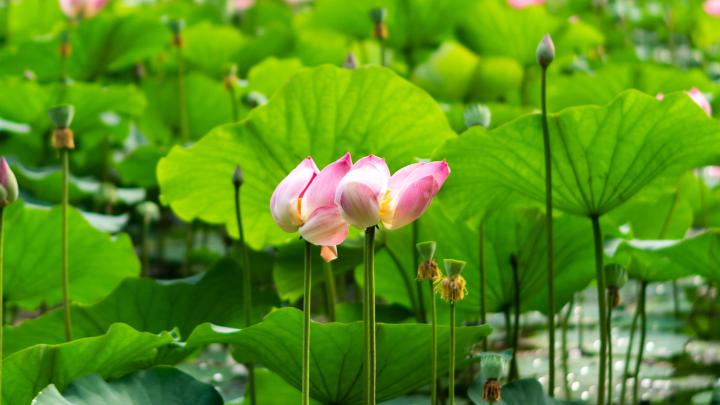
    Nong Han near Kumphawapi is known for water lilies whose display is seasonal, making timing and restraint more important than a fixed promise. It represents a unique opportunity to engage with the natural rhythms of Udon Thani’s wetland ecosystems rather than viewing travel as a checklist of static monuments, highlighting the beauty of natural, non-permanent phenomena.

    Context and history

    The Tourism Authority of Thailand describes the Red Lotus Lake as an Udon Thani attraction and notes the commonly cited flowering period. It is essential to understand this site as a living wetland landscape, not a permanent floral installation. The lake’s character is defined by its biological cycles, which are subject to environmental variables beyond human control, making each visit a unique experience.

    How to approach the visit

    Plan for early light and a quiet observation rather than demanding a particular bloom. A boat outing, where available, is an opportunity to observe the lake’s scale and local conditions without chasing wildlife or flowers. By adopting a patient approach, visitors can better appreciate the scale of the wetland environment and the subtle beauty of the ecosystem.

    Access and conditions

    Flowering, water level, boats and access are seasonal. Because the lake is a natural environment, its appearance and accessibility are subject to change. Do not assume the lake will look the same outside the relevant period. Visitors should prioritize flexibility in their travel planning to account for these natural fluctuations and ensure they are visiting during the optimal window.

    Respectful behaviour and safety

    When visiting, wear sun protection and follow boat-safety instructions provided by local operators. Respect the natural habitat by minimizing disturbance to the water and surrounding flora. The lake is a delicate ecosystem, and responsible observation ensures that the site remains undisturbed for both the local environment and future visitors.

    Verification before travel

    Operational details, access, weather, conservation rules, ceremonies and local instructions can change. Verify the current official information before travelling by consulting the Tourism Authority of Thailand — Udon Thani destination profile at https://www.tourismthailand.org/Destinations/Provinces/Udon-Thani/588. Always check for the most recent updates on-site to confirm current conditions.

    Sources

  • Travel

    Behind the blinding white and thousands of mirror shards, one artist has been building a manifesto on good and evil since 1997 — and refuses to guarantee an end date.

    3 min read

    Wat Rong Khun, the White Temple: the life's work its creator refuses to finish

    Travel

    Wat Rong Khun, the White Temple: the life's work its creator refuses to finish

    Last reviewed: 18 July 2026 Written by Ricardo Santos

    Photo by Luca Sammarco / Pexels

    Behind the blinding white and thousands of mirror shards, one artist has been building a manifesto on good and evil since 1997 — and refuses to guarantee an end date.

    A temple that isn't an ancient one

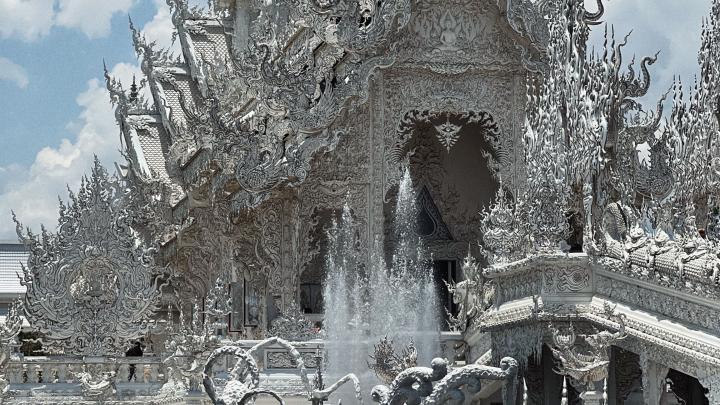
    Unlike almost every major Buddhist site in Thailand, Wat Rong Khun has no historic pedigree: construction began in 1997, fully funded and designed by Thai artist Chalermchai Kositpipat, who personally poured his own fortune into the project rather than accept outside donations he felt would compromise his artistic vision. The result is a dazzling white architectural complex, inlaid with thousands of mirror fragments that catch the light, conceived as total artwork rather than a conventional place of worship — though it remains a consecrated, functioning Buddhist temple.

    The hidden meaning behind white and mirror

    The white represents the purity of the Buddha, while the mirror shards stand for his radiant wisdom illuminating the entire universe — a deliberate aesthetic and symbolic choice, not just a style. Crossing the bridge to the main ubosot (ordination hall) means passing over a small chasm filled with hundreds of sculpted hands reaching upward, representing desire and human suffering holding souls back in hell — a deliberately uncomfortable passage before reaching the purity of the main building, where photography is strictly forbidden out of respect for the working place of worship.

    The details most rushed visitors miss

    Inside the ubosot, the murals don't depict traditional Buddhist scenes but a striking mix of contemporary pop-culture figures — Superman, Batman, planes crashing into twin towers — set against classic religious symbols, a reflection by the artist on good, evil, and the fragility of the modern world, periodically updated. The isolated gold building off to the side of the complex, often mistaken for a treasury or a secondary hall, is actually the public restrooms — gold symbolising the physical body, deliberately set against the spiritual white of the main temple, a contrast Chalermchai made explicit on purpose.

    A work that will never be officially finished

    Chalermchai Kositpipat has repeatedly stated the complex will never be fully completed in his lifetime, and has arranged for a foundation to continue the project after his death, following a master plan of nine buildings in total. This deliberately unfinished, almost organic design sets Wat Rong Khun apart from every other religious monument in the country: visiting today means seeing a living artistic construction site, not something frozen in time.

    When to go to avoid the crowds

    The temple usually opens around 8am and draws the bulk of tour groups between 10am and 3pm; arriving at opening time or late afternoon (the site closes around 5:30pm) lets you photograph the bridge and façade without the crush that makes crossing difficult at midday. Wat Rong Khun pairs naturally, in the same day, with artist Thawan Duchanee's Baan Dam (Black House) about thirty minutes north — a deliberately dark counterpoint to the White Temple, designed by another major name in contemporary Thai art.

    Sources

  • Travel

    A black art compound built over four decades by a Buddhist monk-artist, and a temple painted the colour of a vanished tiger's forest — two ways Chiang Rai turns darkness and dread into something to look at closely.
    3 min read

    Chiang Rai: Baan Dam and Wat Rong Suea Ten

    Travel

    Chiang Rai: Baan Dam and Wat Rong Suea Ten

    Last reviewed: 16 July 2026 Written by Ricardo Santos

    Gije Cho / Pexels

    A black art compound built over four decades by a Buddhist monk-artist, and a temple painted the colour of a vanished tiger's forest — two ways Chiang Rai turns darkness and dread into something to look at closely.
    An artist who spent forty years building his own necropolis

    About ten kilometres north of Chiang Rai, some forty blackened-teak structures spread across nearly 16 hectares of rice fields and lawns. Baan Dam — the "Black House" — is not a museum in the ordinary sense: it is the working testament of Thawan Duchanee (1939-2014), named a National Artist of Thailand in 2001, who began raising the compound in 1975 and kept adding to it until his death. Some buildings, including the vast cathedral-scale wooden hall, reportedly took nearly a decade to complete. Duchanee spent six years studying at the Rijksakademie in Amsterdam, absorbing Dutch and Flemish masters who mixed the holy and the grotesque without apparent contradiction — a direct influence on Baan Dam's aesthetic, sometimes described as a Thai answer to a Rembrandt cabinet of curiosities.

    What's actually inside

    Buffalo horns, python skins, elephant skulls, tusks, turtle shells and carved wooden phallic forms fill rooms with vertiginous ceilings. None of it is shock for its own sake: a devout Buddhist, Duchanee used these dark materials to explore impermanence (anicca), desire and mortality — a deliberate counterpoint to the luminous white of Wat Rong Khun, the White Temple a few kilometres away, built by his friend and fellow artist Chalermchai Kositpipat.

    Wat Rong Suea Ten, the dancing tiger's lair

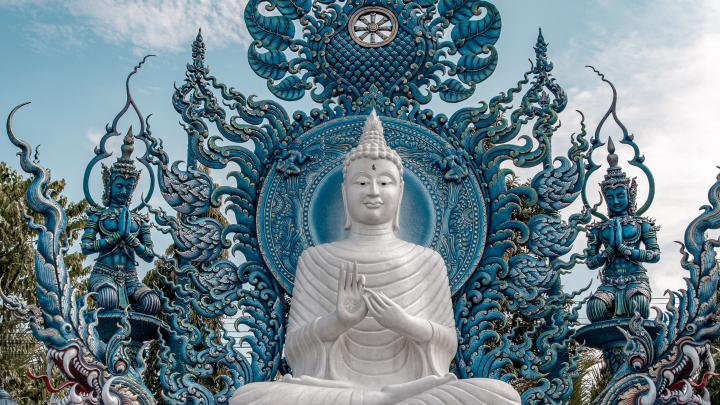
    Ten kilometres away, in Rimkok district, an indigo-blue and gold temple took more than twenty years to reach its present form. The land was once forest reputedly home to tigers — hence "Rong Suea Ten," literally the dancing tiger's den. An older temple on the site had fallen into disrepair until the monk Kruba Chao Thong raised local donations and brought in Putha Kabkaew, a student of Kositpipat, to rebuild it starting in 1996.

    Blue, gold, and the guardian Rahu

    The temple's deep blue stands for sky, water, Dharma and wisdom — a visual metaphor for tranquillity and letting go of material attachment, set against gilded nagas and Buddha imagery. At the entrance stands a striking golden figure: Rahu, the asura who swallows the sun and moon in Buddhist cosmology, associated with eclipses and inauspicious fate, placed here as a protective guardian rather than a threat.

    Practical information

    Baan Dam is open daily 9am-5pm (closed for lunch from noon to 1pm), entrance 80 baht; allow 45-60 minutes. Wat Rong Suea Ten is open 6am-8pm daily, free entry (donations welcome), but shoulders and knees must be covered — sarongs are lent on site for anyone underdressed. Both sites sit roughly 10-13km north of central Chiang Rai and are easily combined in the same half-day by rented car, taxi or songthaew.

    Sources