
Travel
Chiang Rai: Baan Dam and Wat Rong Suea Ten
Last reviewed: 2026-07-16
Written by Ricardo Dos Santos
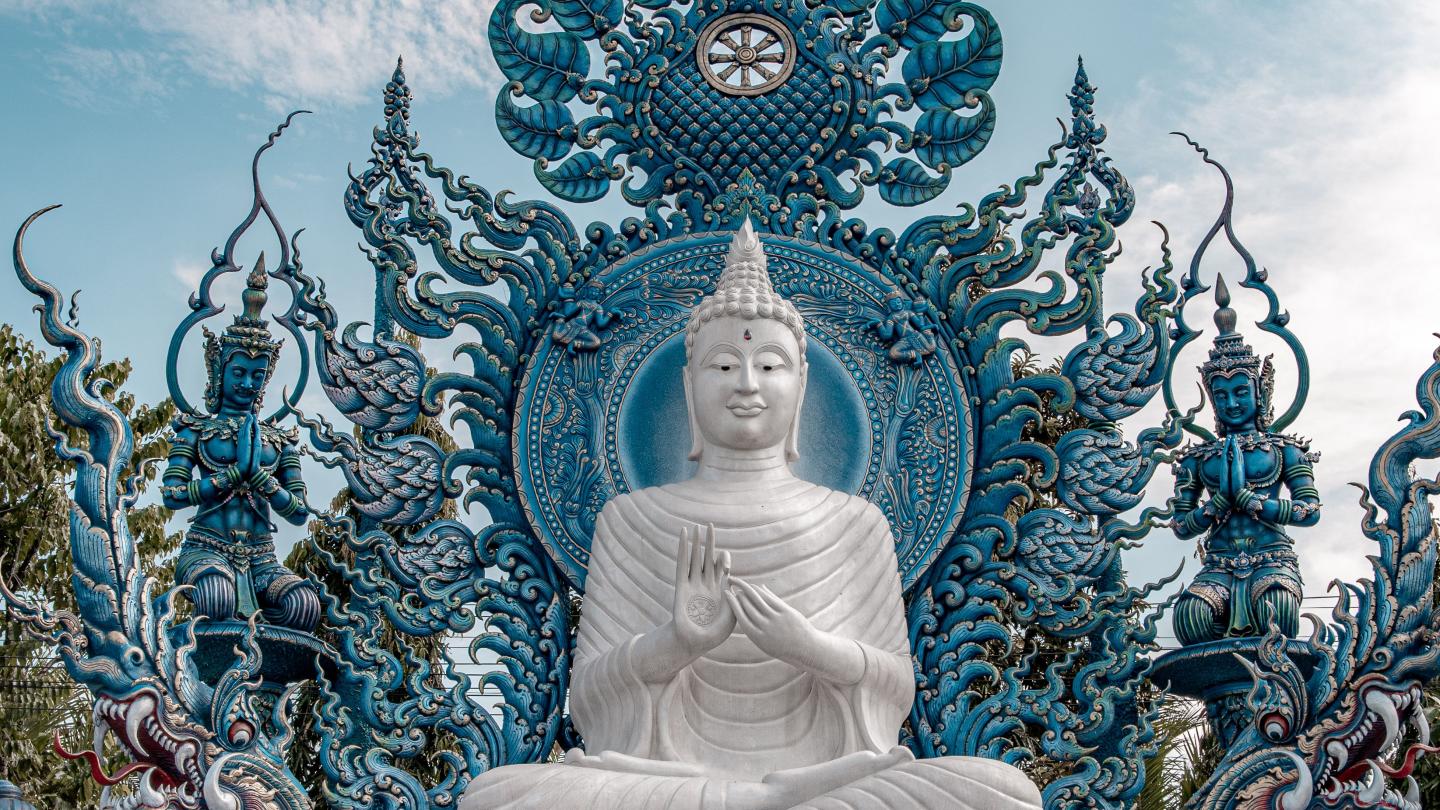
A black art compound built over four decades by a Buddhist monk-artist, and a temple painted the colour of a vanished tiger's forest — two ways Chiang Rai turns darkness and dread into something to look at closely.
An artist who spent forty years building his own necropolis
About ten kilometres north of Chiang Rai, some forty blackened-teak structures spread across nearly 16 hectares of rice fields and lawns. Baan Dam — the "Black House" — is not a museum in the ordinary sense: it is the working testament of Thawan Duchanee (1939-2014), named a National Artist of Thailand in 2001, who began raising the compound in 1975 and kept adding to it until his death. Some buildings, including the vast cathedral-scale wooden hall, reportedly took nearly a decade to complete. Duchanee spent six years studying at the Rijksakademie in Amsterdam, absorbing Dutch and Flemish masters who mixed the holy and the grotesque without apparent contradiction — a direct influence on Baan Dam's aesthetic, sometimes described as a Thai answer to a Rembrandt cabinet of curiosities.
What's actually inside
Buffalo horns, python skins, elephant skulls, tusks, turtle shells and carved wooden phallic forms fill rooms with vertiginous ceilings. None of it is shock for its own sake: a devout Buddhist, Duchanee used these dark materials to explore impermanence (anicca), desire and mortality — a deliberate counterpoint to the luminous white of Wat Rong Khun, the White Temple a few kilometres away, built by his friend and fellow artist Chalermchai Kositpipat.
Wat Rong Suea Ten, the dancing tiger's lair
Ten kilometres away, in Rimkok district, an indigo-blue and gold temple took more than twenty years to reach its present form. The land was once forest reputedly home to tigers — hence "Rong Suea Ten," literally the dancing tiger's den. An older temple on the site had fallen into disrepair until the monk Kruba Chao Thong raised local donations and brought in Putha Kabkaew, a student of Kositpipat, to rebuild it starting in 1996.
Blue, gold, and the guardian Rahu
The temple's deep blue stands for sky, water, Dharma and wisdom — a visual metaphor for tranquillity and letting go of material attachment, set against gilded nagas and Buddha imagery. At the entrance stands a striking golden figure: Rahu, the asura who swallows the sun and moon in Buddhist cosmology, associated with eclipses and inauspicious fate, placed here as a protective guardian rather than a threat.
Practical information
Baan Dam is open daily 9am-5pm (closed for lunch from noon to 1pm), entrance 80 baht; allow 45-60 minutes. Wat Rong Suea Ten is open 6am-8pm daily, free entry (donations welcome), but shoulders and knees must be covered — sarongs are lent on site for anyone underdressed. Both sites sit roughly 10-13km north of central Chiang Rai and are easily combined in the same half-day by rented car, taxi or songthaew.