Skip to content
SawaLife BETA

Practical Thailand guides

Practical Thailand guides

Step-by-step guidance for planning a trip, a longer stay or a move to Thailand.

Relocation & Customs in Thailand 2026: Duty-Free Personal Effects Guide
Visa & Immigration

Relocation & Customs in Thailand 2026: Duty-Free Personal Effects Guide

Duty-free tax exemption rules for importing used household goods and shipping containers into Thailand.

1 min ↗
Visa & Immigration

Relocation & Customs in Thailand 2026: Duty-Free Personal Effects Guide

· Last reviewed: 23 September 2026 · Written by Ricardo Dos Santos
Relocation & Customs in Thailand 2026: Duty-Free Personal Effects Guide

Duty-free tax exemption rules for importing used household goods and shipping containers into Thailand.

Relocation & Customs in Thailand 2026: Duty-Free Personal Effects Guide

Thai Customs Exemption Criteria: Duty-free importation of used household effects is strictly reserved for holders of qualifying Non-Immigrant Visas (with a minimum 1-year Work Permit or LTR status). Personal belongings must arrive between 1 month prior and 6 months after your official date of arrival in Thailand.


1. Eligible Goods vs Taxable Items

Goods Category Duty Status Guidelines
Used clothing, books, personal items Exempt Must show evident signs of prior ownership
Used household electrical appliances Exempt (1 unit per category) 1 TV, 1 refrigerator, 1 washing machine per household
Motor Vehicles (Cars & Motorcycles) Heavily Taxed (200%–300% duties) Commercial importation strongly discouraged
Lost or Stolen Passport & Smartphone in Thailand: Emergency Guide 2026
Visa & Immigration

Lost or Stolen Passport & Smartphone in Thailand: Emergency Guide 2026

Step-by-step emergency procedures: tourist police report, emergency travel document from your embassy, and visa stamp transfer at Immigration.

1 min ↗
Visa & Immigration

Lost or Stolen Passport & Smartphone in Thailand: Emergency Guide 2026

· Last reviewed: 23 September 2026 · Written by Ricardo Dos Santos
Lost or Stolen Passport & Smartphone in Thailand: Emergency Guide 2026

Step-by-step emergency procedures: tourist police report, emergency travel document from your embassy, and visa stamp transfer at Immigration.

Lost or Stolen Passport & Smartphone in Thailand: Emergency Guide 2026

Three-Step Emergency Replacement Protocol:

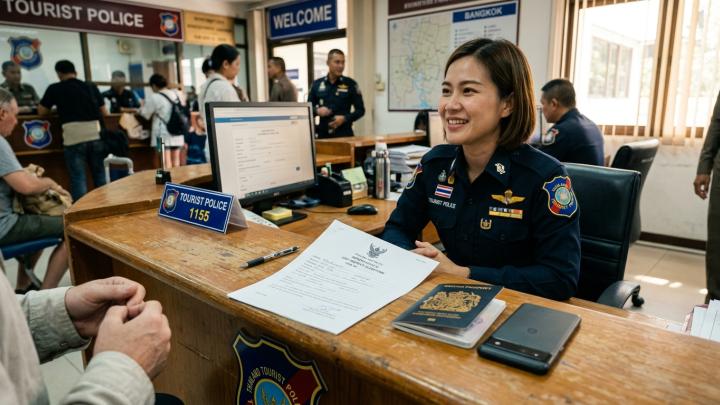
  1. File a formal report at the nearest Tourist Police Station (Call 1155) to secure an official Police Report.
  2. Visit your embassy or consulate in Bangkok for an emergency passport or travel document.
  3. Attend the Immigration Bureau Headquarters to officially transfer your entry stamps and valid visa endorsements.

1. Securing Your Smartphone & Financial Apps

  • Instantly contact your bank hotlines to freeze mobile banking access (K PLUS, Bualuang, SCB EASY).
  • Initiate remote locking via Apple Find My or Google Find My Device.
  • Obtain a replacement SIM card at a carrier shop with your police report and identity proof.
Common Scams in Thailand: Verification Before Payment Guide 2026
Moving to Thailand

Common Scams in Thailand: Verification Before Payment Guide 2026

Anti-fraud survival guide for Thailand: fake Facebook rental deposits, unlicensed visa agents, nominee bank accounts, and reporting scams.

1 min ↗
Moving to Thailand

Common Scams in Thailand: Verification Before Payment Guide 2026

· Last reviewed: 23 September 2026 · Written by Ricardo Dos Santos
Common Scams in Thailand: Verification Before Payment Guide 2026

Anti-fraud survival guide for Thailand: fake Facebook rental deposits, unlicensed visa agents, nominee bank accounts, and reporting scams.

Common Scams in Thailand: Verification Before Payment Guide 2026

Cybercrime Vigilance Notice: The majority of expat-targeted scams occur online through social media rental groups and messaging apps. Never send deposit funds before physically viewing a property or verifying the recipient's authenticated banking identity.


1. Top Three Scams and Countermeasures

  1. Fake Rental Deposits on Social Media: Scammers post stolen luxury condo photos at below-market rates, pressuring buyers for immediate PromptPay deposits.
    • Defense: Never transfer money before an in-person viewing and verifying the owner's Chanote title deed.
  2. Fraudulent Visa Agents: Unlicensed operators providing counterfeit immigration stamps that lead to blacklisting and deportation.
    • Defense: Apply only through official immigration portals or certified law firms.
  3. Mule Bank Accounts: Payments routed through straw men accounts.
    • Defense: Ensure recipient bank accounts match the exact name on the legally binding lease or agreement.
PromptPay & QR Payments in Thailand: The 2026 Cashless Guide
Moving to Thailand

PromptPay & QR Payments in Thailand: The 2026 Cashless Guide

How PromptPay works in Thailand: bank activation, merchant QR scanning, zero-fee instant transfers, and transaction security rules.

1 min ↗
Moving to Thailand

PromptPay & QR Payments in Thailand: The 2026 Cashless Guide

· Last reviewed: 23 September 2026 · Written by Ricardo Dos Santos
PromptPay & QR Payments in Thailand: The 2026 Cashless Guide

How PromptPay works in Thailand: bank activation, merchant QR scanning, zero-fee instant transfers, and transaction security rules.

PromptPay & QR Payments in Thailand: The 2026 Cashless Guide

Universal Cashless Adoption: PromptPay, overseen by the Bank of Thailand, is the ubiquitous backbone of daily commerce in Thailand. From street food stalls to luxury department stores, over 95% of retail transactions are completed via mobile QR scanning with zero buyer fees.


1. How to Setup and Use PromptPay

  1. Account Linkage: Open a Thai bank account (Kasikornbank, Bangkok Bank, SCB) and link your registered Thai mobile number via the banking app.
  2. Paying Merchants (Scan to Pay): Open your mobile banking app, tap Scan, frame the merchant's Thai QR Code, confirm the verified recipient name, and authorize the amount with your PIN or biometric ID.
  3. Receiving Funds: Display your personal in-app receiving QR code or share your registered mobile number for instant, zero-fee remittances.
Bringing Your Dog or Cat to Thailand 2026: DLD Veterinary Protocol
Banking

Bringing Your Dog or Cat to Thailand 2026: DLD Veterinary Protocol

Step-by-step guide to relocating pets to Thailand: ISO microchip, DLD Import Permit, required vaccinations, and Bangkok airport quarantine inspection.

1 min ↗
Banking

Bringing Your Dog or Cat to Thailand 2026: DLD Veterinary Protocol

· Last reviewed: 23 September 2026 · Written by Ricardo Dos Santos
Bringing Your Dog or Cat to Thailand 2026: DLD Veterinary Protocol

Step-by-step guide to relocating pets to Thailand: ISO microchip, DLD Import Permit, required vaccinations, and Bangkok airport quarantine inspection.

Bringing Your Dog or Cat to Thailand 2026: DLD Veterinary Protocol

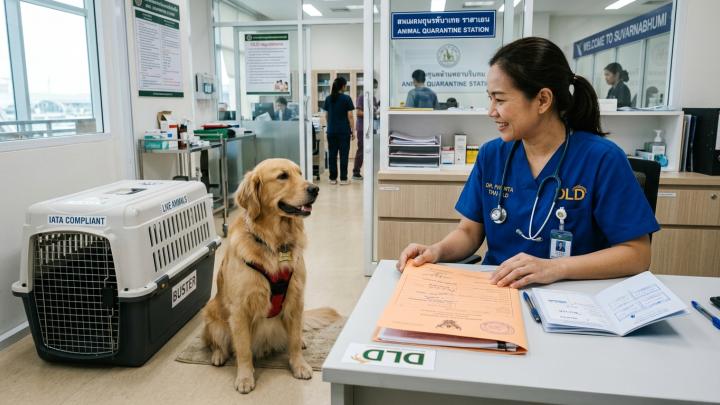
Mandatory Prior Authorization (DLD): You must secure a pre-approved Import Permit from the Department of Livestock Development (DLD) at least 15–30 days prior to departure. Animals landing without a pre-cleared permit face mandatory quarantine or return dispatch.


1. Veterinary Timeline & Vaccination Requirements

  1. ISO 11784/11785 Microchip: Implanted prior to rabies vaccination.
  2. Core Vaccinations (administered > 21 days before departure):
    • Dogs: Rabies, Distemper, Hepatitis, Parvovirus, Leptospirosis.
    • Cats: Rabies, Feline Panleukopenia.
  3. Application Submission: Email Form R-1/1, health book, and passport to the airport Animal Quarantine Station (e.g., qsap_bkk@dld.go.th for Bangkok Suvarnabhumi).
Leaving Thailand: The Definitive Expat Departure Checklist 2026
Banking

Leaving Thailand: The Definitive Expat Departure Checklist 2026

Comprehensive departure checklist: security deposit retrieval, work permit/visa cancellations, banking closure, and tax compliance.

1 min ↗
Banking

Leaving Thailand: The Definitive Expat Departure Checklist 2026

· Last reviewed: 23 September 2026 · Written by Ricardo Dos Santos
Leaving Thailand: The Definitive Expat Departure Checklist 2026

Comprehensive departure checklist: security deposit retrieval, work permit/visa cancellations, banking closure, and tax compliance.

Leaving Thailand: The Definitive Expat Departure Checklist 2026

Orderly Exit Compliance: Closing an expatriate life in Thailand properly ensures you reclaim your full rental deposit, formally cancel corporate visas, and avoid future entry issues.


Departure Timeline (Day -60 to Departure)

Timeline Essential Closure Tasks
Days -60 to -30 • Provide written notice to landlord to trigger security deposit return.• Schedule home fiber broadband termination.• Coordinate official Work Permit and Non-B visa cancellation with employer.
Days -15 to -7 • Conduct pre-moveout inspection and finalize utility settlement balances.• Transfer vehicle registration at DLT upon sale.
Days -3 to Day 0 • Repatriate funds and close inactive bank accounts.• Ensure clear immigration exit stamp at airport passport control.
Relocating to Thailand with Family & Children: The 2026 Vital Guide
Banking

Relocating to Thailand with Family & Children: The 2026 Vital Guide

Complete guide for family relocation: selecting family-friendly neighborhoods, pediatric healthcare, hiring nannies, and community activities.

1 min ↗
Banking

Relocating to Thailand with Family & Children: The 2026 Vital Guide

· Last reviewed: 23 September 2026 · Written by Ricardo Dos Santos
Relocating to Thailand with Family & Children: The 2026 Vital Guide

Complete guide for family relocation: selecting family-friendly neighborhoods, pediatric healthcare, hiring nannies, and community activities.

Relocating to Thailand with Family & Children: The 2026 Vital Guide

Family Quality of Life in Thailand: Thailand is globally renowned as one of the safest and most welcoming countries for raising children. A successful family relocation centers on two critical decisions: housing location within short commute of schools and comprehensive pediatric health coverage.


1. Selecting Family-Friendly Neighborhoods

  • Bangkok: Secure gated communities (Moobans) or multi-bedroom condos in Sukhumvit (Ekkamai, Phrom Phong), Sathorn, or Bangna near international school bus lines.
  • Chiang Mai: Hang Dong and San Sai districts offering standalone houses with gardens close to international campuses.
  • Phuket: Central hubs of Kathu, Koh Kaew, or Cherngtalay proximate to premier schools.
Buying a Freehold Condominium in Thailand as a Foreigner in 2026
Travel

Buying a Freehold Condominium in Thailand as a Foreigner in 2026

Legal guide to buying a condo in Thailand in 2026: 49% foreign quota, FET banking certificates, and Chanote title registration.

1 min ↗
Travel

Buying a Freehold Condominium in Thailand as a Foreigner in 2026

· Last reviewed: 23 September 2026 · Written by Ricardo Dos Santos
Buying a Freehold Condominium in Thailand as a Foreigner in 2026

Legal guide to buying a condo in Thailand in 2026: 49% foreign quota, FET banking certificates, and Chanote title registration.

Buying a Freehold Condominium in Thailand as a Foreigner in 2026

Legal Framework (Condominium Act B.E. 2522): Foreign nationals are legally permitted to own condominium units under 100% direct freehold ownership, provided the building remains within the 49% foreign quota limit. All purchase funds must be remitted from abroad in foreign currency and verified by a Foreign Exchange Transaction (FET) certificate.


1. Three Golden Rules of Safe Property Acquisition

  1. Verify the 49% Foreign Ownership Ratio: Obtain a formal certificate from the Condominium Juristic Person confirming available foreign quota.
  2. FET Banking Certificate (ex-Thor Tor 3): Incoming international transfers must include the clear remark: For purchasing condominium unit [Unit #] at [Building Name].
  3. Chanote Title Deed (Nor Sor 4 Jor): Insist exclusively on true freehold title deeds with official GPS land markers.

2. Land Department Closing Costs and Taxes

Fee / Tax Category Statutory Rate Standard Market Allocation
Transfer Fee 2.0% of government appraisal Split 50/50 buyer and seller
Stamp Duty 0.5% (if owned > 5 years) Paid by seller
Specific Business Tax (SBT) 3.3% (if sold within 5 years) Paid by seller
Withholding Tax Progressive withholding on appraised value Paid by seller
Thai Driving License & International Driving Permit (IDP) in 2026
Cost of Living

Thai Driving License & International Driving Permit (IDP) in 2026

Practical guide to driving legally in Thailand in 2026: Geneva/Vienna conventions, DLT license conversion, and 2-year/5-year validity.

1 min ↗
Cost of Living

Thai Driving License & International Driving Permit (IDP) in 2026

· Last reviewed: 23 September 2026 · Written by Ricardo Dos Santos
Thai Driving License & International Driving Permit (IDP) in 2026

Practical guide to driving legally in Thailand in 2026: Geneva/Vienna conventions, DLT license conversion, and 2-year/5-year validity.

Thai Driving License & International Driving Permit (IDP) in 2026

2026 Driving Regulations & Insurance Compliance:

  • Short-term Tourists (< 90 days): Must hold a valid National Driver's License accompanied by an International Driving Permit (IDP) under the 1949 Geneva or 1968 Vienna convention with the appropriate motorcycle (Category A) or car (Category B) endorsement.
  • Long-term Residents (> 90 days): Must obtain a Thai Driving License from the Department of Land Transport (DLT) to maintain valid health and liability insurance coverage.

1. DLT License Conversion Procedure

Step Requirement Documentation
1. Medical Certificate Clinic physical check (100–200 THB) Form 5-disease medical clearance (< 30 days old)
2. Proof of Address Immigration Office / Embassy Official Certificate of Residence with TM30 slip
3. Home License Valid license + IDP or notarized translation Original license + signed copies
4. Physical Testing On-site at DLT (half-day) Color blindness, reaction time, depth perception, peripheral vision

2. License Validity (2-Year Temporary to 5-Year Full)

  • Initial Issuance: 2-year temporary driving license.
  • Renewal: Non-immigrant visa holders can renew for a standard 5-year driving license.
Renting a Scooter or Car in Thailand 2026: Insurance & Scams to Avoid
Cost of Living

Renting a Scooter or Car in Thailand 2026: Insurance & Scams to Avoid

Essential tips for vehicle rentals in Thailand in 2026: never leave your passport, video walkaround checks, and insurance options.

1 min ↗
Cost of Living

Renting a Scooter or Car in Thailand 2026: Insurance & Scams to Avoid

· Last reviewed: 23 September 2026 · Written by Ricardo Dos Santos
Renting a Scooter or Car in Thailand 2026: Insurance & Scams to Avoid

Essential tips for vehicle rentals in Thailand in 2026: never leave your passport, video walkaround checks, and insurance options.

Renting a Scooter or Car in Thailand 2026: Insurance & Scams to Avoid

Cardinal Safety Rule: NEVER SURRENDER YOUR ORIGINAL PASSPORT AS A SECURITY DEPOSIT to any rental shop. It is legally dangerous and leaves you vulnerable to extortion. Provide a photocopy of your passport accompanied by a reasonable cash deposit (typically 1,000–3,000 THB for motorbikes, 5,000–10,000 THB for cars).


1. Mandatory Video Inspection Protocol

Before driving off:

  1. Record a continuous high-definition video circling the entire vehicle, focusing on brake levers, mirrors, lower fairings, and wheel rims.
  2. Take clear close-up photos of all pre-existing scratches in front of the rental agent.
  3. Test front and rear brakes, tire tread depth, and headlamps before leaving.

2. Insurance Tiers Explained

Insurance Level Actual Coverage Recommendation
Compulsory (Por Ror Bor) Basic emergency medical fees only (capped at 30k–80k THB) Wholly inadequate for major hospitalization
First Class Commercial (Tier 1) Comprehensive collision, theft, third-party liability Mandatory for car rentals
Expat Health Insurance in Thailand 2026: Coverage, Limits & Best Plans
Healthcare

Expat Health Insurance in Thailand 2026: Coverage, Limits & Best Plans

Complete guide to health insurance in Thailand in 2026: inpatient (IPD), outpatient (OPD), deductibles, and direct billing guarantees.

1 min ↗
Healthcare

Expat Health Insurance in Thailand 2026: Coverage, Limits & Best Plans

· Last reviewed: 23 September 2026 · Written by Ricardo Dos Santos
Expat Health Insurance in Thailand 2026: Coverage, Limits & Best Plans

Complete guide to health insurance in Thailand in 2026: inpatient (IPD), outpatient (OPD), deductibles, and direct billing guarantees.

Expat Health Insurance in Thailand 2026: Coverage, Limits & Best Plans

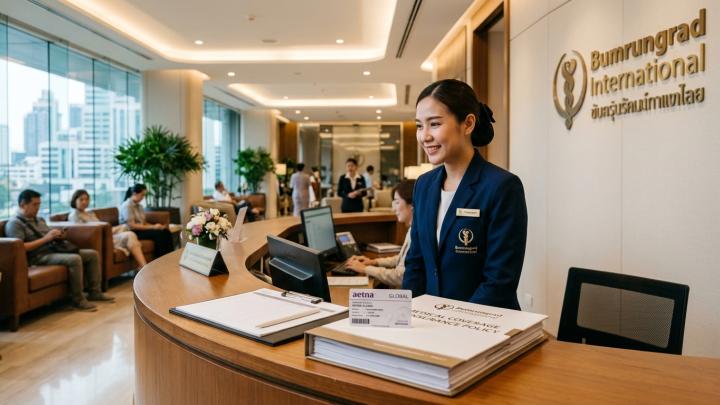
2026 Medical Costs Reality: Private international hospitals in Thailand (e.g., Bumrungrad, Bangkok Hospital, Samitivej) deliver world-class care but at premium private rates. Intensive Care Unit (ICU) admissions can exceed 100,000 to 250,000 THB per day. A comprehensive policy with an annual inpatient cap of at least $1,000,000 USD (approx. 35M THB) is strongly advised for all residents.


1. Optimal Insurance Architecture

  1. Inpatient Care (IPD): Absolute foundation covering surgeries, ICU, imaging, and hospital room fees with direct hospital billing (GOP).
  2. Outpatient Care (OPD): Routine doctor consultations and prescription medicines. Highly optional as everyday clinic visits cost between 800–2,000 THB out-of-pocket.
  3. Medical Evacuation & Repatriation: Crucial for residents located on southern islands or rural provinces.
Medical Emergency, Accidents & Hospital Protocols in Thailand 2026
Healthcare

Medical Emergency, Accidents & Hospital Protocols in Thailand 2026

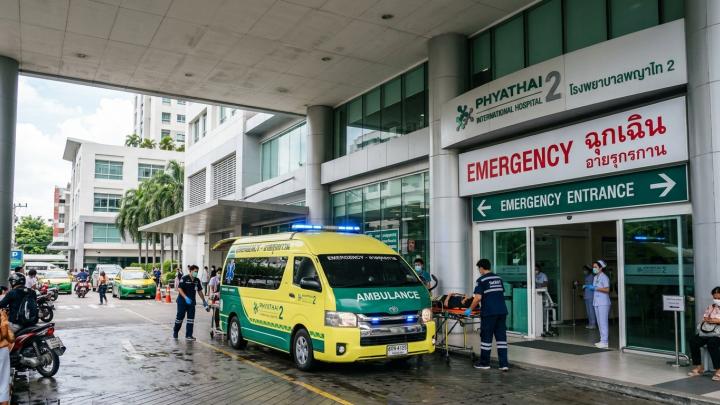
Critical emergency phone numbers (1669, 1155), trauma admission protocols, insurance guarantee letters, and vital procedures in Thailand.

1 min ↗
Healthcare

Medical Emergency, Accidents & Hospital Protocols in Thailand 2026

· Last reviewed: 23 September 2026 · Written by Ricardo Dos Santos
Medical Emergency, Accidents & Hospital Protocols in Thailand 2026

Critical emergency phone numbers (1669, 1155), trauma admission protocols, insurance guarantee letters, and vital procedures in Thailand.

Medical Emergency, Accidents & Hospital Protocols in Thailand 2026

Essential Thai Emergency Contact Numbers:

  • 1669: Emergency Medical Services / Ambulance (NIEM - toll-free, 24/7).
  • 1155: Tourist Police (multilingual English-speaking dispatchers).
  • 191: General Police Emergency.
  • 199: Fire and Rescue Services.

1. Hospital Emergency Admission Procedures

  1. Public vs Private Facilities: Public hospitals provide capable trauma resuscitation at minimal cost. Private international facilities require immediate proof of solvency (credit card pre-authorization or verified insurance) before proceeding with non-life-threatening treatments.
  2. Guarantee of Payment (GOP): Call your insurer's 24/7 emergency hotline immediately upon triage to issue a direct billing GOP to the hospital international desk.
The First 30 Days in Thailand: Complete Expat Relocation Checklist 2026
Banking

The First 30 Days in Thailand: Complete Expat Relocation Checklist 2026

Chronological roadmap for your first 30 days in Thailand: 5G SIM, TM30 compliance, temporary housing, banking, and essential mobile apps.

1 min ↗
Banking

The First 30 Days in Thailand: Complete Expat Relocation Checklist 2026

· Last reviewed: 23 September 2026 · Written by Ricardo Dos Santos
The First 30 Days in Thailand: Complete Expat Relocation Checklist 2026

Chronological roadmap for your first 30 days in Thailand: 5G SIM, TM30 compliance, temporary housing, banking, and essential mobile apps.

The First 30 Days in Thailand: Complete Expat Relocation Checklist 2026

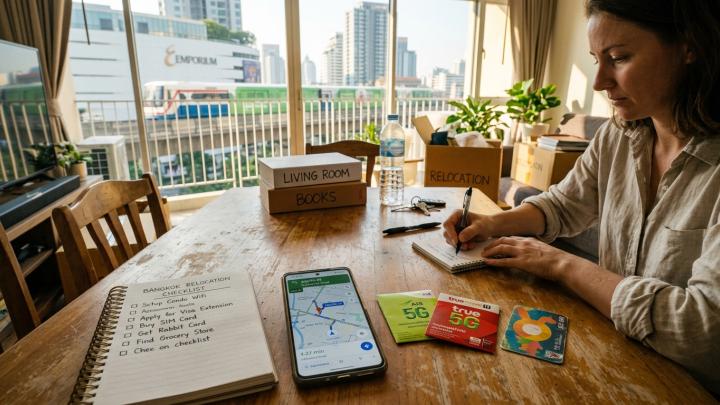
Actionable 30-Day Relocation Roadmap: A smooth transition into Thailand requires executing tasks in a structured sequence to avoid immigration penalties, banking delays, and unnecessary rental expenses.


Chronological Onboarding Timeline

Timeline Critical Priority Actions
Days 1–3 • Purchase a local postpaid/unlimited 5G SIM (AIS or True).• Download everyday lifestyle apps: Grab, Bolt, Lineman, Google Translate, ViaBus.• Confirm hotel TM30 lodging registration.
Days 4–10 • Tour condominiums across 2–3 shortlist neighborhoods.• Negotiate 12-month lease with direct government MEA/PEA electric rates.• Conduct comprehensive photo move-in inspection.
Days 11–20 • Open a local bank account using your lease and visa.• Activate mobile banking and instant PromptPay QR.• Schedule DLT appointment for driver's license conversion.
Days 21–30 • Locate nearest international hospital trauma center.• Install home fiber broadband (AIS Fibre or True).• Set calendar reminders for 90-day reports and visa extensions.
International & Bilingual Schools in Thailand: 2026 Education Guide
Banking

International & Bilingual Schools in Thailand: 2026 Education Guide

Overview of school curriculums (IB, British, American, French), annual tuition ranges, and student/guardian visa processing in Thailand.

1 min ↗
Banking

International & Bilingual Schools in Thailand: 2026 Education Guide

· Last reviewed: 23 September 2026 · Written by Ricardo Dos Santos
International & Bilingual Schools in Thailand: 2026 Education Guide

Overview of school curriculums (IB, British, American, French), annual tuition ranges, and student/guardian visa processing in Thailand.

International & Bilingual Schools in Thailand: 2026 Education Guide

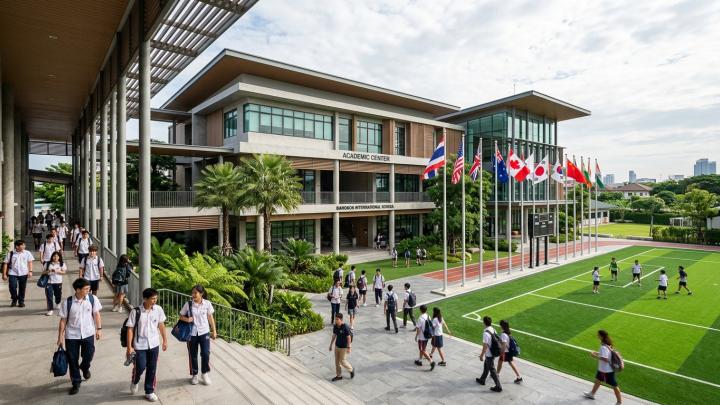
Thailand International School Landscape: Over 200 accredited international schools operate across Thailand under ONESQA certification. Annual tuition ranges from 250,000 THB to over 1,000,000 THB per child depending on curriculum and campus facilities.


1. Curriculum Comparison Matrix

Curriculum Core Educational Focus Prominent Schools Annual Tuition Range
British (IGCSE / A-Levels) Rigorous subject specialization Bangkok Patana, Shrewsbury, Harrow 450,000 – 950,000 THB
International Baccalaureate (IB) Holistic inquiry-based learning NIST International, KIS 600,000 – 1,050,000 THB
French (AEFE) French National Curriculum Lycée Français de Bangkok (LFIB) 280,000 – 480,000 THB
English Program (EP Bilingual) 50/50 dual language Thai-English Sarasas, Assumption 150,000 – 280,000 THB
Working Legally in Thailand 2026: Work Permits, DTV Visa & Restricted Jobs
Insurance

Working Legally in Thailand 2026: Work Permits, DTV Visa & Restricted Jobs

Guide to working legally in Thailand: DTV remote work visa, digital work permits (WP.11), and the official list of 40 restricted occupations.

1 min ↗
Insurance

Working Legally in Thailand 2026: Work Permits, DTV Visa & Restricted Jobs

· Last reviewed: 23 September 2026 · Written by Ricardo Dos Santos
Working Legally in Thailand 2026: Work Permits, DTV Visa & Restricted Jobs

Guide to working legally in Thailand: DTV remote work visa, digital work permits (WP.11), and the official list of 40 restricted occupations.

Working Legally in Thailand 2026: Work Permits, DTV Visa & Restricted Jobs

Core Thai Labor Law Principle: Any local employment within Thailand strictly mandates a Non-Immigrant B Visa and a valid Work Permit issued by the Department of Employment. Remote workers and digital nomads servicing exclusively foreign employers or international clients can legally operate under the Destination Thailand Visa (DTV).


1. Legal Working Frameworks Compared

Status Required Visa Work Permit Mandatory? Permitted Clients / Employer
Thai Company Employee Non-Immigrant B YES (Digital Work Permit) Sponsoring Thai corporate entity
Digital Nomad / Remote Professional DTV (Destination Thailand Visa) NO (Explicitly exempt) 100% overseas foreign employers & clients
Foreign Business Owner / Director Non-Immigrant B YES (Director Work Permit) Thai Co., Ltd maintaining 4 Thai staff per permit

2. Strictly Prohibited Occupations for Foreign Nationals

Thai Royal Decree strictly reserves 40 professions exclusively for Thai citizens, including:

  • Tour Guide / Tour Leader
  • Hairdressing, Barbering, and Beauty Salon work
  • Driving passenger transport (taxis, tuk-tuks, vans)
  • Unskilled manual labor
  • Legal representation in court
TDAC 2026: Official Guide to the Thailand Digital Arrival Card
Visa & Immigration

TDAC 2026: Official Guide to the Thailand Digital Arrival Card

Complete guide to the 2026 Thailand Digital Arrival Card (TDAC): 72-hour window, official procedure, QR code, and common mistakes.

3 min ↗
Visa & Immigration

TDAC 2026: Official Guide to the Thailand Digital Arrival Card

· Last reviewed: 23 September 2026 · Written by Ricardo Dos Santos
TDAC 2026: Official Guide to the Thailand Digital Arrival Card

Complete guide to the 2026 Thailand Digital Arrival Card (TDAC): 72-hour window, official procedure, QR code, and common mistakes.

TDAC 2026: Official Guide to the Thailand Digital Arrival Card

2026 Official Regulation: The Thailand Digital Arrival Card (TDAC) permanently replaces the paper TM6 form for all international arrivals by air, sea, and land. Submissions must be completed exclusively online via the official Royal Thai Immigration portal (tdac.immigration.go.th).


1. What is TDAC and Who is Required to Complete It?

The TDAC is the mandatory digital arrival declaration established by the Royal Thai Immigration Bureau. Every non-Thai traveler entering the Kingdom of Thailand must submit this form prior to border immigration clearance.

Who Must File the TDAC?

  • Tourists entering under visa exemption (60 days) or Tourist Visa (TR).
  • Long-term residents and visa holders (DTV, Non-Immigrant O, B, ED, LTR, Elite).
  • Minors and children: Each traveler, regardless of age, must have an individual TDAC linked to their passport number.

Thai passport holders are exempt from filing the TDAC.


2. When and How to Submit Your TDAC?

The TDAC must be submitted within the 72-hour window prior to scheduled arrival in Thailand.

Step Timeline Required Action
1. Preparation Day -7 to Day -3 Gather: passport (valid > 6 months), flight number, 1st accommodation address in Thailand.
2. Online Submission Within 72h of departure Visit tdac.immigration.go.th, fill out personal identity, flight details, and lodging info.
3. QR Code Issuance Instant Download the confirmation PDF and save the QR Code to your mobile photo library.
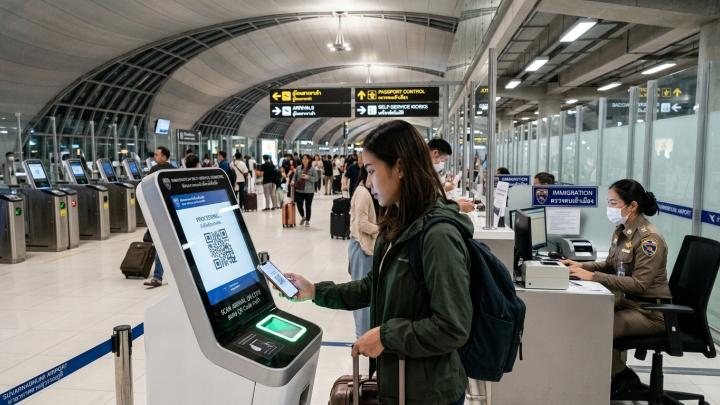
4. Border Clearance Upon Arrival Present the QR Code along with your passport at immigration counters or automated e-Gates.

3. Required Information and Verification

Ensure you have the following details ready before starting:

  1. Biometric Passport: Passport number, issuance/expiry dates, nationality.
  2. Flight Details: Arrival flight number (e.g., TG931, EK384) and scheduled arrival date.
  3. Exact Address in Thailand: Hotel name, condominium or private residence, province (Changwat), district (Amphoe), and postal code.
  4. Contact Info: Valid email address and active mobile phone number.

Beware of Third-Party Scam Websites: The official TDAC application is 100% FREE OF CHARGE. Never enter payment details on unverified third-party websites claiming to charge "processing fees". The only authentic URL is tdac.immigration.go.th.


4. Frequently Asked Questions (FAQ)

What should I do if my flight or hotel changes after submitting the TDAC?

You can log back into the official portal using your reference number and passport credentials to modify your flight details or initial accommodation address for free.

Does the TDAC replace a Thai Visa?

No. The TDAC is an arrival immigration declaration (landing card). It does not replace the visa requirements or visa exemptions governing your nationality.

Does TDAC replace the TM30 notification upon arrival?

No. The TDAC records your border crossing. The TM30 declaration remains strictly mandatory for your landlord or hotel within 24 hours of reaching your accommodation.

TM30 & TM47: Residence Notification & 90-Day Report in 2026
Visa & Immigration

TM30 & TM47: Residence Notification & 90-Day Report in 2026

Complete practical and legal guide to TM30 (24h notification) and TM47 (90-day reporting) in Thailand for 2026.

2 min ↗
Visa & Immigration

TM30 & TM47: Residence Notification & 90-Day Report in 2026

· Last reviewed: 23 September 2026 · Written by Ricardo Dos Santos
TM30 & TM47: Residence Notification & 90-Day Report in 2026

Complete practical and legal guide to TM30 (24h notification) and TM47 (90-day reporting) in Thailand for 2026.

TM30 & TM47: Residence Notification & 90-Day Report in 2026

Core Legal Distinction:

  1. TM30 (Section 38): Notification of alien residence, strictly mandatory within 24 hours of arrival at any property. Legally falls upon the landlord, property owner, or hotel manager.
  2. TM47 (Section 37): 90-day continuous stay reporting, a personal legal obligation of the foreign national residing in Thailand.

1. TM30 Notification: Legal Duties, Steps, and Penalties

The TM30 receipt is an essential document in Thailand. Without a valid TM30 receipt (Tor Mor 30), immigration offices will routinely deny visa extensions, 90-day reports, and certificates of residence.

Who Must File the TM30?

  • Hotels & Guesthouses: Process automatic lodging registration via the commercial portal.
  • Private Landlords: Must file via tm30.immigration.go.th or the official mobile application.
  • Tenant Self-Filing: If the owner is unresponsive, tenants can file in person with the lease agreement, Chanote copy, and landlord's Thai ID/Tabien Baan copy.
Failure to Report Penalty Statutory Fine Range
Non-compliant landlord / hotel 800 to 2,000 THB per undeclared foreigner
Foreigner living in self-owned condo 800 to 1,600 THB upon regularization

2. TM47: Online 90-Day Stay Reporting

Foreigners residing continuously in Thailand for more than 90 days without exiting the country must submit a TM47 notification every 90 days.

Submission Windows:

  • Online (tm47.immigration.go.th): Between 15 days prior and the exact due date.
  • In-Person at Immigration: Between 15 days prior and 7 days after the due date.
  • Registered Mail: Sent at least 15 days prior to the due date.

Leaving Thailand Resets the Clock: Every departure from Thailand resets your 90-day count to zero. Your re-entry date becomes Day 1.


3. Frequently Asked Questions (FAQ)

What happens if I miss my 90-day report deadline?

A statutory fine of 2,000 THB will be assessed when reporting in person (up to 4,000 THB if arrested by authorities).

Do I need to file a TM47 if I extend my visa before day 90?

No. Processing a visa extension in person at immigration resets your 90-day reporting schedule.

Opening a Thai Bank Account in 2026: Requirements & Best Banks
Moving to Thailand

Opening a Thai Bank Account in 2026: Requirements & Best Banks

Practical guide to opening a bank account in Thailand in 2026: eligible visas (Non-Immigrant, LTR, Elite), DTV visa status, recommended banks, and TrueMoney Wallet alternative for PromptPay.

3 min ↗
Moving to Thailand

Opening a Thai Bank Account in 2026: Requirements & Best Banks

· Last reviewed: 23 September 2026 · Written by Ricardo Dos Santos
Opening a Thai Bank Account in 2026: Requirements & Best Banks

Practical guide to opening a bank account in Thailand in 2026: eligible visas (Non-Immigrant, LTR, Elite), DTV visa status, recommended banks, and TrueMoney Wallet alternative for PromptPay.

Opening a Thai Bank Account in 2026: Requirements & Best Banks

Bank of Thailand 2026 Regulations & DTV Visa Status: Due to heightened Anti-Money Laundering (AML) controls and strict measures against mule accounts, traditional Thai banks now restrict bank account openings to residents with long-term visas and local anchoring (Non-Immigrant B with Work Permit, Non-Immigrant O marriage/retirement, LTR, Elite/Privilege). Important notice for DTV (Destination Thailand Visa) holders: As the DTV is classified under the nomad/special tourist category without a local work permit, traditional banks generally refuse to open standard bank accounts for DTV holders. However, DTV holders can register and use the TrueMoney Wallet for Foreigners app to scan and pay seamlessly via the nationwide PromptPay QR network.


1. Recommended Traditional Banks for Eligible Foreigners

Bank Expat Policy & Acceptance Required Visas & Conditions Mobile Banking Strengths
Bangkok Bank (BBL) Most expat-friendly for long-term residents Non-O, Non-B, LTR, Elite + Certificate of Residence Direct SWIFT transfers and robust bilingual app
Kasikornbank (KBank) Industry-leading K PLUS user interface Work Permit or long-term visa strictly required Effortless PromptPay integration and merchant QR scanning
SCB (Siam Commercial Bank) Major presence across metropolitan branches Non-Immigrant visas with proof of income or lease Modern SCB EASY app with virtual card support
Krungsri (Bank of Ayudhya) Expat-focused services backed by MUFG Non-Immigrant or LTR with financial background Favorable FX exchange rates and cross-border remittances

2. Required Document Checklist (Physical Banks)

Eligible applicants (Non-Immigrant, LTR, Elite) should bring the following to their branch appointment:

  1. Original Passport with valid visa sticker/stamp (Non-O, Non-B, LTR, Smart Visa, Elite).
  2. Work Permit or Proof of Residence: Work Permit book/digital WP, Immigration Certificate of Residence, or 1-year registered lease with TM30 slip.
  3. Income or Employment Proof: Thai employment contract, employer recommendation letter, or official pension slip for retirees.
  4. Registered Thai SIM Card: Active local mobile number registered under your name for 2FA SMS/OTP verification.

3. DTV Visa Holders: The TrueMoney Wallet Solution for PromptPay

Since physical bank branches generally refuse account openings for DTV holders, TrueMoney Wallet (Foreigner) serves as the most effective official solution for everyday living and spending in Thailand:

Feature Details for DTV Visa Holders
Eligibility & Sign-Up Open to foreigners with a valid passport and valid DTV visa stamp/e-visa.
Identity Verification (e-KYC) Complete in-app passport scanning + biometric verification at any True Shop or 7-Eleven kiosk.
PromptPay QR Payments Scan and pay instantly at any street food vendor, restaurant, mall, or supermarket accepting PromptPay QR.
Wallet Top-Up Top up THB balance using international credit/debit cards (Visa/Mastercard, Wise, Revolut) or cash over-the-counter at 7-Eleven.
Supported Services Bill payments, rides/orders on Grab / Lazada / Shopee, and peer-to-peer TrueMoney transfers.

Pro-Tip for DTV Digital Nomads: Link an international multi-currency card (such as Wise or Revolut) to your TrueMoney account to easily fund your daily living expenses across Thailand without needing a local bank account.

Foreigner Taxation in Thailand 2026: Tax Residency & Section 41
Moving to Thailand

Foreigner Taxation in Thailand 2026: Tax Residency & Section 41

Comprehensive analysis of 2026 Thai taxation: 180-day rule, taxation of remitted foreign income, and Foreign Tax Credit guidelines.

1 min ↗
Moving to Thailand

Foreigner Taxation in Thailand 2026: Tax Residency & Section 41

· Last reviewed: 23 September 2026 · Written by Ricardo Dos Santos
Foreigner Taxation in Thailand 2026: Tax Residency & Section 41

Comprehensive analysis of 2026 Thai taxation: 180-day rule, taxation of remitted foreign income, and Foreign Tax Credit guidelines.

Foreigner Taxation in Thailand 2026: Tax Residency & Section 41

Revenue Department 2026 Enforcement: Under Section 41 of the Thai Revenue Code, individuals present in Thailand for 180 days or more in a calendar year qualify as tax residents. Foreign-sourced assessable income remitted into Thailand is subject to Thai Personal Income Tax (PIT) progressive rates.


1. Key Rules of Thai Tax Residency

  • 180-Day Rule: Staying in Thailand for 180 days or more between January 1 and December 31.
  • Domestic Income: Taxable in Thailand regardless of residency duration.
  • Foreign-Sourced Income: Taxable only when remitted or transferred into a Thai financial institution.

2. Personal Income Tax (PIT) Brackets 2026

Net Assessable Income (THB) Marginal Tax Rate
0 – 150,000 THB 0% (Exempt)
150,001 – 300,000 THB 5%
300,001 – 500,000 THB 10%
500,001 – 750,000 THB 15%
750,001 – 1,000,000 THB 20%
1,000,001 – 2,000,000 THB 25%
2,000,001 – 5,000,000 THB 30%
Over 5,000,000 THB 35%

3. Double Taxation Agreements (DTA) & Foreign Tax Credit

Thailand has active Double Tax Agreements with over 60 countries. Tax paid in your home jurisdiction on foreign income may be credited against Thai tax obligations using the Revenue Department's official Foreign Tax Credit provisions.

Renting a Condo or House in Thailand 2026: Leases, Deposits & Pitfalls
Travel

Renting a Condo or House in Thailand 2026: Leases, Deposits & Pitfalls

Complete guide to renting in Thailand in 2026: lease negotiation, direct MEA/PEA utility rates, TM30 registration, and deposit return.

1 min ↗
Travel

Renting a Condo or House in Thailand 2026: Leases, Deposits & Pitfalls

· Last reviewed: 23 September 2026 · Written by Ricardo Dos Santos
Renting a Condo or House in Thailand 2026: Leases, Deposits & Pitfalls

Complete guide to renting in Thailand in 2026: lease negotiation, direct MEA/PEA utility rates, TM30 registration, and deposit return.

Renting a Condo or House in Thailand 2026: Leases, Deposits & Pitfalls

2026 Standard Rental Terms: Long-term leases in Thailand typically require a 12-month contract, with 2 months security deposit + 1 month advance rent. Always insist on paying direct government electricity rates (MEA in Bangkok / PEA in provinces) at standard rates of approximately 4 to 5 THB per kWh.


1. Essential Lease Agreement Clauses

  1. TM30 Commitment: Landlord must explicitly agree to submit the TM30 notification within 24 hours of move-in.
  2. Direct Utility Billing: Avoid apartments charging inflated private rates (e.g., 8–10 THB/kWh). In condos, pay government bills directly via mobile banking or convenience stores.
  3. Air Conditioner Maintenance: Units must be professionally serviced before handover; routine 6-month cleanings (~500 THB/unit) are customary for tenants.
  4. Detailed Photo Inventory: Document every pre-existing mark, scratch, and appliance condition on move-in day.

2. Security Deposit Return Procedure

  • Standard deposit refund timelines range between 30 to 45 days following key return to settle final utility bills.
  • Include a specific clause detailing refund terms via bank transfer upon satisfactory final inspection.
Studying in Thailand: The Non-Immigrant ED (Education) Visa Explained
Visa & Immigration

Studying in Thailand: The Non-Immigrant ED (Education) Visa Explained

What the ED visa actually covers, from short-term language courses to full degree programs, how the application and 90-day reporting process works, and a clear warning about the 'visa mill' schools to avoid.

6 min ↗
Visa & Immigration

Studying in Thailand: The Non-Immigrant ED (Education) Visa Explained

· Last reviewed: 19 July 2026 · Written by Ricardo Dos Santos
Studying in Thailand: The Non-Immigrant ED (Education) Visa Explained
Ron Lach / Pexels

What the ED visa actually covers, from short-term language courses to full degree programs, how the application and 90-day reporting process works, and a clear warning about the 'visa mill' schools to avoid.

The Non-Immigrant "ED" visa is Thailand's education visa: a long-stay visa category for foreigners coming to study, covering everything from a short-term Thai-language course to a full university degree or a Ministry of Education-registered vocational program. It is genuinely useful for real students — and it has also been, historically, one of the most abused visa categories in Thailand, which is why due diligence matters as much as the paperwork itself. This guide explains how the ED visa actually works, end to end, and how to avoid the schemes built around it.

What the ED visa covers

The ED visa is not one fixed product; it spans a spectrum of study types, and the conditions attached to it depend heavily on what — and where — you are actually studying.

The basic end: short-term language study

At the simpler end, foreigners enroll in a Thai-language (or other language) course at a school registered with Thailand's Ministry of Education. This typically supports an initial visa or permit-of-stay period that is extended in relatively short increments while enrollment continues, with real class attendance expected. Because pure language-study ED visas were, for years, the category most exploited by "visa mill" operators (see below), Thai Immigration has periodically tightened how long a language-course ED visa can be renewed for — in practice, cumulative language-study stays are often capped well before an indefinite continuation, commonly discussed as being limited to roughly a year or so of pure language study at many immigration offices, though exact limits and enforcement vary by school, by immigration office, and over time. Never treat a specific duration as guaranteed; confirm current practice with the school and with Thai Immigration directly.

The advanced end: degree and registered vocational study

At the more substantial end, the same visa category covers enrollment in a full university degree program (undergraduate or postgraduate) at a Thai higher-education institution, or in vocational and professional training providers that are properly registered with the Ministry of Education or the relevant Thai authority — this includes some Muay Thai training programs and other professional/technical courses, provided the training provider holds real MOE-recognized registration rather than simply advertising "visa courses." For genuine degree and registered-program students, the ED visa is renewable annually for the duration of the study program, tied to continued enrollment and academic progress confirmed by the institution.

How the application and extension process works

The general path is broadly consistent regardless of the type of study:

  1. Enrollment first. You need a confirmed offer or letter of acceptance from an institution properly registered with the Ministry of Education (via the Office of the Private Education Commission for private schools, or the relevant higher-education authority for universities) before a visa application can proceed.
  2. Initial visa application. This is normally done at a Thai embassy or consulate in your home country (or country of legal residence) using the Non-Immigrant "ED" category, supported by the institution's documents, proof of financial means, and standard visa-application paperwork (TM7 form, photos, passport validity).
  3. Arrival and address registration. Once in Thailand, your accommodation (or you, if renting privately without a registered landlord filing it) generally needs to notify Immigration of your address (TM30) — hotels and many landlords handle this automatically, but it's worth confirming.
  4. 90-day reporting. As with other long-stay visa categories, ED-visa holders must report their current address to Thai Immigration every 90 days (TM47), either in person, by mail, or online, for as long as they remain in the country continuously.
  5. Extensions. Extending your permit of stay is handled at a Thai Immigration office inside Thailand, and each extension typically requires an updated confirmation letter from the school or university verifying continued enrollment and — increasingly scrutinized — genuine attendance.

Exact document lists, fees, and processing details change and also vary somewhat by immigration office, so always confirm current requirements directly with the Thai embassy/consulate handling your application and with the Immigration office that will handle your extensions, rather than relying solely on a school's summary of the process.

Scam warning: "visa mill" schools

This is the part of the ED visa system every prospective student should read carefully. For years, a number of Thailand's language schools and course providers have functioned less as real schools and more as "visa mills" — operations whose actual business model is selling long-stay visa status, with little or no real class attendance required. Thai authorities have carried out periodic crackdowns on these operations (Thai Immigration and the Ministry of Education have both, at different points, delisted or investigated schools found to be issuing enrollment documents without providing genuine education), and getting caught up with a delisted or fraudulent provider can put your entire visa status at risk, not just your course fees.

Red flags to watch for:

  • A school whose marketing leads with "get your visa" rather than with the course content, teachers, or curriculum.
  • Promises of little or no real class attendance, or vague statements like "you don't really need to show up."
  • Package pricing that bundles "visa service" as the product, rather than pricing a genuine course with the visa support as a normal administrative service.
  • No visible, specific class schedule, no real curriculum outline, and no ability to see a sample class or meet a teacher before enrolling.
  • A school that cannot show, or is evasive about, its Ministry of Education / Office of the Private Education Commission registration.
  • Reports or reviews from past students describing the school as never actually checking attendance.

Due-diligence steps before enrolling:

  • Verify the school's registration directly — Thailand's Ministry of Education (moe.go.th) and the Office of the Private Education Commission (opec.go.th) oversee registered private education providers; a legitimate school should be able to confirm its registration status without hesitation.
  • Ask for the actual weekly class schedule and the minimum attendance requirement, and treat vague or evasive answers as a warning sign, not a detail to sort out later.
  • Cross-check the school's reputation with independent reviews and expat/student communities, not only its own marketing materials.
  • Confirm current visa and extension requirements directly with Thai Immigration (immigration.go.th) — policy and enforcement around education visas has changed multiple times, and a school's claims about visa rules are not a substitute for the current official position.
  • Be especially cautious of "too good to be true" pricing for a full visa-and-course package — legitimate education has real delivery costs, and unusually cheap all-inclusive visa packages are a recurring pattern in past crackdowns.

The ED visa is a legitimate, useful route for people who are genuinely in Thailand to study — but it only stays that way if the institution behind it is real. Treat "is this a real school" as at least as important a question as "will I get the visa."

Thailand's Education System: Public Schools, Private Schools and Language Schools
Education

Thailand's Education System: Public Schools, Private Schools and Language Schools

How Thai public education actually works from kindergarten to university, what private and international schools cost and where they cluster, and how the country's language-school landscape fits together — a plain-language guide before you enroll a child or start a course.

6 min ↗
Education

Thailand's Education System: Public Schools, Private Schools and Language Schools

· Last reviewed: 19 July 2026 · Written by Ricardo Dos Santos
Thailand's Education System: Public Schools, Private Schools and Language Schools
Ron Lach / Pexels

How Thai public education actually works from kindergarten to university, what private and international schools cost and where they cluster, and how the country's language-school landscape fits together — a plain-language guide before you enroll a child or start a course.

Thailand's education landscape is a mix of a large public system run by the Ministry of Education, a fast-growing private and international-school sector concentrated in a handful of cities, and a wide range of language schools serving both foreign residents learning Thai and Thai students learning English and other languages. This guide walks through all three, in plain terms, so you can understand how schooling actually works before you plan a family move, choose a school, or budget for tuition.

Public and state schools

Early years through lower secondary

Thai public education follows a structure familiar to most parents moving from abroad, but with local names worth learning. Children usually start with anuban (kindergarten), roughly ages 3 to 5, which is widely attended but not compulsory. Primary school, prathom 1 to 6, covers ages 6 to 12. Lower secondary, matthayom 1 to 3 (often written M1-M3), follows directly. Together, primary and lower secondary make up Thailand's legally compulsory education: nine years, from prathom 1 through matthayom 3, under the Compulsory Education Act. Beyond that, government policy has extended free basic education well past the compulsory minimum, covering pre-primary through the end of upper secondary in public schools, administered mainly through the Office of the Basic Education Commission (OBEC) under the Ministry of Education.

Upper secondary and the academic calendar

Upper secondary, matthayom 4 to 6 (M4-M6, roughly ages 15 to 18), is not compulsory but is free in public schools and is where students choose a track — broadly science-math, arts-language, or vocational-oriented streams — that shapes their later university applications. The Thai academic year does not follow the Northern Hemisphere September-to-June pattern: it typically runs from mid-May to around March, split into two semesters with a short break around October and a longer break over the Thai summer (April), which matters for anyone timing a family relocation or transfer. Instruction in standard public schools is in Thai. A subset of public schools run English Program (EP) or Mini English Program (MEP) tracks that teach a portion of the curriculum in English, but full public education in English is the exception rather than the rule.

University and higher education

Higher education is where Thailand's public university system becomes genuinely internationally regarded. Admission to public universities runs through TCAS (Thai University Central Admission System), a centralized, multi-round process — including portfolio-based rounds, quota rounds, and a general admission round — that replaced the older separate entrance-exam system. Students apply and rank preferred faculties through the official TCAS platform. Long-established public universities with strong international reputations include Chulalongkorn University and Thammasat University in Bangkok, and Mahidol University, particularly recognized for medicine and the sciences; other major public universities include Chiang Mai University and Kasetsart University. Many public universities also run international programs taught fully in English, alongside their standard Thai-medium faculties, and these are increasingly popular with both Thai and foreign students.

Private and international schools

Curricula and accreditation

Outside the public system, Thailand has a large and diverse private-school sector, broadly split into two tiers. Bilingual schools generally follow the Thai national curriculum with a significant English-language component, sometimes marketed as an "English Program" within an otherwise Thai school. Full international schools instead follow a foreign curriculum end to end — commonly the British curriculum (IGCSE and A-Levels), the American curriculum (AP courses and a US-style high-school diploma), or the International Baccalaureate (IB, from the Primary Years Programme through the Diploma Programme). Private schools operating in Thailand are registered with the Office of the Private Education Commission (OPEC), a body under the Ministry of Education, and many international schools additionally hold accreditation from recognized international bodies (such as the Council of International Schools or US regional accreditors) on top of that domestic registration — worth checking independently for any school you're considering, since accreditation quality varies.

Where international schools concentrate

International and bilingual schools are not spread evenly across the country. Bangkok has by far the largest concentration and the widest range of curricula, reflecting its size and its large expatriate and affluent local population. Chiang Mai has a smaller but genuinely established international-school scene, popular with long-term expat and digital-nomad families. Phuket and the Pattaya/Chonburi area also host a meaningful number of international schools, tied to their resident foreign communities. Outside these four hubs, options for full international curricula thin out considerably.

Typical fees and the enrollment process

Fees vary enormously by school prestige, curriculum, campus, and grade level, so treat any figure as a general market range rather than a quote. As a rough guide: bilingual, Thai-English programs tend to run somewhere in the order of 150,000 to 400,000 THB per year. Full international or IB schools tend to run higher, roughly 300,000 to 900,000+ THB per year at primary level, generally rising further at secondary and IB Diploma level. On top of tuition, expect a non-refundable registration or application fee, sometimes a refundable enrollment deposit, and separate costs for uniforms, books, and materials. Popular schools — particularly well-regarded international schools in Bangkok — commonly run waiting lists, so early enrollment enquiries and entrance assessments (academic testing and/or a family interview) are standard practice rather than a formality. This guide intentionally does not name or recommend individual schools; treat all school-specific claims (fees, curriculum details, accreditation status) as something to verify directly with the institution and, where relevant, with OPEC.

Language schools

Learning Thai as a foreigner

Alongside the school system, Thailand has a substantial network of language schools and language centers, most heavily concentrated in Bangkok and Chiang Mai. For foreign residents, the most common reason to enroll is learning Thai — for daily life, for work, or, in many cases, because enrollment at a Ministry of Education-registered language school is itself the basis for an ED (education) visa (covered in detail in a separate guide). Thai-language schools range from small independent operators to larger, longer-established institutes, and quality and real classroom rigor vary significantly between them — a point worth taking seriously rather than treating language study as a formality.

English and other language schools

For Thai students and professionals, English-language schools and tutoring centers are widespread, ranging from large international chains to small local academies, reflecting strong demand for English proficiency for work, study abroad, and international university programs. Beyond English and Thai, language schools teaching Chinese, Japanese, Korean, and other languages have grown alongside Thailand's expanding regional trade and tourism ties, particularly in Bangkok.

Course structures

Course formats are fairly consistent across the sector: group classes (typically the most affordable option), one-on-one private tutoring (more expensive, more flexible), and a choice between intensive courses (several hours a day, multiple days a week — the format most relevant for anyone using study as the basis for a long-stay visa) and part-time or evening/weekend courses aimed at residents balancing study with work. Course length, weekly hour requirements, and pricing differ meaningfully from school to school, so comparing actual class schedules — not just marketing material — is the most reliable way to judge a program before enrolling.

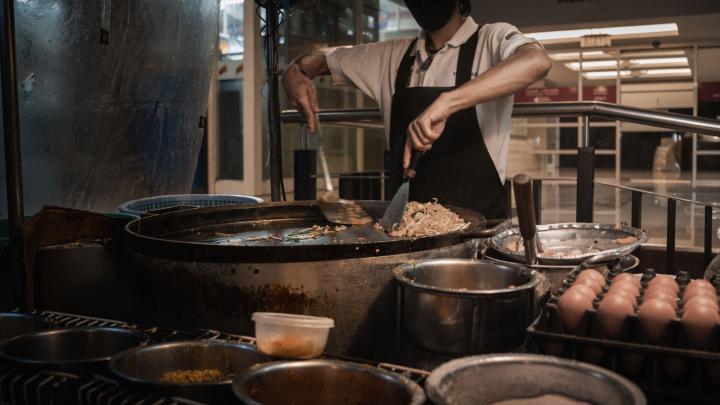
A chef stir-frying Thai food over a hot wok at a street food stall in Thailand
Travel

Learning Thai Cuisine: Cooking Classes, Costs, and the Culinary Training Visa Route

From a relaxed afternoon stir-frying pad thai to structured, multi-week culinary programs that can support a Non-Immigrant ED visa: how Thailand's cooking-class scene actually works, region by region, dish by dish.

10 min ↗
Travel

Learning Thai Cuisine: Cooking Classes, Costs, and the Culinary Training Visa Route

· Last reviewed: 19 July 2026 · Written by Ricardo Dos Santos
A chef stir-frying Thai food over a hot wok at a street food stall in Thailand
Photo by Kim Villanueva / Pexels

From a relaxed afternoon stir-frying pad thai to structured, multi-week culinary programs that can support a Non-Immigrant ED visa: how Thailand's cooking-class scene actually works, region by region, dish by dish.

Thai food is one of the main reasons people fall in love with the country, and for a growing number of travellers, eating it isn't enough — they want to learn how it's made. Thailand has built a genuine cooking-class industry around that curiosity, running from a single relaxed afternoon in a hotel kitchen to structured, multi-week culinary programs that can anchor a long stay in the country. This guide walks through why Thai cuisine rewards the effort, what a class actually looks like, what it costs, where the country's cooking-school scene concentrates, and — for anyone thinking well beyond a holiday souvenir — how a genuine culinary education can connect to Thailand's Non-Immigrant "ED" (education) visa.

Why Thai cuisine is worth learning

Thai food is often flattened into a handful of export dishes — pad thai, green curry, tom yum — but the cuisine actually eaten across the country is far more regionally distinct than that shortlist suggests. Central Thai cooking, the style most familiar internationally, balances sweet, sour, salty, and spicy in the same dish, often within a single bite, using palm sugar, tamarind, fish sauce, and fresh chillies in careful proportion. Northern (Lanna) cuisine, centred on Chiang Mai and the old kingdoms around it, is generally milder and more herbal, built around dishes like khao soi (a curried noodle soup with Burmese and Yunnanese influence), sai ua (herb-packed grilled sausage), and nam prik varieties eaten with sticky rice and raw or blanched vegetables. Northeastern (Isaan) food, closely tied to neighbouring Laos, leans sour, funky, and fiery — som tam (green papaya salad), larb (minced meat salad with toasted rice powder), and grilled meats built around fermented fish sauce (pla ra) rather than the milder fish sauce used elsewhere. Southern Thai cuisine, shaped by the peninsula's Malay and Muslim influence and its access to seafood, is typically the spiciest and most turmeric-forward of the four, seen in dishes like gaeng tai pla and khao yam.

What ties these regional cuisines together, more than any single flavour, is technique: a reliance on fresh herbs and aromatics — galangal, lemongrass, kaffir lime leaf, Thai basil, cilantro root — pounded rather than simply chopped, and a cook's instinct for balancing the four core tastes against each other rather than following a fixed recipe. That instinct is genuinely difficult to pick up from a cookbook alone, which is exactly why hands-on classes have become so popular: they teach the logic of Thai cooking, not just a list of steps.

What a typical cooking class looks like

"Thai cooking class" covers a wide range of actual experiences, and it's worth knowing the differences before booking one.

Format. The most common option is a half-day class, usually three to four hours, held either at a dedicated cooking school, a hotel kitchen, or a home-style setup run by a local family. Full-day classes extend this with a market tour at the start — walking through a fresh or wet market with an instructor who explains unfamiliar herbs, curry pastes, and produce before you cook with them — and sometimes cover a longer menu or an additional cooking technique, such as making your own curry paste from scratch with a mortar and pestle rather than using a pre-made one.

Kitchen-only versus market-inclusive. Kitchen-only classes save time and are more predictable (useful if you're short on a day), but market-inclusive classes are widely considered the more rewarding introduction to Thai food culture, since they show where ingredients actually come from and why Thai cooks choose particular vegetables, herbs, or cuts of meat. Chiang Mai in particular is well known for this market-to-table style of class, often built around one of the city's produce or morning markets.

Skill level. Casual one-off classes assume no prior cooking experience and are designed for tourists fitting a few hours into an itinerary — they typically walk small groups through four or five classic dishes with a lot of hands-on guidance. At the other end, structured multi-week courses and professional culinary-school programs are aimed at people who want a real qualification: proper knife skills, food-safety training, menu planning, and enough repetition to actually retain technique, not just a pleasant afternoon.

Typical costs. As a general market range rather than a fixed quote — prices vary by city, venue, and inclusions — a single half-day tourist class in Thailand commonly runs somewhere in the order of 800 to 1,800 THB per person, with market-inclusive or full-day classes often landing in a 1,500 to 3,000+ THB range. Private classes, small-group premium formats, or classes at higher-end hotels can run well above that. Multi-week or longer structured culinary programs, by contrast, are priced more like a course than an activity — costs can run from the tens of thousands of THB up into six figures (THB) depending on the institution, program length, and whether it leads to a recognized culinary qualification. Always confirm current pricing directly with the school; these are rough orientation figures, not quotes.

Where cooking schools concentrate

Thailand's cooking-class scene isn't spread evenly across the country — it concentrates in a handful of well-established hubs. Bangkok has the largest and most varied offering, from budget-friendly group classes to high-end culinary institutes, reflecting the capital's size and its role as the country's main hospitality and culinary-training centre. Chiang Mai is particularly well known for market-to-table style classes and home-style, family-run schools, helped by its strong food culture and relatively relaxed pace. Phuket and Koh Samui are also commonly cited hubs, largely because of their concentration of resorts and hotels that run cooking classes as part of a broader guest-activity offering, often with a stronger seafood focus given their coastal setting. This guide deliberately doesn't name or link to individual commercial schools — treat any specific business you find through your own research the same way you would any other tourism operator: check recent reviews, confirm what's actually included, and compare a few options before booking.

What to expect, and how to prepare

A typical class starts with introductions and a rundown of the day's menu, followed either directly by cooking or by a market walk first. Expect hands-on cooking rather than pure demonstration at nearly all tourist-facing classes — you'll be at your own wok or station for most dishes, with the instructor circulating to correct technique, not cooking for you while you watch. Most schools provide a printed or digital recipe booklet to take home, and some include a small take-home kit of curry paste or spices you made during the class.

Dietary needs. Vegetarian, vegan, and allergy-conscious adaptations are generally well accommodated in Thailand's cooking-class industry, since many core techniques (stir-frying, curry-making, salads) adapt naturally to substituting tofu or vegetables for meat and swapping fish sauce for a soy-based alternative. That said, "generally accommodated" is not a guarantee for any specific school or dish — confirm your dietary requirements directly with the school before booking, especially for serious allergies (shellfish and peanuts in particular), since shared kitchen equipment and pastes made in bulk can carry cross-contamination risk even when a substitute ingredient is used in your own dish.

Hygiene and food safety. Reputable cooking schools that cater to tourists generally follow standard commercial kitchen hygiene practices — you should expect a clean, organized kitchen, properly stored ingredients, and an instructor who handles raw meat and produce separately. As with any food-related activity anywhere in the world, it's reasonable to use ordinary judgment: a well-reviewed, established operation with a real kitchen setup is a safer bet than an ad hoc arrangement with no visible standards. If a market tour is included, the same general food-safety awareness travellers already apply to Thai street food and market stalls applies there too.

From hobby to qualification: the culinary training visa route

A one-day or half-day cooking class is a tourist activity, not a course of study, and it does not qualify anyone for any Thai visa — that distinction matters and is worth stating plainly before going further. But Thailand's cooking-school sector also includes a genuinely different tier: structured, longer-term culinary programs run by registered vocational or culinary institutes, some of which lead to a recognized professional qualification. Much like Thailand's well-established Thai-language schools, some of these institutes are registered in a way that allows them to support a student's application for a Thai Non-Immigrant "ED" (education) visa, provided the applicant is genuinely enrolled in a substantial course of study rather than using enrollment as a formality.

The mechanics broadly mirror any other Thai education visa route: the institute must be properly registered with the relevant Thai education authority for the purpose of sponsoring foreign students, the applicant needs a genuine offer or acceptance letter and an actual curriculum with defined class hours, and — once in the country — real attendance and progress requirements apply, since Thai immigration can and does check that ED-visa holders are actually attending their course, not simply holding paperwork. This is materially different from, and should never be confused with, a short tourist cooking class, which carries no visa eligibility of any kind regardless of how many classes are booked in sequence.

The same due-diligence rules that apply to any Thai study-visa route apply here. Before committing time, tuition, or a visa application to a culinary program:

  • Verify the institute's registration independently. Confirm the school is registered with the appropriate Thai authority for the specific purpose of sponsoring student visas — don't rely solely on the school's own marketing claim that it "does ED visas."
  • Confirm the real curriculum and attendance requirements in writing. A legitimate program will be able to tell you exactly how many class hours per week are required, what the course actually covers, and what happens if attendance drops.
  • Be cautious of any provider whose main pitch is the visa itself. This is the same visa-mill pattern that affects language schools: an operator that leads with "get a long-stay visa" rather than "learn professional Thai cooking," offers suspiciously minimal or no real class time, or promises the visa with little or no attendance, is a red flag worth taking seriously — both because it risks the applicant's immigration status and because it undermines genuine culinary institutes doing the work properly.
  • Treat it as immigration law, not a booking detail. Visa rules, registration requirements, and enforcement practices can change; confirm current requirements with the institute and, ideally, independently through official Thai government sources or a qualified immigration adviser before relying on any program to support a visa application.

For most visitors, the destination is simple: a single class, or a short series of them, is a memorable, hands-on way to understand Thai food from the inside — no visa considerations involved. For the smaller number of people considering Thailand as a place to seriously study cooking over months rather than hours, the ED-visa route exists and is real, but it demands the same care, verification, and healthy scepticism as any other long-term study-visa decision.

Muay Thai in Thailand: training as a traveller or resident, from drop-in classes to the ED training visa
Travel

Muay Thai in Thailand: training as a traveller or resident, from drop-in classes to the ED training visa

Muay Thai is Thailand's national martial art and a serious training option for visitors and residents. How to choose a gym, what training actually costs, the etiquette to know, and how the Non-Immigrant ED training visa works for long-term students.

8 min ↗
Travel

Muay Thai in Thailand: training as a traveller or resident, from drop-in classes to the ED training visa

· Last reviewed: 19 July 2026 · Written by Ricardo Dos Santos
Muay Thai in Thailand: training as a traveller or resident, from drop-in classes to the ED training visa
Alari Tammsalu / Pexels

Muay Thai is Thailand's national martial art and a serious training option for visitors and residents. How to choose a gym, what training actually costs, the etiquette to know, and how the Non-Immigrant ED training visa works for long-term students.

What Muay Thai is

Muay Thai is Thailand's national sport and one of the country's most recognised cultural exports. Its roots trace back to unarmed combat methods developed alongside Thai battlefield weapons training from at least the Sukhothai and Ayutthaya periods, when soldiers who lost their weapons needed an effective close-combat system. Over centuries this evolved from the older Muay Boran ("ancient boxing") styles into the modern ring sport codified in the early twentieth century, with standardised rules, gloves, a roped ring and weight classes.

Muay Thai is often called the "art of eight limbs" because a fighter can strike with fists, elbows, knees and shins — four pairs of striking weapons rather than the two (fists) used in Western boxing. This range of legal strikes, combined with clinch work (grappling and off-balancing an opponent at close range), makes it distinctive among stand-up striking arts. It remains taught through a lineage system: a student trains under a "kru" (teacher), and larger gyms and stadiums carry their own lineage and reputation built up over generations. Bangkok's two historic government-affiliated stadiums, Lumpinee and Rajadamnern, are the sport's best-known competitive venues and a useful reference point for understanding Muay Thai's institutional weight in Thai society — well beyond a tourist activity.

Practicing Muay Thai as a traveller or resident

Thailand's Muay Thai scene covers a wide spectrum, and it helps to know where a given gym sits on it before committing time or money:

  • Tourist-oriented gyms offer single drop-in classes, usually group sessions covering pad work, bag work and basic technique, aimed at complete beginners and short-stay visitors who want one class or a few sessions during a holiday.
  • Serious training camps cater to long-term students, amateur and professional fighters, and often combine accommodation, meals and multiple daily sessions into live-in packages lasting weeks or months.
  • Both categories include Thai-owned gyms run by former fighters and trainers, and foreign-run gyms (often owned by expatriates or partnerships with Thai trainers), each with a different atmosphere, teaching style and mix of nationalities among students.

Fitness levels catered to range from complete beginners with no combat-sports background to competitive amateur and professional fighters preparing for bouts; most established camps grade class intensity or offer separate beginner and advanced sessions so the two groups are not simply thrown together.

Typical costs vary a great deal by region, gym reputation and package length, so treat the following as general market ranges rather than a quote:

  • A single drop-in class commonly runs roughly 300–600 THB.
  • A private one-on-one session with a trainer is commonly around 600–1,200 THB.
  • A monthly training-only membership (unlimited group classes, no accommodation) is commonly in the region of 8,000–15,000 THB.
  • A live-in package combining training, accommodation and meals typically runs from around 15,000–40,000 THB per month at mid-range camps, rising to roughly 25,000–60,000 THB or more per month at premium, resort-style training camps.

A typical week at a training camp

Most full-time camps follow a similar daily rhythm built around Thailand's climate: an early-morning session (often starting around 7am, before the heat builds) covering roadwork, pad work, bag work and technique, followed by a rest period through the hottest part of the day, then a second session in the late afternoon that often adds clinch work and sparring for more experienced students. A single rest day per week, commonly Sunday, is typical. Complete beginners are usually welcome to join at whatever pace they can manage, while fighters preparing for a bout follow a more structured, higher-volume schedule set by their trainer.

Regions and areas known for Muay Thai gyms and camps

Muay Thai training is available across the country, but several regions are particularly well known as hubs, each with a different character:

  • Bangkok — the sport's institutional and competitive heart, home to Lumpinee and Rajadamnern stadiums and a dense concentration of gyms ranging from small neighbourhood setups to large training camps.
  • Phuket — one of the most internationally established training destinations, with a large concentration of both Thai-owned and foreign-run camps geared toward long-stay foreign students.
  • Chiang Mai — a popular base in the north, often associated with a slightly slower pace and a strong ED-visa training-camp presence.
  • Pattaya — a large, varied gym scene close to Bangkok, popular with both short-term visitors and longer-term residents.
  • Koh Samui — a smaller but established island scene, often combined with a beach-holiday stay.
  • Koh Phangan — a growing training destination alongside the island's other activities.
  • Hua Hin — a quieter seaside town with a smaller number of well-regarded camps, popular with residents and long-stay visitors.

This list describes the general landscape rather than recommending any specific business — the right gym for any individual depends on personal goals, budget and the trainers' fit with the student, and is worth researching directly rather than choosing on region alone.

Customs and etiquette to know

Muay Thai carries real cultural and ritual weight, and visitors are expected to show respect for it:

  • Wai kru ram muay is the ceremonial dance performed before a fight, in which the fighter pays respect to their trainers, gym and the art itself, usually accompanied by traditional Sarama music. Spectators and training partners should watch respectfully rather than treat it as a photo prop.
  • Respect for the kru (trainer) runs through everyday gym life: a wai (the traditional Thai greeting, palms pressed together with a slight bow) on meeting a trainer for the first time each day is common, and instructions from a kru are followed promptly and without argument.
  • Gym etiquette typically includes bowing or stepping over the ropes rather than through them when entering the ring, removing footwear before stepping onto training mats, keeping equipment (gloves, pads, shin guards) clean and returning it after use, and not offering unsolicited advice or correction to other students.
  • Appropriate training attire is modest and practical: Muay Thai shorts or athletic shorts, a t-shirt, rash guard or sports bra, hand wraps and gloves for pad or bag work. Jewellery is normally removed before training for safety.

Practical advice for choosing a gym

  • Check trainer credentials and reputation. Look for a track record — how long the gym has operated, who the head trainers are and their fighting background, and recent, verifiable reviews rather than only a gym's own marketing.
  • Confirm insurance coverage before training. Muay Thai is a contact sport with a genuine injury risk (bruising, cuts, sprains, and occasionally more serious injuries during sparring). Many standard travel insurance policies exclude contact sports or martial-arts training entirely — check the policy wording explicitly for Muay Thai or "combat sports" coverage before signing up for regular training, and ask the gym what it covers, if anything.
  • Set realistic expectations about intensity. A first class at a serious camp can be far more demanding than a typical gym workout; pace yourself, communicate your fitness level and injury history to the trainer, and treat any pain beyond normal muscle fatigue as a signal to stop.
  • Take Thailand's heat seriously. Training sessions, especially outdoors or in non-air-conditioned gyms, happen in consistently high heat and humidity. Hydrate well before, during and after sessions, use electrolytes if training more than once a day, and build up training volume gradually rather than matching an experienced fighter's schedule from day one.

Training on a Non-Immigrant ED visa

Long-term, serious students sometimes train under a Non-Immigrant ED (education) visa, sponsored by a Muay Thai gym or camp that is also licensed as a vocational or sports-training institute — structurally similar to the ED visa route used by language schools. SawaLife's dedicated guide to Thailand's study and training visas at /en/visas/thailand-study-and-training-visas covers the visa mechanics (application process, extensions and documentation) in full; this section only summarises how it applies to Muay Thai specifically.

A few precautions matter before relying on this route:

  • Verify the gym or camp is genuinely registered with the relevant Thai authorities to sponsor an ED visa. Not every gym can do this — ask for the institution's registration or licence details directly rather than taking a gym's marketing claim at face value.
  • Confirm real training-hour requirements apply. A genuine ED visa route requires actual, trackable attendance at training (commonly cited in the range of roughly 8–15 hours per week), not a nominal enrolment used only to obtain a visa. Immigration can request attendance records at extension time, and a gym that treats the visa as a formality rather than a real training obligation is a warning sign.
  • Treat it as the same scam risk as any ED-visa-sponsoring institution. So-called "visa mill" arrangements — schools or camps that sell ED visa sponsorship with little or no real instruction — carry a genuine risk of visa cancellation or refused extension if discovered. Apply the same due diligence used for any ED-visa-sponsoring language school: check the institution's standing, ask other current students about their real experience, and be wary of any gym that presents the visa itself, rather than the training, as the product being sold.

Sources and review

This guide was researched and reviewed before publication using publicly available Thai tourism and visa information. Gym pricing, regional gym density, visa processing details and training-hour requirements change over time and vary by institution — verify current details directly with any gym, training camp or Thai immigration office before committing money, time or a visa application.

Sangkhlaburi: the wooden bridge, the sunken temple, and Thailand's forgotten Myanmar border
Travel

Sangkhlaburi: the wooden bridge, the sunken temple, and Thailand's forgotten Myanmar border

At Thailand's western edge, a Mon wooden bridge, a temple drowned by a dam, and a refugee community make up one of the country's least-known corners.

3 min ↗
Travel

Sangkhlaburi: the wooden bridge, the sunken temple, and Thailand's forgotten Myanmar border

· Last reviewed: 18 July 2026 · Written by Ricardo Dos Santos
Sangkhlaburi: the wooden bridge, the sunken temple, and Thailand's forgotten Myanmar border
Photo by Laura Paredis / Pexels

At Thailand's western edge, a Mon wooden bridge, a temple drowned by a dam, and a refugee community make up one of the country's least-known corners.

The end of the road, literally

Sangkhlaburi sits at the far end of Route 323, less than ten kilometres from the Myanmar border, in Kanchanaburi province — roughly five to six hours' drive from Bangkok, which is exactly why the town remains largely absent from organised tours that stop at the much closer River Kwai Bridge. It isn't a transit stop or a logical waypoint on a standard route: you come to Sangkhlaburi on purpose, not in passing.

Thailand's longest wooden bridge

Saphan Mon, usually just called the "wooden bridge" (Mon Bridge), stretches roughly 400 metres across the Vajiralongkorn reservoir, connecting the Thai town to a district populated mostly by Mon refugees, a Burmese ethnic minority settled here since the 1980s. Built without a single metal nail using traditional methods, the bridge is best crossed at dawn to watch Mon monks receive morning alms, a daily ritual that plays out directly on the wooden planks, a world away from the tourist protocol at the River Kwai Bridge.

Wat Sam Prasop, the temple the dam drowned

Below the bridge, when the reservoir drops low enough in dry season (usually March to May), the ruins of Wat Sam Prasop emerge from the water: this Buddhist temple was partly submerged when the Vajiralongkorn Dam was built in the 1980s, and its ghostly silhouette — reachable by small boat, and occasionally on foot when the water recedes completely — makes it one of the most unusual and least-photographed sites in the country. The rest of the year only the stupa's tip breaks the surface, a quiet, permanent reminder of what lies beneath.

A community at the border of three cultures

Sangkhlaburi holds a mixed population of Thai, Mon, and Karen residents alongside a significant Burmese refugee community, which shows up concretely in markets selling hand-woven Mon textiles, cooking influenced by neighbouring Myanmar, and temples blending architectural styles. The morning market near the town centre is worth the visit just to see this cultural mix play out with no particular tourist staging — it's an ordinary neighbourhood market that happens to be extraordinarily diverse.

Access, season, and pace

From Bangkok, the direct drive by car or rented minibus takes five to six hours; public buses from Kanchanaburi (itself about three hours from Bangkok) take longer but remain the cheapest option. Dry season (November to April) brings the best conditions, and March to May offers a real chance of seeing the sunken temple emerge; monsoon (June to October) raises water levels again and can make some back roads difficult. Two nights are usually enough for the dawn bridge crossing, the sunken temple depending on season, the morning market, and a boat ride on the reservoir — a deliberately slow pace that matches the place itself.

Bangkok: Golden Mount and the historic-city skyline
Travel

Bangkok: Golden Mount and the historic-city skyline

Bangkok's only hill is entirely artificial — built from the rubble of a chedi that collapsed under its own weight, then crowned with a relic and 318 steps of bells.

3 min ↗
Travel

Bangkok: Golden Mount and the historic-city skyline

· Last reviewed: 16 July 2026 · Written by Ricardo Dos Santos
Bangkok: Golden Mount and the historic-city skyline
Zaonar Saizainalin / Pexels

Bangkok's only hill is entirely artificial — built from the rubble of a chedi that collapsed under its own weight, then crowned with a relic and 318 steps of bells.

A monument built from failure

Wat Saket dates to the Ayutthaya era, when it was known simply as Wat Sakae, but the hill that made it famous didn't exist yet. In the early 1800s, King Rama III ordered a giant chedi built on the temple grounds — an ambitious project that outgrew Bangkok's notoriously soft, waterlogged soil. The structure collapsed mid-construction, and rather than clear the debris, the court left it in place. Over decades the rubble mound grew, settled, and became the only real elevation in a city built on a floodplain: an accidental hill made of a failed monument's own ruins.

From rubble pile to relic shrine

Rama IV reinforced the mound with timber piles so it would stop slumping, but it was Rama V who transformed it into what stands today, sometime in the late 19th century. British colonial administrators in India gifted Siam a Buddha relic, and rather than house it in an existing temple, the king chose to finish what his predecessors started: a gilded chedi was finally completed atop the reinforced hill, with the relic sealed inside. What began as an engineering failure ended as one of the most visited pilgrimage points in the old city — Phu Khao Thong, the Golden Mount.

Climbing 318 steps of bells

The ascent is part of the experience, not an obstacle to it. A spiral staircase — sources count between roughly 300 and 344 steps depending on where the count starts — winds up past a collection of bells and gongs that visitors are invited to strike on the way, a Thai Buddhist tradition believed to spread merit with each ring. At the top, a circular terrace wraps around the chedi's base and delivers one of the only unobstructed panoramas over Rattanakosin, the old royal island: temple spires, low tiled rooftops, and the Chao Phraya curling past in the distance, with none of the high-rise skyline that dominates the view from modern Bangkok viewpoints.

What the climb asks of you

Unlike the Grand Palace, there's no ticket booth crowd and no long queue, which makes it an easy add-on to a temple-cluster day rather than a destination requiring its own half-day. But it is a genuine physical climb in tropical heat and humidity, and shoes come off before entering the sanctuary itself, so factor in bare feet on stone and a shawl if shoulders need covering — rentable on-site for roughly 50 THB.

Practical planning

Wat Saket opens daily from around 7:30am to 5:30pm. Entry for foreign visitors is 100 THB; Thai nationals enter free. Dress modestly — knees and shoulders covered — and expect to remove shoes at the sanctuary level near the summit. The temple sits near Phan Fa Lilat, reachable by khlong canal boat to the Phan Fa Lilat pier, by public bus, or by taxi; it pairs naturally with a walk through the nearby Golden Mount fair grounds and Loha Prasat's distinctive metal spires. Allow 45 to 60 minutes including the full climb and a slow look at the view.

Source: Tourism Authority of Thailand, tourismthailand.org

Chiang Mai: planning a responsible Doi Inthanon day
Travel

Chiang Mai: planning a responsible Doi Inthanon day

Thailand's highest peak is also, literally, a king's grave. A practical framework for visiting its summit, twin pagodas and closed-season trail without turning the mountain into a box to tick.

3 min ↗
Travel

Chiang Mai: planning a responsible Doi Inthanon day

· Last reviewed: 16 July 2026 · Written by Ricardo Dos Santos
Chiang Mai: planning a responsible Doi Inthanon day
Frank van Dijk / Pexels

Thailand's highest peak is also, literally, a king's grave. A practical framework for visiting its summit, twin pagodas and closed-season trail without turning the mountain into a box to tick.

The mountain named after its own grave

At 2,565 metres, Doi Inthanon is mainland Thailand's highest point, but its modern name is a relatively recent tribute. It was once called Doi Luang Ang Ka, "crow's pond mountain," until it was renamed for King Inthawichayanon, Chiang Mai's seventh ruler, who reigned from 1870 to 1897 and pushed early forest-conservation policy for the region's northern highlands. British surveyor James McCarthy formalized the name "Inthanon" on official maps as tribute. What makes the story more than a naming footnote: after the king's death in 1897, his daughter, Princess Dara Rasmi, had his ashes interred in a small stupa near the true summit. The "Roof of Thailand" is, quite literally, also a royal tomb — most visitors who tick off the summit marker never learn they're standing beside a grave.

Twin pagodas with a different story entirely

A ridge lower down the mountain holds Phra Mahathat Naphamethanidon and Naphaphonphisai, two large pagodas built in 1987 and 1992 to mark the 60th birthdays of King Bhumibol and Queen Sirikit respectively. Unlike the centuries-old temples of Chiang Mai's Old City, these are modern royal monuments, and their setting is the point: a hanging garden walkway threads between them through cloud forest, with views that shift from bright sun to drifting mist within minutes depending on the hour. They read as a deliberate counterpoint to the summit's quiet grave — one site built to be seen, the other built to be found.

Why Kew Mae Pan needs a guide

The park's ecological centerpiece is the Kew Mae Pan nature trail, a loop through high-altitude cloud forest and grassland considered one of the most sensitive habitats in the park. It closes entirely from June through October each year to let the ecosystem recover from dry-season foot traffic, and even in open months a local guide is mandatory — arranged on-site for roughly 200-220 THB per group, not optional or skippable. The rule exists because the trail's soil and rare montane plant species erode quickly under unsupervised, off-boardwalk traffic; staying on the marked path isn't a suggestion here.

Weather that changes the plan

Doi Inthanon runs cool to genuinely cold year-round by Thai standards, and fog rolls through the upper elevations often enough that a hazy or socked-in summit is a real possibility, not a rare fluke. Bring layers regardless of season — a T-shirt-weather morning in Chiang Mai can mean a jacket-and-scarf afternoon at the peak. There's no temple-strict dress code at the pagodas, but modest clothing is customary and appreciated.

Practical planning

Entry costs 300 THB for foreign adults, 150 THB for children, plus a small 20-30 THB vehicle fee. From Chiang Mai, the route runs via Highway 107 to Chom Thong, then Highway 1009 for roughly 48 km up to the summit area; budget travelers can catch a songthaew from Chom Thong or Mae Klang Waterfall for around 20 THB, though a private driver or organized tour is more practical for covering the whole park in one day. Treat this as a full-day outing — six to eight hours — rather than a summit-and-leave dash: the twin pagodas, at least one waterfall (Mae Ya or Wachirathan are the standouts), and the Kew Mae Pan trail if it's open all deserve unhurried time, and rushing the mountain misses the point of what makes it worth the drive.

Source: Tourism Authority of Thailand, tourismthailand.org

Phuket: inside the 1934 schoolhouse that is the Thai Hua Museum
Travel

Phuket: inside the 1934 schoolhouse that is the Thai Hua Museum

Built in 1934 as Phuket's first Chinese-language school, the Thai Hua Museum is the best briefing before walking the Old Town.

3 min ↗
Travel

Phuket: inside the 1934 schoolhouse that is the Thai Hua Museum

· Last reviewed: 16 July 2026 · Written by Ricardo Dos Santos
Phuket: inside the 1934 schoolhouse that is the Thai Hua Museum
Jom / Pexels

Built in 1934 as Phuket's first Chinese-language school, the Thai Hua Museum is the best briefing before walking the Old Town.

A schoolhouse before it was a museum

The building at 28 Krabi Road opened in 1934, not as a museum but as Phuket Thai Hua School, the island's first institution to teach the Hokkien Chinese language. Tin-mining families funded its construction and shaped its purpose: they needed literate clerks and traders who could operate in both Chinese and Thai commercial worlds. The school taught generations of Phuket's Sino-Thai children until it relocated to modern premises in 1995, leaving the original Sino-Portuguese mansion empty for over a decade before restoration and its reopening as a museum in 2010.

Read the roofline before you go inside

Above the entrance sits a red bat carved into the gable — in Chinese symbolism, the bat's outstretched wings recall an open book, and its colour and pronunciation both link to fortune. It is a small detail easy to miss, but it states the building's original purpose more plainly than any plaque inside: this was always meant to be a place of learning.

Thirteen rooms, one continuous story

Inside, thirteen themed rooms spread across two floors trace the same arc as the Old Town outside its doors. Ground-floor exhibits cover the tin-mining economy and the earliest Hokkien settlement, including tools, ledgers and photographs of the docks and mining camps that built the district's wealth. Upstairs, the rooms shift toward culture rather than commerce: the origins of the Phuket Vegetarian Festival, Baba-Peranakan dress and cuisine, and domestic life inside the mixed Sino-Siamese households that produced much of the town's merchant class.

Why visit before, not after, the walk

Treat the museum as a briefing rather than a stop on the itinerary. Reading its rooms first gives names and dates to what would otherwise be handsome but mute facades: the shophouse arcades, the shrine doorways, the Soi Romanee lane you pass ten minutes later. The museum makes no claim to be comprehensive, and doesn't need to be — an hour here is enough to walk out noticing details the building's own former students would have taken for granted.

Practical details

The museum opens daily from 9:00 a.m. to 5:00 p.m. and is closed on Mondays. Admission is 200 baht, with an additional 200 baht for a photography pass if you want to shoot inside the rooms. Allow about an hour for an unhurried visit. It sits within a five-minute walk of Thalang Road and Soi Romanee, making it an easy first or last stop on an Old Town loop.

Before you go

Confirm current hours and pricing close to your visit, since museum schedules and fees can change without much notice, and Mondays should be avoided entirely rather than risked. Combine the visit with a slow walk rather than a rushed multi-site day — the museum rewards attention more than speed.

Pattaya: reading the Sanctuary of Truth beyond its silhouette
Travel

Pattaya: reading the Sanctuary of Truth beyond its silhouette

A 105-metre all-teak structure begun in 1981 and still deliberately unfinished, built without nails, concrete or metal supports.

3 min ↗
Travel

Pattaya: reading the Sanctuary of Truth beyond its silhouette

· Last reviewed: 16 July 2026 · Written by Ricardo Dos Santos
Pattaya: reading the Sanctuary of Truth beyond its silhouette
Kirandeep Singh Walia / Pexels

A 105-metre all-teak structure begun in 1981 and still deliberately unfinished, built without nails, concrete or metal supports.

A billionaire's unfinished argument

The Sanctuary of Truth rises 105 metres above the coast at Naklua, a few kilometres north of central Pattaya, built entirely from teak with no nails, no concrete and no metal supports — every joint cut and interlocked using traditional Thai carpentry. It was begun in 1981 by Lek Viriyaphant, a self-made Thai-Chinese businessman who also created the open-air museum Ancient City and the Erawan Elephant Museum near Bangkok. Lek died in 2000, but construction never stopped: admission tickets now fund the ongoing work, and on any given day visitors can watch carvers actively shaping new panels rather than viewing a finished monument. More than four decades in, it's still explicitly unfinished, and that's by design.

Four faces, one argument

The structure is built around four wings, each drawing on a different artistic tradition — Thai, Khmer, Chinese and Indian — fused into a single silhouette that some describe as a kind of cosmic mandala. Every gable, pillar and panel is hand-carved with gods, mythical animals, elephants and human figures pulled from Buddhist and Hindu narratives. Lek's stated intent wasn't decorative: he believed that rapid technological progress was pulling people away from moral reflection, and he built the Sanctuary as a rebuttal in wood, a structure meant to argue that all these traditions converge on the same underlying truths about how to live.

What the carvings actually show

Look past the sheer scale and the carvings reward slow reading — cross-legged deities meditating above doorways, elephants bearing symbolic weight in Hindu cosmology, gods locked in poses drawn straight from temple reliefs in Angkor and Ayutthaya. Because it functions as a living workshop rather than a sealed monument, the wood ages visibly: newer sections show pale, raw teak, while older carvings have weathered to the dark grey-brown seen in most photographs, so a careful look across the building doubles as a rough timeline of forty-plus years of work.

Practical details

The site opens daily from 8am to 6pm, with last entry around 5pm; admission is 500 baht for foreign adults and 250 baht for children under 12 and for Thai nationals, with small discounts for booking online in advance. Shoulders and knees must be covered — sarongs are lent free of charge at the entrance for anyone who arrives underdressed. It's roughly 4 kilometres from central Pattaya: a Grab or taxi runs 80–120 baht and takes about 15 minutes, while a songthaew from Beach Road costs 10–20 baht but leaves a 1.5-kilometre walk or motorbike-taxi hop to the gate. Budget at least 2–3 hours, with 45–60 minutes for the main structure alone and the rest for the grounds, cultural shows and simply watching the carvers work.

Why "unfinished" is the point

Most landmarks are visited as completed objects; the Sanctuary of Truth asks to be seen mid-sentence. Scaffolding, active tools and half-carved beams aren't signs of neglect here — they're the clearest evidence that Lek's original argument about craft, patience and continuity is still being made, decades after the man who started it died.

Koh Samui: Hin Ta and Hin Yai as a coastal landscape stop
Travel

Koh Samui: Hin Ta and Hin Yai as a coastal landscape stop

A restrained guide to Samui's distinctive coastal rock formations, with practical attention to footing, weather, local conduct and changing access.

3 min ↗
Travel

Koh Samui: Hin Ta and Hin Yai as a coastal landscape stop

· Last reviewed: 16 July 2026 · Written by Ricardo Dos Santos
Koh Samui: Hin Ta and Hin Yai as a coastal landscape stop
Anetta Kolesnikova / Pexels

A restrained guide to Samui's distinctive coastal rock formations, with practical attention to footing, weather, local conduct and changing access.

A landscape with a story attached before it has a sign

At the southern end of Lamai Beach, a short stretch of granite coast has been given names — Hin Ta ("Grandfather Rock") and Hin Yai ("Grandmother Rock") — that only make sense once you hear the shapes described: a standing stone pillar and, nearby, a cleft in a cliff face, positioned close enough together that generations of visitors have read them as a pair. The names came from folklore first; the tourist attraction came after.

The couple the rocks are said to be

The story told locally follows an elderly couple, named in the telling as Ta Kreng and Yai Riam (spellings vary across retellings), who set out by boat from Nakhon Si Thammarat toward Prachuap Khiri Khan to arrange their son's marriage to the daughter of a man called Ta Monglai. A storm wrecked the boat off this stretch of coast, and both drowned. In the folk version, their bodies washed ashore and were transformed into the two rocks — a testament, the story goes, to how far they had been willing to travel for their son's wedding. The rocks are treated today as fertility and love symbols; small offerings are still left near them.

What actually shaped the stone

Strip away the legend and the geology is more mundane but still worth knowing: both formations are granite, worn into their current shapes by long-term erosion from sea spray, wind and sun rather than by any single dramatic event. Hin Ta is a freestanding granite pillar; Hin Yai is best understood as a weathered cleft or cavity in a coastal rock face, carved out by wave action over an extended period. It is the pairing of the two distinct forms, standing stone and hollowed cliff, that produced the resemblance the names describe — geology arriving, by coincidence, at a shape that folklore was ready to explain.

Visiting without overselling it

Access is free, and the site sits within Hat Lamai in Tambon Maret, close to the southern end of Lamai's beach strip — near enough to the town's main tourist area that most visitors combine it with a walk along the beach road rather than treating it as a separate excursion. A line of vendor stalls along the approach path sells coconut-wood carvings, bracelets and beachwear, which tells you this has been a stop on the tourist circuit for some time, even if no source pins down exactly when it became one.

What to actually expect on the ground

Published hours run roughly 8am to 6pm. Beyond that, be honest with yourself about what isn't well documented: there is no reliable published figure for walking time from central Lamai, and no consistent guidance on whether low or high tide makes for a better view — conditions along this stretch of granite shoreline shift with both the season and the swell, so the more useful approach is to check current local conditions on arrival rather than plan around a number nobody can actually confirm in advance.

A stop, not a headline event

Hin Ta and Hin Yai reward a modest amount of time — most visitors spend well under an hour here — and work best as one stop within a longer walk along Lamai's coastline rather than a destination that justifies a trip on its own. The rocks are unusual enough to be worth the short detour; the surrounding stalls and the beach itself are what make the stop feel worthwhile rather than merely photographed and left.

Hua Hin: preparing for Pa La-u Waterfall and its forest setting
Travel

Hua Hin: preparing for Pa La-u Waterfall and its forest setting

Sixty kilometres west of Hua Hin, Pa La-u Waterfall cascades through Kaeng Krachan National Park's forests — here's what to know about tiers, seasons, fees, and wildlife before you go.

3 min ↗
Travel

Hua Hin: preparing for Pa La-u Waterfall and its forest setting

· Last reviewed: 16 July 2026 · Written by Ricardo Dos Santos
Hua Hin: preparing for Pa La-u Waterfall and its forest setting
Santasak Trirattanasak / Pexels

Sixty kilometres west of Hua Hin, Pa La-u Waterfall cascades through Kaeng Krachan National Park's forests — here's what to know about tiers, seasons, fees, and wildlife before you go.

Sixty kilometres from the beach, a different Thailand

Pa La-u Waterfall sits inside Kaeng Krachan National Park, Thailand's largest protected area at nearly 2,900 km², roughly 60 km west of Hua Hin — about an hour and a half by car, though the last stretch winds through hills close enough to the Myanmar border that phone signal drops out. The falls are split into two named sections, Pa La-u Yai and Pa La-u Noi, cascading down what's commonly described as 16 tiers, though counts as low as 11 appear in older sources — treat the number as approximate. What matters practically: only the first four or five tiers on the Thai side are realistically reachable on foot; the rest fade into remote, largely unvisited terrain toward the border.

Forest, not just water

The park shifts from dry evergreen and deciduous dipterocarp forest at lower elevations to moist evergreen and montane forest higher up, and it's one of the richest wildlife sites in mainland Southeast Asia: seven of Thailand's fourteen hornbill species and all seven of its broadbill species have been recorded here, alongside elephants, gibbons, and even sun bears deeper in the park. Pa La-u itself is also a serious butterfly destination — around 300 species recorded park-wide, with the damp mineral patches near stream crossings sometimes drawing dozens of species at once in the early morning.

What most guides don't say

The bulk of Pa La-u's tiers are, in practice, off-limits to casual visitors — a fact tourist blogs tend to gloss over in favour of "16 stunning waterfalls." What they mention even less is who lives here: Kaeng Krachan is home to Karen (and some Hmong) communities whose presence predates the park's 1981 establishment, and the park's 2021 UNESCO World Heritage listing was genuinely controversial internationally because of documented tension between park authorities and these communities. It's worth knowing before framing the forest as untouched wilderness.

When to go, and what it costs

Foreign adults pay 300 baht to enter (children 200 baht), plus roughly 30 baht per vehicle; Thai nationals pay far less. The park generally operates 8:00 am to 5:00 pm, though hours can shift seasonally — confirm locally. Rainy season, June to October and peaking around September, brings the falls to their fullest and most dramatic, though trails turn slippery and leeches appear; the cool dry season, December to February, is far more comfortable to hike but the water thins noticeably, and by March–April some upper tiers can run close to dry.

Practicalities

There's no real public transport to the falls — most visitors arrive by rental car, motorbike, or organised tour from Hua Hin. Budget a half day: allow at least two hours for hiking between the accessible tiers, more if you plan to swim in the pools at the base (safe enough in dry season, best avoided in strong rainy-season currents). Bring water, sturdy shoes, a swimsuit, insect repellent, and cash for the entrance gate — and if you have time, the Karen villages nearer the park boundary are worth a respectful stop on the way back.

Krabi: understanding Thale Waek and the tide-dependent sand connection
Travel

Krabi: understanding Thale Waek and the tide-dependent sand connection

Twice a day, the Andaman Sea withdraws and a narrow ribbon of white sand surfaces between three Krabi islands. It is a tombolo, not a fixed path — and it follows the moon more than any tour schedule.

2 min ↗
Travel

Krabi: understanding Thale Waek and the tide-dependent sand connection

· Last reviewed: 16 July 2026 · Written by Ricardo Dos Santos
Krabi: understanding Thale Waek and the tide-dependent sand connection
Balazs Simon / Pexels

Twice a day, the Andaman Sea withdraws and a narrow ribbon of white sand surfaces between three Krabi islands. It is a tombolo, not a fixed path — and it follows the moon more than any tour schedule.

A sandbar that only half-exists

"Thale Waek" literally means "separated sea." The phenomenon is a tombolo: a sediment bridge shaped by wave refraction and diffraction around offshore obstacles, gradually depositing sand between two islands until it forms a temporary natural land bridge. Twice a day, as the Andaman Sea's tide retreats, a narrow, firm ribbon of white sand surfaces between three islands before disappearing again at high tide — a window of roughly two hours.

Three islands, one strip of sand

The tombolo links Koh Kai (Chicken Island), Koh Tup and Koh Mor in a rough T-shape. Most tours bundle it with nearby Koh Poda and Phra Nang Beach, sold as "4 Islands" trips.

A little-known fact: the moon decides, not the calendar

Because this is a genuine tombolo rather than a fixed isthmus, its width and even its exact shape shift with every tidal and lunar cycle. Locals recommend the five days before and after the 15th day of the waxing moon, when the month's lowest tides occur — meaning the "best" days to see it follow the lunar calendar rather than the Western one.

How and when to go

The dry season, November to May, offers the most reliable conditions; either way, time the visit around local tide tables rather than a fixed date. Long-tail boats or speedboats leave from Ao Nang Pier (about 25 minutes), Krabi Town or Railay Beach. Most visitors book a combined "4 Islands" boat tour.

Budget and duration

Expect to pay roughly 1,000-2,900 baht per person depending on the operator, boat type and inclusions (meals, snorkel gear). On top of that comes the Hat Noppharat Thara-Mu Ko Phi Phi National Park entry fee, separate from the boat fare: 400 baht for foreign adults, 40 baht for Thai nationals. Allow about two hours at the sandbar itself, and a half-day for a full multi-island tour.

Udon Thani: reading Phu Phrabat as a sacred cultural landscape
Travel

Udon Thani: reading Phu Phrabat as a sacred cultural landscape

A UNESCO-source guide to Phu Phrabat’s rock shelters and Sīma stone tradition, with a conservation-first approach to visiting the protected landscape.

2 min ↗
Travel

Udon Thani: reading Phu Phrabat as a sacred cultural landscape

· Last reviewed: 16 July 2026 · Written by Ricardo Dos Santos
Udon Thani: reading Phu Phrabat as a sacred cultural landscape
Nathan Tran / Pexels

A UNESCO-source guide to Phu Phrabat’s rock shelters and Sīma stone tradition, with a conservation-first approach to visiting the protected landscape.

Why Phu Phrabat is exceptional

UNESCO inscribed Phu Phrabat on the World Heritage List in 2024 as testimony to the Sīma stone tradition of the Dvaravati period. The property combines a distinctive rock-shelter landscape with evidence of prehistoric use and later Buddhist sacred boundaries. This layered significance means the visit should be read as a cultural landscape, not as a collection of isolated rock shapes.

Understand Sīma in the landscape

UNESCO explains that Sīma stones marked sacred areas for Buddhist activity and that Phu Phrabat preserves an exceptional in-situ body of this tradition on the Khorat Plateau. Look for the relationship between the stones, shelters and terrain rather than approaching each feature as a separate object. Use official interpretation to distinguish documented heritage from local stories.

Respect prehistoric and religious evidence

Rock art, stone markers and archaeological surfaces are irreplaceable evidence. Do not touch, trace, wet, climb or lean on them, and never cross a conservation barrier for a photograph. Religious meaning also continues beyond the archaeological record, so behave quietly around sacred areas and follow any current instruction concerning worship.

Prepare for an outdoor heritage visit

The property is a landscape, so weather, heat, rain and uneven ground affect the route. Wear suitable footwear, carry water where allowed and choose a public circuit compatible with your mobility. Stay on marked paths to protect both visitors and heritage. If part of the route closes, use the available interpretation rather than attempting an unofficial detour.

Give the site enough time

Phu Phrabat deserves to be the principal focus of the outing from Udon Thani rather than a hurried add-on. Leave transport and daylight margin, read the site information and accept that understanding the relationship between nature and sacred use takes time. Do not rely on an old map for current circulation.

Current management comes first

UNESCO describes a protected property led by Thailand’s Fine Arts Department with other public authorities and local participation. Opening arrangements, visitor capacity, conservation work and photography rules remain operational decisions. Verify them through the responsible authority before departure and treat on-site instructions as final.

Sources and review

This original SawaLife guide was researched and reviewed before publication. Operational details, access, weather, conservation rules, ceremonies and local instructions can change. Verify current official information before travelling.

Chiang Rai: approaching the Golden Triangle as a border landscape
Travel

Chiang Rai: approaching the Golden Triangle as a border landscape

At Sop Ruak, the Ruak and Mekong rivers draw the line where Thailand, Myanmar and Laos meet. A former opium heartland turned museum and viewpoint — worth visiting for the geography and the history, not for crossing anything.

2 min ↗
Travel

Chiang Rai: approaching the Golden Triangle as a border landscape

· Last reviewed: 16 July 2026 · Written by Ricardo Dos Santos
Chiang Rai: approaching the Golden Triangle as a border landscape
Olivier Darny / Pexels

At Sop Ruak, the Ruak and Mekong rivers draw the line where Thailand, Myanmar and Laos meet. A former opium heartland turned museum and viewpoint — worth visiting for the geography and the history, not for crossing anything.

Where three countries meet

At Sop Ruak, roughly 70km north of Chiang Rai town (about an hour to ninety minutes by road), the small Ruak River flows into the Mekong. It is exactly at this confluence that the borders of Thailand, Myanmar and Laos touch. From the Thai bank, you are literally looking at the other two countries without ever crossing into them — the scene is geographical and symbolic before it is any kind of crossing point.

Where the name comes from

The phrase "Golden Triangle" originated in a U.S. State Department memo describing the region's dominance of global opium production. Through the 1960s, Thailand alone produced an estimated 145 tonnes of raw opium a year, rivalling present-day Afghanistan. Hill-tribe farmers, Kuomintang remnant forces who had retreated south after 1949, and regional warlords — most notoriously Khun Sa — built an economy in which a kilo of raw opium traded for a kilo of gold.

A little-known fact: the CIA and Air America

During the CIA's secret war in Laos through the 1960s and 70s, its proprietary airline Air America flew logistics for anti-communist Hmong forces in the region. Historian Alfred McCoy argued this indirectly enabled opium transport through the Golden Triangle; later scholars dispute whether the CIA or its pilots were knowingly involved. It remains a contested footnote of Cold War history, tied directly to this stretch of river.

From opium to coffee: the Royal Project

In 1969, King Bhumibol Adulyadej founded the Royal Project Foundation, Thailand's first crop-substitution programme, replacing poppy fields with coffee, strawberries, macadamia and flowers. Credited with helping more than 100,000 people, it played a central role in ending Thai opium production. The trade is now memorialised rather than practised: the Hall of Opium, a large government-run museum about 2km north of Sop Ruak, traces its global history across multiple exhibition levels and a theatre space.

Practical information

The Hall of Opium is open 8am-4pm, entrance 200 baht. The smaller House of Opium, founded in 1990 by private collector Patcharee Srimatyakul, is open 7am-6pm, entrance 50 baht. Long-tail boats leave from the Sop Ruak pier for roughly 30-minute rides covering 5-6km with views of the tri-border point, at around 1,000 baht per person for an hour (shared boats cost less per head).

Detail of Wat Pho's golden spires against a blue sky in Bangkok
Travel

Wat Pho, Bangkok: the temple that invented Thai massage and carved medicine into marble

A 46-metre reclining Buddha with mother-of-pearl soles, over 1,000 UNESCO-listed medical and massage inscriptions: Wat Pho isn't just a monument — it was Thailand's first public university.

3 min ↗
Travel

Wat Pho, Bangkok: the temple that invented Thai massage and carved medicine into marble

· Last reviewed: 16 July 2026 · Written by Ricardo Dos Santos
Detail of Wat Pho's golden spires against a blue sky in Bangkok
Scarlett Syu / Pexels

A 46-metre reclining Buddha with mother-of-pearl soles, over 1,000 UNESCO-listed medical and massage inscriptions: Wat Pho isn't just a monument — it was Thailand's first public university.

From an Ayutthaya-era temple to the kingdom's first public university

Wat Pho has existed since the Ayutthaya period, dating to the reign of King Phetracha in the late 17th century, but it was Rama I who turned it, from 1788, into the founding temple of the new capital — a restoration and expansion project that took nearly eight years. Rama III gave it its definitive form in 1830 with an unprecedented ambition: turning the temple into a knowledge centre open to everyone, teaching medicine, literature, martial arts and astrology to a population with no access to formal schooling. Wat Pho effectively became the country's first public university, long before any modern institution carried that name.

A 46-metre reclining Buddha with mother-of-pearl soles

The reclining Buddha, completed in 1832 under Rama III, is 46 metres long and 15 metres high, depicting the Buddha's entry into nirvana. The soles of its feet, entirely inlaid with mother-of-pearl, are divided into 108 panels illustrating auspicious symbols — elephants, tigers, dancers, altar objects — arranged around a central dharma wheel. Along an adjoining corridor stand 108 bronze bowls, one for each auspicious characteristic: visitors drop coins into them, a merit-making gesture believed to bring good fortune.

The birthplace of traditional Thai massage

Few visitors realise Wat Pho is the birthplace of Thai massage as a codified discipline. Between 1831 and 1841, Rama III had over a thousand marble inscriptions carved around the temple: medical texts, body maps marking the "sen" energy lines, massage diagrams — a genuine public-health encyclopaedia carved in stone so anyone could study it freely. This collection, the Epigraphic Archives of Wat Pho, is now inscribed on UNESCO's Memory of the World Register. The temple still runs an active traditional massage school, and it remains possible to get a massage within the complex itself — a rare continuity between heritage and living practice.

A vast site, not just a photo stop

Beyond the reclining Buddha, Wat Pho holds over a thousand Buddha images spread across chapels, cloisters and courtyards — a complex large enough that a quick visit only scratches the surface. Shoes come off before entering buildings (plastic bags are provided to carry them), and shorts aren't allowed.

Practical details

The temple is open 8am–7:30pm, with a 300 THB entrance fee (free for children under 120cm). Allow one-and-a-half to two hours on site given the scale of the complex and the number of buildings worth seeing.

Pairing it with Wat Arun, right across the water

Wat Pho sits on the same riverbank as the Grand Palace, a short walk from Tha Tien pier, where a cheap cross-river ferry (3–5 THB) reaches Wat Arun on the opposite bank. The classic itinerary combines the Grand Palace early in the morning, Wat Pho by late morning, then a ferry crossing to Wat Arun for the late-afternoon light.

Wat Arun's prang lit up at sunset on the banks of the Chao Phraya
Travel

Wat Arun, Bangkok: a fleeing king's vow and the broken porcelain that glitters at sunset

In 1767, a general on the run vows to build a temple at the exact spot where he lands at dawn. Two reigns later, its Khmer spire is clad in broken Chinese crockery — and it's at sunset, not dawn, that it truly comes alive.

3 min ↗
Travel

Wat Arun, Bangkok: a fleeing king's vow and the broken porcelain that glitters at sunset

· Last reviewed: 16 July 2026 · Written by Ricardo Dos Santos
Wat Arun's prang lit up at sunset on the banks of the Chao Phraya
Kirandeep Singh Walia / Pexels

In 1767, a general on the run vows to build a temple at the exact spot where he lands at dawn. Two reigns later, its Khmer spire is clad in broken Chinese crockery — and it's at sunset, not dawn, that it truly comes alive.

A vow made at dawn, after a capital fell

In 1767, the Burmese army sacked Ayutthaya, the Siamese capital for over four centuries. General Taksin, fleeing with what remained of his troops, sailed down the Chao Phraya and landed on the Thonburi riverbank at first light. He vowed to build a temple on that exact spot, naming it Wat Chaeng — the Temple of Dawn — after Aruna, the Hindu god of daybreak. Once crowned king, Taksin briefly housed the Emerald Buddha here, before the relic moved across the river to Wat Phra Kaew inside the Grand Palace compound.

A Khmer spire dressed in broken crockery

The 82-metre central prang was begun under Rama II but only completed in 1851, under Rama III — two generations of work for a single tower. Its shape follows that of a Khmer prasat, representing Mount Meru, the cosmic axis of the Buddhist-Hindu universe; four smaller prangs at the corners complete a layout that literally maps the cosmos. What sets Wat Arun apart from every other Bangkok temple is its skin: not precious stone, but fragments of broken Chinese porcelain, which arrived by the ton as simple ballast in Chinese trading junks, topped up with crockery donated by Bangkok residents. Set into cement as floral mandalas and chrysanthemum chains, these ceramic shards catch and scatter low-angle light — the concrete, not just poetic, reason the temple glitters.

The "Temple of Dawn" paradox

Despite its name, Wat Arun is at its most spectacular at sunset, not dawn — a paradox few visitors expect. The best viewpoint isn't even the temple itself, but the opposite riverbank near Wat Pho's Tha Tien pier, where the prang's silhouette cuts against an orange sky and reflects in the river. Local folklore adds a legendary twist: the guardian giants (yaksha) at Wat Arun's entrance are said to be the very same pair locked in combat with their counterparts at Wat Pho in the Ramakien epic — split between the two riverbanks.

Climbing the prang, step by step

A steep, narrow central staircase leads partway up the prang for a close-up look at its ornamentation and a view over the river below — good shoes and a bit of caution are needed, as the steps are tall and tightly spaced. Allow roughly one to one-and-a-half hours on site if you plan to climb.

Practical details and the best time to go

The temple is open 8am–6pm, with last entry around 5:30pm, for a 200 THB entrance fee. The dress code is strict — shoulders and knees covered — with sarongs available for rent on site for visitors caught unprepared. To dodge the crowds, two windows stand out: early morning between 8 and 10am for quiet, or late afternoon between 4 and 5:30pm for the golden light before sunset. It's reached from the historic centre by a cheap cross-river ferry (3–5 THB) departing from Tha Tien pier.

Pairing it with Wat Pho, right across the water

Wat Arun sits directly across the Chao Phraya from Wat Pho, linked by that same inexpensive ferry. The classic itinerary combines the Grand Palace early in the morning before the crowds, Wat Pho by late morning, a ferry crossing, then Wat Arun in the late afternoon to catch the low light through to sunset.

Bangkok: the Grand Palace and Wat Phra Kaew
Travel

Bangkok: the Grand Palace and Wat Phra Kaew

Inside the walled 218,000 m² compound where Rama I founded Bangkok in 1782: a jade Buddha with a 300-year odyssey, three seasonal costumes, and a royal chapel with no monks.

3 min ↗
Travel

Bangkok: the Grand Palace and Wat Phra Kaew

· Last reviewed: 16 July 2026 · Written by Ricardo Dos Santos
Bangkok: the Grand Palace and Wat Phra Kaew
Ana / Pexels

Inside the walled 218,000 m² compound where Rama I founded Bangkok in 1782: a jade Buddha with a 300-year odyssey, three seasonal costumes, and a royal chapel with no monks.

A capital founded in a single decree

When King Rama I crossed the Chao Phraya from Thonburi in 1782 to found the new Chakri capital, the first structure he ordered built wasn't a palace hall — it was a walled royal chapel to house the kingdom's most sacred object. That chapel, Wat Phra Kaew, still stands inside the 218,000 m², 1.9 km-long walled compound of the Grand Palace, and it remains the only Thai temple with no resident monks: it exists purely as the private chapel of the monarchy, mirroring a layout Rama I copied from the fallen Ayutthaya and Sukhothai courts he was determined to resurrect in miniature.

A green stone with a 300-year detour

The temple's namesake is not actually emerald. The Phra Kaew Morakot is carved from a single block of green jasper (or jadeite, depending on the source), and its documented story begins in 1434 in Chiang Rai, when lightning cracked open a stucco-covered chedi and monks found a gilded Buddha figure inside. It took years before a flake of plaster fell away to reveal green stone underneath. What followed reads like a relic on the run: Chiang Rai to Lampang, then Chiang Mai, then — remarkably — north to Luang Prabang and Vientiane in Laos, where it stayed for over two centuries. It only returned to Siam in 1778-79, carried back by the general who would become Rama I after a military campaign, and it has not left Bangkok since.

Three wardrobes for one Buddha

Twice a year, at the change of season, the King or a senior royal family member personally changes the Emerald Buddha's costume — a ceremony instituted by Rama I himself and still performed today. There is a gilded robe for the hot season, a gold-and-blue enamel set for the rains, and a solid-gold mesh cloak for the cool months. The figure itself is small, just 66 cm tall including its base, seated on a tall gilded traymasat altar that dwarfs it — deliberately, since scale here signals sanctity rather than spectacle.

Reading the compound like a map

Twelve marble pavilions ring the Convocation Hall, each marking a cardinal point of the sacred boundary; look for the Phra Si Rattana Chedi sheathed in gold mosaic tiles and the Phra Mondop library raised on a base to keep flood water from the palace's original scriptures. The murals lining the cloister gallery — over 1.9 km of them — narrate the entire Ramakien, Thailand's version of the Ramayana, painted and repainted since Rama I's reign whenever the tropical climate wore the pigment away.

Practical planning

The complex opens daily 8:30am-4:30pm, with the last ticket sold at 3:30pm — arrive by mid-morning if you want to avoid both the heat and the tour-group crush. Entry costs 500 THB for foreign visitors, which also includes the Queen Sirikit Textile Museum on-site; Thai nationals enter free with ID. The dress code is strictly enforced: no shorts, sleeveless tops, see-through fabric or tight clothing — sarongs are loaned free at the entrance if needed. The easiest access is BTS to Saphan Taksin, then the Chao Phraya express boat to Tha Chang pier, or MRT to Sanam Chai station followed by a short walk. Budget two to three unhurried hours, not a quick photo stop.

Source: Royal Grand Palace official visitor information, royalgrandpalace.th

Doi Suthep, Chiang Mai: the white elephant that picked a temple's location
Travel

Doi Suthep, Chiang Mai: the white elephant that picked a temple's location

A relic carried by an elephant, 309 naga-flanked steps, and a view over the whole Chiang Mai valley: the founding legend of Wat Phra That Doi Suthep, and how to visit without the crowds.

3 min ↗
Travel

Doi Suthep, Chiang Mai: the white elephant that picked a temple's location

· Last reviewed: 18 July 2026 · Written by Ricardo Dos Santos
Doi Suthep, Chiang Mai: the white elephant that picked a temple's location
Photo by Luca Sammarco / Pexels

A relic carried by an elephant, 309 naga-flanked steps, and a view over the whole Chiang Mai valley: the founding legend of Wat Phra That Doi Suthep, and how to visit without the crowds.

A legend that literally drew the route

According to the 14th-century founding legend, a monk received a dream instructing that a Buddha relic be placed on the mountain, without knowing exactly where. King Kuena's solution was to load the relic onto a sacred white elephant and let it walk freely: the animal climbed the mountain, trumpeted three times at the summit, turned in a circle, then collapsed and died on that exact spot — taken ever since as the place the spirits intended. The temple was built precisely where the elephant stopped, which explains a location that, from a purely practical standpoint, makes no obvious sense.

The naga staircase: 309 steps as a symbolic threshold

Climbing to the temple via the historic staircase flanked by two seven-headed mosaic nagas (mythical serpents) means ascending 309 steps, conceived as spiritual progress rather than mere practical access — a funicular exists for those who can't or don't want to climb, but taking the stairs remains the closest experience to what pilgrims have done for centuries. At the top, the central gold chedi, visible from much of the Chiang Mai valley on a clear day, holds the relic itself — direct access is restricted, but visitors circle it clockwise, as tradition requires.

Summit etiquette: what sets this site apart from lowland temples

Doi Suthep remains an active pilgrimage site, not just a scenic overlook: shoulders and knees must be covered to enter the chedi enclosure (sarongs are lent free at the entrance if needed), shoes come off before certain sanctuary areas, and the relative quiet around the gold chedi contrasts with the bustle of the car park and stalls below. The bells hung around the enclosure can be rung by visitors as a gesture of good fortune — one of the few ritual acts openly extended to non-Buddhists.

When to climb to avoid the afternoon crush

Air-conditioned buses and tour taxis arrive mostly between 10am and 3pm, when groups combine Doi Suthep with a half-day city loop; climbing early morning (the temple usually opens around 6am) lets you watch the monks' morning rituals and see the valley still veiled in mist before the heat burns it off. The drive from Chiang Mai takes about 30-45 minutes by shared red songthaew or private taxi, along a winding but well-maintained mountain road.

Beyond the temple: the summit keeps going

Few visitors continue past the temple car park to Phuping Palace, a royal summer residence open to the public on certain days with rose gardens blooming December to February, or to the Hmong village of Doi Pui a few kilometres further up — two simple extensions that turn a temple visit into a full half-day in the hills above Chiang Mai.

Chiang Mai: read the Old City through Wat Phra Singh and Wat Chedi Luang
Travel

Chiang Mai: read the Old City through Wat Phra Singh and Wat Chedi Luang

Two 14th-century Lanna temples, ten minutes apart: one holds a Buddha image that sailed from Sri Lanka, the other a 500-year-old earthquake scar left deliberately unrepaired.

3 min ↗
Travel

Chiang Mai: read the Old City through Wat Phra Singh and Wat Chedi Luang

· Last reviewed: 16 July 2026 · Written by Ricardo Dos Santos
Chiang Mai: read the Old City through Wat Phra Singh and Wat Chedi Luang
Mineia Martins / Pexels

Two 14th-century Lanna temples, ten minutes apart: one holds a Buddha image that sailed from Sri Lanka, the other a 500-year-old earthquake scar left deliberately unrepaired.

Two temples, one dynasty

Both temples trace back to the Mangrai dynasty that founded Chiang Mai in 1296, and walking between them — barely ten minutes on foot inside the moated Old City — is effectively a walk through the first century of Lanna kingship. Wat Phra Singh was founded in 1345 by King Pha Yu to enshrine the ashes of his father, King Kham Fu, under its original name, Wat Lichiang Phra. Wat Chedi Luang rose in the same century a short walk away, and for two hundred years the pair anchored the spiritual geography of a capital built to rival Sukhothai.

A Buddha image that took a decade to arrive

Wat Phra Singh only gained its present name after 1367, when the Phra Buddha Sihing image reached Chiang Mai — legend holds it was originally cast in Sri Lanka and shipped in stages via Nakhon Si Thammarat and Kamphaeng Phet before finally completing its journey north. It remains enshrined in the Wihan Lai Kham, a hall decorated with rare Lanna-style murals depicting the Suphannahong legend that art historians say survive nowhere else in this form — faded, hand-painted narrative scenes rather than the gilded relief work found in most Bangkok temples.

The chedi the earthquake couldn't finish

Wat Chedi Luang's defining feature is damage, not decoration. Its chedi originally rose to roughly 80 metres, making it the tallest structure in the old kingdom, until a massive earthquake in 1545 sheared off its upper section, leaving today's roughly 60-metre ruin. Restoration attempts in the 1990s stopped short of full reconstruction, so what visitors see is genuine 16th-century damage rather than a modern replica — a rare case of a monument being conserved as a wound rather than repaired into looking new. The temple briefly held an even more famous resident: the Emerald Buddha itself was enshrined here between 1468 and 1551, before being moved for safekeeping after the same 1545 quake chipped its housing.

The city's actual foundation stone

Easy to miss on the temple grounds is the Sao Inthakin, Chiang Mai's city pillar — first erected in 1296 at the city's founding and relocated into Wat Chedi Luang's compound around 1800 by King Kawila. It functions as the symbolic anchor of the city itself, and the small shrine housing it is traditionally closed to women, a custom still observed today.

Practical planning

Wat Chedi Luang opens roughly 6am to 6pm, with the main hall closing slightly earlier; entry is 40 THB for adults, 20 THB for children, free for Thai nationals. Wat Phra Singh opens around 8am to 5pm and operates on a donation basis at most entrances, though some access points post a 20-40 THB fee — worth confirming on arrival. Both enforce a standard dress code: shoulders and knees covered, shoes off before entering any hall. They sit an easy walk or short songthaew ride apart inside the Old City's square moat. Allow around 45 minutes at each, more if the Wihan Lai Kham murals or the city pillar shrine interest you.

Source: Tourism Authority of Thailand, tourismthailand.org

Phuket: reading the Sino-Portuguese facades of the Old Town
Travel

Phuket: reading the Sino-Portuguese facades of the Old Town

Phuket Old Town's Sino-Portuguese shophouses were built on tin money, not tourism — and the quietest lane, Soi Romanee, has the most revealing past.

3 min ↗
Travel

Phuket: reading the Sino-Portuguese facades of the Old Town

· Last reviewed: 16 July 2026 · Written by Ricardo Dos Santos
Phuket: reading the Sino-Portuguese facades of the Old Town
Luca Sammarco / Pexels

Phuket Old Town's Sino-Portuguese shophouses were built on tin money, not tourism — and the quietest lane, Soi Romanee, has the most revealing past.

A town built on tin, not sand

Long before Phuket became a byword for beaches, its wealth came from underground. From the late 18th century through the early 20th, Hokkien Chinese migrants worked tin deposits across the island, and the profits built a town a few kilometres inland from the coast. By the reign of King Rama V (1868-1910), the streets around Thalang, Dibuk, Krabi, Phang Nga and Yaowarat roads had filled with two-storey shophouses whose owners could afford to build in the fashionable style of the era: Sino-Portuguese.

Where the style actually comes from

The name is a shorthand, not a precise pedigree. Wealthy Hokkien merchants hired builders trained in the Portuguese-influenced architecture of Malacca and Penang, across the Strait of Malacca, and imported the look wholesale: shuttered windows, five-foot covered arcades running the length of each block, stucco garlands, and shophouse footprints rarely wider than six metres but sometimes eighty deep, courtyard after courtyard receding toward a rear kitchen. No single building marks the style's arrival in Phuket — it simply became the town's default over a few decades of tin-fuelled construction.

Read the street, not just the postcard

Thalang Road is the most photographed stretch, and deservedly so, but the more revealing walk is one block over on Soi Romanee. This narrow lane of candy-coloured facades was, within living memory, Phuket's red-light district, serving tin miners who had no families on the island. Its current prettiness is a second life, not the original one — a reminder that Old Town streets were working streets, not designed backdrops.

The Baba-Peranakan thread

Many of the tin fortunes were built inside mixed households: Hokkien miners married Siamese women, and their descendants, the Baba-Peranakan community, blended Chinese ancestor rites with Thai dress, language and food into something particular to this coast. Chinpracha House on Krabi Road, still lived in by descendants of the family that built it in 1903, is the clearest place to see that domestic world rather than just its street-facing shell.

Walk it on a Sunday if you can

On Sunday evenings, Thalang Road closes to traffic for the Lard Yai walking street market, when the same facades that once fronted tin-trading offices host food stalls late into the night. It's touristy, but it also fills the street with exactly the kind of foot traffic the shophouses were built to handle — a rare moment when the Old Town feels used rather than preserved.

Before you go

Wear comfortable shoes for uneven five-foot ways, carry water for the middle of the day, and time a first pass for late afternoon when the light is kinder to the facades and the heat has eased. A slow 90-minute loop covering Thalang, Dibuk, Krabi and Soi Romanee is enough for a first visit; add the Thai Hua Museum and Chinpracha House if you want the interiors as well as the exteriors.

Verification before travel

This SawaLife guide was researched and reviewed before publication. Opening hours, road closures, market schedules and conservation rules can change. Verify current details before travelling via the Tourism Authority of Thailand — Phuket Old Town.

Phuket: Wat Chalong, the temple that sheltered a rebellion's wounded
Travel

Phuket: Wat Chalong, the temple that sheltered a rebellion's wounded

Wat Chalong owes its fame to a 19th-century rebellion its monks helped survive — and it's still a working temple, not a monument.

3 min ↗
Travel

Phuket: Wat Chalong, the temple that sheltered a rebellion's wounded

· Last reviewed: 16 July 2026 · Written by Ricardo Dos Santos
Phuket: Wat Chalong, the temple that sheltered a rebellion's wounded
Namfon Sasimaporn / Pexels

Wat Chalong owes its fame to a 19th-century rebellion its monks helped survive — and it's still a working temple, not a monument.

A temple born from an uprising

Wat Chalong's full name is Wat Chaiyathararam, but almost no one uses it. The temple owes its fame to 1876, when Chinese tin-mine labourers rose up in what became known as the Ang Yi rebellion, attacking mining camps and a nearby town. Two monks then resident at the temple, Luang Pho Chaem and Luang Pho Chuang, organised local villagers to defend Chalong and used their knowledge of herbal medicine to treat the wounded on both sides. Luang Pho Chaem, who lived until 1908, remains the most venerated monk in Phuket's history; his statue, alongside Luang Pho Chuang's, still receives gold leaf and incense from visitors who have never opened a history book on the rebellion.

The chedi that holds a splinter of bone

The temple's dominant structure is a 60-metre chedi, built on three tiered levels that visitors can climb inside. It houses what devotees believe is a fragment of the Buddha's breastbone, displayed behind glass on the upper level alongside murals depicting the Buddha's life. Climbing to the top is less about the relic itself than the view it grants: a wide look over Chalong's low rooftops toward the hills that separate this side of the island from the beach resorts most visitors never leave.

A working temple, not a museum piece

Wat Chalong opens at 7:00 a.m. and closes at 5:00 p.m., with no entry fee — donation boxes are placed discreetly rather than at a ticket counter. Monks live and study on the grounds, ordinations and merit-making ceremonies happen on ordinary weekdays, and the compound routinely hosts far more Thai visitors than foreign ones. That imbalance is worth noticing: this is one of the few major Phuket sites where tourism is a secondary activity layered onto an active religious institution, not the other way around.

What the etiquette actually protects

Cover shoulders and knees before entering any building — sarongs are sometimes available to borrow near the entrance, but arriving already dressed avoids a wait. Remove shoes at chapel doors, keep your head lower than seated monks or Buddha images where practical, and never let the soles of your feet point toward a statue when sitting. These aren't arbitrary rules for visitors; they're the same conduct expected of Thai worshippers, which is part of why the temple still feels lived-in rather than staged.

Getting there and timing the visit

Wat Chalong sits about 8 kilometres from Phuket Town and roughly 20 minutes by car from Patong, reachable by metered taxi, ride-hailing app or the regional songthaew network running along Chao Fah Road. Most visits run 45 minutes to an hour: enough time for the main chedi, the ordination hall with its ceiling murals, and the market stalls that spill from the car park toward the entrance selling amulets, birds released for merit, and the temple's own herbal remedies — a direct, still-functioning echo of 1876.

Verification before travel

This SawaLife guide was researched and reviewed before publication. Opening hours, ceremonies and access conditions can change. Verify current official information before travelling via the Tourism Authority of Thailand — Phuket cultural route.

Pattaya: Khao Chi Chan Buddha Mountain
Travel

Pattaya: Khao Chi Chan Buddha Mountain

A former quarry fifteen kilometres south of Pattaya carries a 130-metre gold Buddha outline, laser-drawn onto the cliff in two nights in 1996.

3 min ↗
Travel

Pattaya: Khao Chi Chan Buddha Mountain

· Last reviewed: 16 July 2026 · Written by Ricardo Dos Santos
Pattaya: Khao Chi Chan Buddha Mountain
Kim Villanueva / Pexels

A former quarry fifteen kilometres south of Pattaya carries a 130-metre gold Buddha outline, laser-drawn onto the cliff in two nights in 1996.

A quarry that became a portrait of the king

Fifteen kilometres south of central Pattaya, a limestone hill called Khao Chi Chan carries a 130-metre-high, 70-metre-wide outline of a seated Buddha, drawn in gold leaf directly onto the bare rock. The image, officially named Phra Phuttha Maha Wachira Uttamopat Satsada, was commissioned in 1996 to mark the fiftieth anniversary of King Bhumibol Adulyadej's accession to the throne — the Golden Jubilee. Before that date, the mountain had a much less serene history: quarrying during the Vietnam War supplied stone for the runways of U-Tapao airbase, then in the following decades illegal mining chipped away at the cliff face for construction material, leaving a raw scar that the government decided to consecrate rather than simply close off.

Two nights with a laser, months with gold leaf

What makes Khao Chi Chan unusual isn't its size — Thailand has other giant Buddha images — but how it was made. Engineers projected the outline using a 20-watt argon-ion laser, tracing the contours of a seated Buddha in the Sukhothai style directly onto the cliff. Because the beam only showed up clearly against darkness, the actual marking was done at night; the full engraving was completed in two nights. Only after the lines were cut into the rock did craftsmen begin filling the grooves with gold leaf, a slower process that took several months. It remains, by most accounts, the only Buddha image of this scale ever produced with laser-guided carving.

Reading the pose

The Buddha sits cross-legged, right hand resting open on the right knee, left hand upturned in the lap — the bhumisparsha mudra, the gesture said to mark the exact moment of enlightenment under the Bodhi tree, when Buddha called the earth to witness his awakening. Sukhotho-era proportions give the face a calm, elongated symmetry rather than the more muscular modelling of later Ayutthaya-style images, which is part of why the outline reads so cleanly from a distance despite having almost no three-dimensional relief.

Visiting

Entry to the site is free, and it's open daily from 8am to 5pm. At the base of the mountain, landscaped gardens with lotus ponds and small shrines give the golden outline room to breathe rather than crowding right up to the rock. There's no direct public bus route; most visitors arrive by chartered songthaew or taxi from central Pattaya, a ride of roughly 20–30 minutes depending on traffic, and it's commonly combined with a stop at a nearby temple since the site itself only needs 30–45 minutes to see properly. Come in the late afternoon if you can — the low sun catches the gold leaf and makes the outline noticeably brighter against the darkening limestone.

Why it still matters locally

Beyond the postcard image, Khao Chi Chan is a rare case of a damaged industrial landscape being reclaimed for religious and civic meaning rather than redeveloped or abandoned. For a coastal district built largely around nightlife and beach tourism, the mountain functions as a counterweight: a free, quiet, unmistakably Thai landmark that draws both pilgrims and sightseers without an entrance fee filtering who gets to see it.

Pattaya: Koh Lan as a day-trip island
Travel

Pattaya: Koh Lan as a day-trip island

A 30-minute ferry from Bali Hai Pier reaches Koh Lan's six beaches and 3,000 residents, but the island runs on a strict boat timetable, not a fixed schedule.

3 min ↗
Travel

Pattaya: Koh Lan as a day-trip island

· Last reviewed: 16 July 2026 · Written by Ricardo Dos Santos
Pattaya: Koh Lan as a day-trip island
Gyan Pratim Raichoudhury / Pexels

A 30-minute ferry from Bali Hai Pier reaches Koh Lan's six beaches and 3,000 residents, but the island runs on a strict boat timetable, not a fixed schedule.

An island that lives on a ferry timetable

Koh Lan sits 7.5 kilometres off Pattaya's coast, close enough that the crossing from Bali Hai Pier takes about half an hour by regular ferry, or as little as 15 minutes by speedboat. The island itself is small — roughly 4 kilometres long, 2 wide, about 5.6 square kilometres in total — but its rhythm is dictated less by geography than by boat schedules. Ferries leave Pattaya at 07:00, 10:00, 12:00, 14:00, 15:30, 17:00 and 18:30; the last boat back from the island departs at 18:00, with a second overflow boat ten minutes later for anyone who misjudged the tide of the day. Fares have crept up over the years — the standard one-way ferry ticket, long fixed at 30 baht, rose to 40 baht in early 2026 — while speedboats run 150–300 baht depending on route and whether it's one-way or return.

A working island, not a resort shell

Around 3,000 people live on Koh Lan year-round, most of them clustered near Na Ban pier on the island's eastern side, and daily life there looks nothing like the beach clubs a few hundred metres away. There are almost no cars; getting around means walking, hopping on a motorbike taxi, or squeezing into a songthaew truck that loops the main roads. Fishing families, small guesthouses and market stalls share the same narrow lanes that day-trippers use to reach the beaches, which keeps the island feeling inhabited rather than staged for tourists — a distinction that's increasingly rare this close to a major resort city.

Six beaches, six different moods

Tawaen Beach, on the island's northwest side, is the busiest by far: parasailing, jet skis, banana boats and a dense row of beach chairs make it feel like an extension of Pattaya itself. Samae Beach is quieter and notable for something most visitors miss entirely — solar panels and small wind turbines installed along the shoreline, part of an effort to reduce the island's dependence on diesel generators and undersea cabling. Tien Beach draws a slower crowd with clearer water for swimming, while Nual Beach at the southern tip is the most remote of the six, occasionally visited by monkeys that come down from the wooded hills behind it looking for food dropped by picnickers.

Planning the day

Realistically, budget 7 to 8 hours if you're doing this independently: ferry over, time on one or two beaches, lunch, ferry back, with margin for the inevitable wait at the pier. Organised day-trip packages run 500–600 baht including hotel pickup around 9am, the ferry crossing, lunch and a return by mid-afternoon — useful if you'd rather not manage the ferry timetable yourself, though they trade away flexibility on which beach you actually reach. There's no general entrance fee to the beaches themselves; costs come from optional water sports, beach chair rental and food.

The trade-off worth knowing

Koh Lan is not a substitute for Thailand's more famous southern islands — the water is serviceable rather than spectacular by regional standards, and on weekends the ferries and beaches both fill fast with Pattaya day-trippers. What it offers instead is proximity: a genuine change of pace and scenery reachable and returnable within a single afternoon, without committing to an overnight island stay or a long transfer south.

Koh Samui: Phra Yai and temple etiquette by the sea
Travel

Koh Samui: Phra Yai and temple etiquette by the sea

A 12-metre gold Buddha on a tidal islet off Koh Samui's northeast coast, and the small rituals of dress and conduct that keep a working temple working.

3 min ↗
Travel

Koh Samui: Phra Yai and temple etiquette by the sea

· Last reviewed: 16 July 2026 · Written by Ricardo Dos Santos
Koh Samui: Phra Yai and temple etiquette by the sea
Nirjhar Basak / Pexels

A 12-metre gold Buddha on a tidal islet off Koh Samui's northeast coast, and the small rituals of dress and conduct that keep a working temple working.

A giant that sits on its own tide

Come at Koh Samui from the north-east and the first landmark you register from the airport road is not a beach but a statue: a seated Buddha, 12 metres of gold-painted concrete, rising above the causeway that ties the mainland to a speck of land called Ko Faan. The islet is small enough to walk around in under ten minutes, and the statue was finished in 1972, paid for the way most working Thai temples are paid for — not by a single royal or corporate donor, but by an accumulation of small offerings from islanders and, later, from the visitors who kept coming. Locals simply call the place Wat Phra Yai, "the temple of the big Buddha." Tourism brochures added the nickname that stuck internationally.

The gesture the statue is making

Look closely before you photograph it: the right hand rests over the knee, fingertips reaching toward the ground, while the left lies open in the lap. This is the bhumisparsha pose, "touching the earth," the moment in the Buddha's story when he responds to the temptations and illusions of the demon Mara not with argument but by calling the earth itself to witness his resolve. It is one of the most common gestures in Thai religious art, but few visitors are told what it means as they climb the naga-flanked staircase toward the platform.

Layers added over fifty years

The temple has not stood still since 1972. A large ceremonial prayer wheel was installed behind the main statue only in 2012, four decades after the original build, and a smaller, separate statue depicting Maitreya — the Buddha still to come, in Thai belief — sits elsewhere on the grounds. The serpent balustrades lining the entrance stairs are a standard feature of Thai temple architecture, drawn from older Brahmanic and animist symbolism that Thai Buddhism absorbed rather than replaced. None of this is explained by a sign at the entrance; it rewards asking, or reading, before you go.

What the dress code actually requires

Entry is free, though donation boxes are placed discreetly around the platform and giving something small is customary rather than optional in spirit. The rule that is not optional: shoulders and knees covered for both men and women, and shoes removed before stepping into any covered shrine building. Sarongs are sold or lent at the entrance for anyone arriving in shorts or a tank top, so being turned away is avoidable but embarrassing if it happens.

Getting there and timing it well

From Chaweng, the drive is short — about 6 kilometres, some 15 minutes by road, since the temple sits close to Samui International Airport on the island's northeast tip. A shared songthaew runs roughly 70 baht per person if you can flag one heading the right way; chartering one privately or negotiating a taxi lands closer to 200-300 baht one-way. Most visits last 30 to 45 minutes, which is enough to see the statue, the smaller shrines, and the row of stalls selling drinks and souvenirs at the base of the causeway.

Why sunset earns its reputation

The temple opens early, generally from around 6 to 8 in the morning depending on the season, and stays accessible into the evening, typically until 6pm. Early morning avoids the tour buses; late afternoon, roughly between 5:30 and 6:30pm, is when the gold statue catches the low light against the sea — a genuinely photogenic hour, not just a marketing line, and one where a few extra minutes of patience for the crowd to thin is worth it.

Koh Samui: approaching Mu Ko Ang Thong Marine National Park responsibly
Travel

Koh Samui: approaching Mu Ko Ang Thong Marine National Park responsibly

Forty-two limestone islands protected since 1980, reached by boat from the Samui area — a marine park where conditions, fees and low-impact conduct genuinely matter.

3 min ↗
Travel

Koh Samui: approaching Mu Ko Ang Thong Marine National Park responsibly

· Last reviewed: 16 July 2026 · Written by Ricardo Dos Santos
Koh Samui: approaching Mu Ko Ang Thong Marine National Park responsibly
Peggy Anke / Pexels

Forty-two limestone islands protected since 1980, reached by boat from the Samui area — a marine park where conditions, fees and low-impact conduct genuinely matter.

A park older than the resorts around it

Mu Ko Ang Thong was declared Thailand's 21st national park on 12 November 1980, following preliminary talks between the Ministry of Defense and the Royal Forest Department that began a few years earlier. It protects 42 islands scattered over roughly 102 square kilometres of the Gulf of Thailand, of which only about half is land — the rest is the shallow, current-swept sea between the limestone outcrops. Since 2002 the whole archipelago has also carried Ramsar Wetland status, a designation reserved for wetlands judged internationally significant. The park predates almost every hotel now operating on Koh Samui's beaches.

The novel it really did inspire — and the film it didn't

Ang Thong has a literary footnote that is often repeated and only half-true. Alex Garland, then a young backpacker, heard about the archipelago's hidden lagoon while on Koh Phangan in the 1990s, and it became a real inspiration for his novel The Beach. What did not happen here is the film: Danny Boyle's 2000 adaptation was shot at Maya Bay on Koh Phi Phi Leh, chosen for easier production logistics. Visitors who arrive expecting a film set are looking in the wrong archipelago — what they find instead is the actual place that seeded the story.

An emerald lake sealed inside a mountain

The park's signature sight is Thale Nai, the "Inland Sea," a saltwater lake inside Ko Mae Ko connected to the open ocean only through unseen limestone caves and fissures beneath the cliffs — not by any visible channel. Reaching the viewpoint above it means a roughly 20-minute walk from the landing point. On neighbouring Ko Wua Talap, the park's tallest viewpoint trail is a genuinely steep 500-metre climb, parts of it rope-assisted, rewarding the effort with a view over the whole scattered archipelago at once.

What actually lives here

Ang Thong is not just scenery. Surveys count roughly 16 mammal species across the islands, including dusky leaf monkeys, long-tailed macaques, and — more elusive — leopard cats and fishing cats, alongside smooth-coated otters working the tidal margins. Around 50 bird species and more than a dozen reptile species round out a park that functions as a real, if compact, wildlife refuge rather than a purely scenic backdrop.

Fees, seasons and getting there

Entry runs about 300 baht for a foreign adult and 150 baht for a foreign child, against 50 baht (adult) and 25 baht (child) for Thai nationals; boat transport is arranged and paid separately through tour operators from Nathon or Bophut piers on Koh Samui, or from Koh Phangan. The park closes to visitors roughly from 1 November to 15 December each year for the monsoon, and the calmest, clearest conditions generally run from January to March. Camping is permitted on a couple of islands for about 80 baht per person per night, with tents rentable on-site for around 450 baht.

Conduct that keeps the park intact

None of this survives casual treatment: no touching or standing on coral, no plastic left behind, no removing shells or rock. Boat operators brief this before departure, but the responsibility to follow it does not end at the briefing — a marine park with this much protected status stays worth visiting only if every visitor treats it that way.

Hua Hin: the railway station as a heritage landmark
Travel

Hua Hin: the railway station as a heritage landmark

Opened in 1911 and rebuilt in 1926, Hua Hin's railway station pairs a working platform with a royal pavilion relocated from Nakhon Pathom — one of Thailand's most photographed train stations.

3 min ↗
Travel

Hua Hin: the railway station as a heritage landmark

· Last reviewed: 16 July 2026 · Written by Ricardo Dos Santos
Hua Hin: the railway station as a heritage landmark
Ahmad Anafee / Pexels

Opened in 1911 and rebuilt in 1926, Hua Hin's railway station pairs a working platform with a royal pavilion relocated from Nakhon Pathom — one of Thailand's most photographed train stations.

A station built for a king

Hua Hin Railway Station opened on 25 November 1911, the year King Vajiravudh (Rama VI) came to the throne and began pushing the Southern Line down the Malay Peninsula. The stop turned a fishing village into a resort: within a decade the king had built Maruekhathaiyawan, his "palace of love and hope," a few kilometres up the coast, and the railway was the reason wealthy Bangkok families could reach the sea in a single night's journey. The building visitors photograph today isn't the 1911 original — it's a 1926 rebuild, overseen by Prince Purachatra Jayakara, then director of the Royal State Railways of Siam, and its red-and-cream, wood-and-masonry silhouette has barely changed since.

The pavilion that traveled twice

The station's most photographed structure isn't the platform building at all — it's the small, four-gabled royal waiting pavilion standing apart from it, painted in ochre and red under a steep teak roof. It wasn't built for Hua Hin. It began life at Sanam Chandra Palace in Nakhon Pathom, roughly 200 km north, where Rama VI used it during military drills. After his death it was dismantled and re-erected here — sources differ on whether that happened in 1967 or 1974, so treat the date as approximate rather than exact. Either way, it's now protected as a historic structure by Thailand's Fine Arts Department, and it remains the single most reproduced image of Thai railway architecture, appearing on postcards, stamps, and tourism posters for decades.

Steam and teak

Look past the pavilion and there's a second relic worth the walk: locomotive No. 305, a 2-8-2 Baldwin-built steam engine dating to 1925, parked on a short spur beside the platform. It's a working reminder that this station was, for most of the 20th century, a functioning link in the line to Malaysia, not a museum piece. The State Railway of Thailand kept both buildings largely intact even through a 2023 reconstruction tied to the Southern Line's double-tracking project, which widened the platforms without erasing the original facades.

Recognition

In 1982 the station received an Association of Siamese Architects conservation award, and it has since been named by the BBC among the world's most remarkable railway stations — rare company for a building that still runs scheduled trains.

Visiting today

The station sits on Damnoen Kasem Road, an easy 10–15 minute walk from Hua Hin's main beach and close enough to the night market and Chatchai Market to fold into an evening stroll. It's a working station, open around the clock, and free to enter — you only pay if you're boarding a train. Most visitors spend 20 to 30 minutes photographing the pavilion and the platform before moving on, though train enthusiasts linger longer. Go in late afternoon, when the low sun catches the ochre paintwork and the crowds thin.

Hua Hin: Khao Takiab, temple hill and coastline
Travel

Hua Hin: Khao Takiab, temple hill and coastline

A rocky headland south of Hua Hin beach, Khao Takiab pairs a 20-metre golden Buddha and a working fishing pier with hundreds of bold long-tailed macaques — hence its nickname, Monkey Mountain.

3 min ↗
Travel

Hua Hin: Khao Takiab, temple hill and coastline

· Last reviewed: 16 July 2026 · Written by Ricardo Dos Santos
Hua Hin: Khao Takiab, temple hill and coastline
Da Na / Pexels

A rocky headland south of Hua Hin beach, Khao Takiab pairs a 20-metre golden Buddha and a working fishing pier with hundreds of bold long-tailed macaques — hence its nickname, Monkey Mountain.

Chopsticks Hill

Khao Takiab — "Chopsticks Hill" — is the rocky headland that closes off the southern end of Hua Hin beach, about 7 km from the town centre, where it separates Hua Hin from the quieter sands of Khao Tao. The hill rises somewhere around 270 metres depending on which survey you trust (sources genuinely disagree, anywhere from 77 to 272 metres depending on what's being measured), and its outline is visible from most of Hua Hin's beachfront hotels, especially at sunset when it turns violet against the Gulf of Thailand.

The temple and the golden Buddha

At the summit sits Wat Khao Takiab, a Thai-Chinese temple whose grounds cover roughly 152 rai (about 24 hectares). It was formally established on 29 November 1985, though local tradition holds the site was sacred long before that, and it reportedly received a visit from Queen Rambhai Barni. The temple's defining feature is a standing golden Buddha, some 20 metres tall, facing out to sea — visible far enough offshore that fishermen have used it for generations as a navigational landmark, a point of reference to steer home by. Local fishing folklore goes further: the statue is said to hold back storms, both the literal kind that threaten boats and the metaphorical "storms of the heart."

Monkey Mountain

Wat Khao Takiab shares its hillside with a large population of long-tailed macaques — enough of them, fed regularly by temple visitors, that the hill is better known locally as "Monkey Mountain." They are markedly bolder than macaque troops elsewhere on the coast: expect them to go for water bottles, plastic bags, and anything that looks edible. Keep food out of sight, don't offer it by hand, and hold bags close — a grabbed phone or sunglasses is the most common complaint from visitors, not a bite.

A working shoreline

At the base of the hill, Khao Takiab village keeps a working fishing pier that predates Hua Hin's transformation into a royal resort — the area's association with the Thai crown actually goes back further than the beach hotels, to King Mongkut's 1868 eclipse expedition to nearby Wa Ko. Long-tail boats still land here, and the smell of diesel and drying fish is a useful reminder that this stretch of coast has an economy beyond tourism.

Visiting

Khao Takiab is reachable by songthaew from Phet Kasem Road (around 20 baht), by tuk-tuk or motorbike taxi (agree the fare first), or by scooter — allow around 15 minutes from central Hua Hin. Entry to the temple is free, though donations are welcomed; the site is open roughly 8:00 am to 5:00 pm. Cover shoulders and knees and remove your shoes before entering temple buildings. Budget one to two hours for the climb, the viewpoint, and the monkeys, and go early morning if you want calmer macaques and thinner crowds — or come back at dusk for one of the best sunset views on this stretch of coast.

Railay, Krabi: the roadless peninsula only a boat can reach
Travel

Railay, Krabi: the roadless peninsula only a boat can reach

No road reaches Railay: limestone cliffs, the hidden Phra Nang beach, a secret lagoon, and the climbing village of Tonsai, reachable only by longtail boat.

3 min ↗
Travel

Railay, Krabi: the roadless peninsula only a boat can reach

· Last reviewed: 18 July 2026 · Written by Ricardo Dos Santos
Railay, Krabi: the roadless peninsula only a boat can reach
Photo by Una Baufala / Pexels

No road reaches Railay: limestone cliffs, the hidden Phra Nang beach, a secret lagoon, and the climbing village of Tonsai, reachable only by longtail boat.

A peninsula the road never reached

No paved road connects to Railay: karst limestone cliffs drop straight into the Andaman Sea all around it, cutting this peninsula off from the rest of Krabi despite being only a few kilometres away as the crow flies. The only way in is a longtail boat from Ao Nang or Krabi Town, which naturally filters the flow of visitors and preserves a pace most Thai coastal destinations lost long ago.

Getting there: boat logistics, not road logistics

Longtails leave Ao Nang every 15-20 minutes during the day (about a 15-20 minute crossing) and land, depending on the tide, at either Railay East (mangrove side, permanent jetty) or Railay West (main beach, direct landing on sand). At low tide the boat sometimes stops short of the beach and you wade through shallow water — sandals and a dry bag for electronics are worth carrying. There is no regular night crossing: the last boat usually leaves before 6pm, which catches travellers used to late departures off guard.

Railay West versus Railay East: two moods, one isthmus

Railay West holds the region's best sunsets and most beachfront accommodation, with clear water good for swimming year-round. Railay East, a five-minute walk across the isthmus, has an unglamorous mangrove shoreline at low tide but concentrates the bars, budget restaurants, and most of the nightlife — the two sides complement rather than compete with each other.

Phra Nang: the sacred beach that belongs to a shrine

A fifteen-minute walk south of Railay West, Phra Nang beach holds a shrine to a legendary princess, where local fishermen still leave carved wooden phallic offerings — an old fertility and maritime-protection practice, worth observing respectfully and without intrusive photography. White sand and turquoise water framed by vertical rock walls make this Railay's most photographed beach; it's best seen early morning, before the organised tour boats arrive around 10am.

The hidden lagoon and viewpoint few visitors reach

A trail climbing from the far end of Railay East leads, via fixed ropes and improvised scrambling over wet rock, to a viewpoint overlooking the whole peninsula, then down into a brackish lagoon ringed by sheer walls — accessible only at low tide and inadvisable after rain, when the rock turns slick. The effort involved (30-45 minutes each way, demanding terrain, no railings) explains why only a minority of day-trippers attempt it, which makes it one of the few genuinely quiet corners left in Railay.

Tonsai: the climbing village right next door

A ten-minute walk or a very short boat hop from Railay West, Tonsai remains the epicentre of sport climbing in Thailand, with more than 700 bolted routes on the surrounding cliffs, climbable year-round for intermediate to advanced levels thanks to the region's compact limestone. The vibe is deliberately rougher — fewer upscale stays, more simple bungalows, and a population of long-stay climbers that gives Tonsai an identity distinct from beach-resort Railay.

When to go, and how to keep the balance

Dry season, November to April, brings the calmest sea and best climbing conditions; monsoon (May to October) brings heavier swell that can suspend boat crossings for hours, a real factor for any tight itinerary. As with most fragile Thai natural sites, favouring certified local climbing guides, never taking coral or shells, and respecting the quiet and posted hours around the Phra Nang shrine are what let Railay stay what it is: a peninsula the road never reached, and doesn't need to.

Krabi: Wat Tham Suea (Tiger Cave Temple) and a demanding hilltop visit
Travel

Krabi: Wat Tham Suea (Tiger Cave Temple) and a demanding hilltop visit

A forest-monastery cave complex where a meditating monk once shared space with a tiger, and a staircase of some 1,260 uneven steps that turns a temple visit into a genuine climb.

2 min ↗
Travel

Krabi: Wat Tham Suea (Tiger Cave Temple) and a demanding hilltop visit

· Last reviewed: 16 July 2026 · Written by Ricardo Dos Santos
Krabi: Wat Tham Suea (Tiger Cave Temple) and a demanding hilltop visit
Kirandeep Singh Walia / Pexels

A forest-monastery cave complex where a meditating monk once shared space with a tiger, and a staircase of some 1,260 uneven steps that turns a temple visit into a genuine climb.

A monk, a cave, a tiger

In 1975, vipassana forest monk Ajahn Jamnian Seelasettho came to meditate in a cave about 8km northeast of Krabi town. He stayed, a community grew around him, and the site became a working forest monastery where monks' dwellings (kuti) are built directly into the cliffside and karst cavities. Ajahn Jamnian went on to become one of Thailand's most respected meditation teachers.

Where the name comes from

Accounts differ. Some say a real tiger lived in the cave and was regularly seen by the meditating monk. Others point to claw marks shaped like a tiger's paw on the cave walls, or the cave's own silhouette, said to resemble a giant feline footprint. No version is officially settled — which is part of the site's appeal.

A little-known fact: an open-air ossuary

At the base of the staircase, the complex doubles as an informal archaeological site. Human skeletons and decorated skulls are displayed at several points — a memento mori teaching tool common to Thai forest-monastery tradition, meant to underline the body's impermanence. Ancient stone tools, pottery shards and carved Buddha footprints uncovered on site are also on view. Monkeys, meanwhile, have colonised the lower stairway.

The climb: 1,237 steps, or closer to 1,260

Signage states 1,237 steps, but a rebuilt section has pushed the actual current count closer to 1,260, with irregular risers, some over 30cm high. The summit sits at roughly 278 metres elevation (some sources cite up to 309m). Allow 45 minutes to 1.5 hours up depending on fitness, and about the same coming down — budget 2-3 hours in total including the lower cave complex.

Practical information

Entry is free, with donation boxes placed around the site. Standard Thai temple modesty rules apply: shoulders and knees covered. The site is generally open from early morning (around 7-8am) to dusk (roughly 6pm), though cave and summit access can close earlier — worth confirming locally. Wat Tham Suea sits about 8km northeast of Krabi town, roughly 20-30 minutes by car or taxi from Ao Nang.

Than Sadet, Koh Phangan: the royal waterfall nine kings carved into stone
Travel

Than Sadet, Koh Phangan: the royal waterfall nine kings carved into stone

Nine generations of Thai kings visited this waterfall and left their monogram carved in the rock — today it remains one of the few corners of Koh Phangan untouched by the Full Moon Party.

3 min ↗
Travel

Than Sadet, Koh Phangan: the royal waterfall nine kings carved into stone

· Last reviewed: 18 July 2026 · Written by Ricardo Dos Santos
Than Sadet, Koh Phangan: the royal waterfall nine kings carved into stone
Photo by ArtHouse Studio / Pexels

Nine generations of Thai kings visited this waterfall and left their monogram carved in the rock — today it remains one of the few corners of Koh Phangan untouched by the Full Moon Party.

A waterfall the monarchy made sacred

Than Sadet takes its name (literally "royal waterfall") from repeated visits by the Thai royal family, from King Rama V's reign in the late 19th century through more recent visits by Rama IX: at least nine monarchs or royal family members had their royal initials carved into the rock across its successive pools, a practice that gave this stream a near-sacred status rare for a simple jungle waterfall. Those carvings, still visible today on several boulders along the trail, turn the hike into something both natural and historical.

A chain of pools, not one single fall

Contrary to the image of one dramatic single cascade, Than Sadet is actually a chain of pools and small falls stretched over more than a kilometre of forest stream, each offering different swimming conditions depending on seasonal flow — some upper pools, more isolated, are reached only after roughly thirty minutes' walk from the main pool accessible by car. This tiered layout explains why most rushed visitors only see the first pool, leaving the upper sections noticeably quieter.

Access: via the east coast road, far from Haad Rin

Than Sadet sits on Koh Phangan's east coast, geographically and culturally opposite Haad Rin and its monthly Full Moon Party; access is via a paved but winding road from Thong Sala, or by longtail boat from the nearby Thong Nai Pan beaches. A rented scooter remains the most flexible way to reach the parking spot below the trailhead, provided you're comfortable with the island's occasionally steep grades — Koh Phangan's roads stay rougher than neighbouring Koh Samui's.

Best season for a satisfying flow

The waterfall's flow varies sharply by season: the stretch right after the Gulf of Thailand monsoon, generally November to January, brings the fullest flow and deepest swimming pools, while late dry season (March-April) can reduce some upper pools to a trickle. Checking recent conditions before dedicating half a day avoids the disappointment of a dry fall.

A quiet counterpoint to the party island

Koh Phangan remains globally associated with the Full Moon Party, but most of the island — its interior hills, northeastern beaches, and Than Sadet in particular — has nothing to do with that one-night reputation. Pairing the waterfall with lunch at one of Thong Nai Pan's beach restaurants, about twenty minutes' drive away, builds a full day around the island's other, quieter face, without ever crossing the Haad Rin crowd.

Koh Phangan: the northeast beaches as a slower island day
Travel

Koh Phangan: the northeast beaches as a slower island day

Thong Nai Pan Yai and Thong Nai Pan Noi illustrate a quieter side of Koh Phangan, but remain part of a working island with weather-dependent access.

2 min ↗
Travel

Koh Phangan: the northeast beaches as a slower island day

· Last reviewed: 16 July 2026 · Written by Ricardo Dos Santos
Koh Phangan: the northeast beaches as a slower island day
Tom Lorber / Pexels

Thong Nai Pan Yai and Thong Nai Pan Noi illustrate a quieter side of Koh Phangan, but remain part of a working island with weather-dependent access.

Why this belongs on a Thailand itinerary

Thong Nai Pan Yai and Thong Nai Pan Noi illustrate a quieter side of Koh Phangan, but remain part of a working island with weather-dependent access. These areas provide a different perspective on the island's rhythm and landscape, offering a contrast to the more densely populated or event-focused regions.

Context and history

Both beaches are named in the official destination profile alongside Than Sadet and other natural attractions. Their importance lies in showing that Koh Phangan contains different rhythms and landscapes, not in promising isolation. They are integral parts of the island's geography, reflecting the diverse ways in which the island is inhabited and experienced.

How to approach the visit

Choose one area for a day rather than trying to cross the island repeatedly. Allow enough time for road conditions, rain, heat and a safe return before dark. Planning your day around a single location helps mitigate the challenges of island transit, ensuring a more relaxed and manageable experience.

Access and conditions

Conditions at sea and on roads are live matters. Confirm local transport and avoid driving if you are not properly licensed and equipped. The roads and marine access can be affected by weather, so always prioritize safe transit methods. Being aware of the current state of infrastructure is essential for a smooth visit.

Respectful behaviour and safety

Beach attire belongs on the beach; dress appropriately in villages and temples. Respecting local customs and maintaining appropriate attire is a key part of responsible travel on the island. This helps maintain the harmony between visitors and the local community.

Verification before travel

Operational details, access, weather, conservation rules, ceremonies and local instructions can change. Verify the current official information before travelling via the Tourism Authority of Thailand — Ko Pha-ngan destination profile (https://www.tourismthailand.org/Destinations/Provinces/Ko-Phangan/358). Always check local conditions before planning your transit.

Udon Thani: Ban Chiang Archaeological Site and deep-time Thailand
Travel

Udon Thani: Ban Chiang Archaeological Site and deep-time Thailand

Ban Chiang is an archaeological landscape near Udon Thani recognised by UNESCO, offering a different scale of Thai history from the country’s royal and temple sites.

2 min ↗
Travel

Udon Thani: Ban Chiang Archaeological Site and deep-time Thailand

· Last reviewed: 16 July 2026 · Written by Ricardo Dos Santos
Udon Thani: Ban Chiang Archaeological Site and deep-time Thailand
Vansh Sharma / Pexels

Ban Chiang is an archaeological landscape near Udon Thani recognised by UNESCO, offering a different scale of Thai history from the country’s royal and temple sites.

Why this belongs on a Thailand itinerary

Ban Chiang is an archaeological landscape near Udon Thani recognised by UNESCO, offering a different scale of Thai history from the country’s royal and temple sites. It provides a unique look at prehistoric communities and their material culture, allowing visitors to engage with a timeline that predates the more commonly visited historical periods.

Context and history

The site is associated with prehistoric communities and is recognised as a World Heritage property. Its importance lies in archaeology and evidence, so visitors should let museum interpretation lead rather than repeat simplified claims about a single “first” civilisation. The site serves as a vital record of human development in the region, offering insights into ancient lifestyles and technological advancements.

How to approach the visit

Use the museum and public interpretation to understand what is documented, then approach the wider site with care. This is a strong half-day or day-trip focus, not a place to rush through between unrelated stops. Taking the time to engage with the museum's information is essential for a meaningful visit and for appreciating the significance of the findings.

Access and conditions

Do not touch, climb or cross barriers around archaeological material. The site is protected, and strict adherence to these rules is necessary to preserve the integrity of the findings. Respecting these boundaries ensures that the site remains intact for ongoing research and future generations.

Respectful behaviour and safety

Respect the site as a place of historical and scientific significance. Follow all posted guidelines and instructions provided by the museum staff to ensure the site remains protected for future study. Maintaining a quiet and observant presence is appropriate for such a significant cultural location.

Verification before travel

Confirm current museum opening, access and photography policies directly with the responsible authority before leaving Udon Thani. Operational details, access, weather, conservation rules, ceremonies and local instructions can change. Verify the current official information via the UNESCO World Heritage Centre — Ban Chiang Archaeological Site (https://whc.unesco.org/en/list/575/).

Udon Thani: the Red Lotus Lake as a seasonal landscape
Travel

Udon Thani: the Red Lotus Lake as a seasonal landscape

Nong Han near Kumphawapi is known for water lilies whose display is seasonal, making timing and restraint more important than a fixed promise.

2 min ↗
Travel

Udon Thani: the Red Lotus Lake as a seasonal landscape

· Last reviewed: 16 July 2026 · Written by Ricardo Dos Santos
Udon Thani: the Red Lotus Lake as a seasonal landscape
Fajri Nugroho / Pexels

Nong Han near Kumphawapi is known for water lilies whose display is seasonal, making timing and restraint more important than a fixed promise.

Why this belongs on a Thailand itinerary

Nong Han near Kumphawapi is known for water lilies whose display is seasonal, making timing and restraint more important than a fixed promise. It represents a unique opportunity to engage with the natural rhythms of Udon Thani’s wetland ecosystems rather than viewing travel as a checklist of static monuments, highlighting the beauty of natural, non-permanent phenomena.

Context and history

The Tourism Authority of Thailand describes the Red Lotus Lake as an Udon Thani attraction and notes the commonly cited flowering period. It is essential to understand this site as a living wetland landscape, not a permanent floral installation. The lake’s character is defined by its biological cycles, which are subject to environmental variables beyond human control, making each visit a unique experience.

How to approach the visit

Plan for early light and a quiet observation rather than demanding a particular bloom. A boat outing, where available, is an opportunity to observe the lake’s scale and local conditions without chasing wildlife or flowers. By adopting a patient approach, visitors can better appreciate the scale of the wetland environment and the subtle beauty of the ecosystem.

Access and conditions

Flowering, water level, boats and access are seasonal. Because the lake is a natural environment, its appearance and accessibility are subject to change. Do not assume the lake will look the same outside the relevant period. Visitors should prioritize flexibility in their travel planning to account for these natural fluctuations and ensure they are visiting during the optimal window.

Respectful behaviour and safety

When visiting, wear sun protection and follow boat-safety instructions provided by local operators. Respect the natural habitat by minimizing disturbance to the water and surrounding flora. The lake is a delicate ecosystem, and responsible observation ensures that the site remains undisturbed for both the local environment and future visitors.

Verification before travel

Operational details, access, weather, conservation rules, ceremonies and local instructions can change. Verify the current official information before travelling by consulting the Tourism Authority of Thailand — Udon Thani destination profile at https://www.tourismthailand.org/Destinations/Provinces/Udon-Thani/588. Always check for the most recent updates on-site to confirm current conditions.

Wat Rong Khun, the White Temple: the life's work its creator refuses to finish
Travel

Wat Rong Khun, the White Temple: the life's work its creator refuses to finish

Behind the blinding white and thousands of mirror shards, one artist has been building a manifesto on good and evil since 1997 — and refuses to guarantee an end date.

3 min ↗
Travel

Wat Rong Khun, the White Temple: the life's work its creator refuses to finish

· Last reviewed: 18 July 2026 · Written by Ricardo Dos Santos
Wat Rong Khun, the White Temple: the life's work its creator refuses to finish
Photo by Luca Sammarco / Pexels

Behind the blinding white and thousands of mirror shards, one artist has been building a manifesto on good and evil since 1997 — and refuses to guarantee an end date.

A temple that isn't an ancient one

Unlike almost every major Buddhist site in Thailand, Wat Rong Khun has no historic pedigree: construction began in 1997, fully funded and designed by Thai artist Chalermchai Kositpipat, who personally poured his own fortune into the project rather than accept outside donations he felt would compromise his artistic vision. The result is a dazzling white architectural complex, inlaid with thousands of mirror fragments that catch the light, conceived as total artwork rather than a conventional place of worship — though it remains a consecrated, functioning Buddhist temple.
The hidden meaning behind white and mirror

The white represents the purity of the Buddha, while the mirror shards stand for his radiant wisdom illuminating the entire universe — a deliberate aesthetic and symbolic choice, not just a style. Crossing the bridge to the main ubosot (ordination hall) means passing over a small chasm filled with hundreds of sculpted hands reaching upward, representing desire and human suffering holding souls back in hell — a deliberately uncomfortable passage before reaching the purity of the main building, where photography is strictly forbidden out of respect for the working place of worship.

The details most rushed visitors miss

Inside the ubosot, the murals don't depict traditional Buddhist scenes but a striking mix of contemporary pop-culture figures — Superman, Batman, planes crashing into twin towers — set against classic religious symbols, a reflection by the artist on good, evil, and the fragility of the modern world, periodically updated. The isolated gold building off to the side of the complex, often mistaken for a treasury or a secondary hall, is actually the public restrooms — gold symbolising the physical body, deliberately set against the spiritual white of the main temple, a contrast Chalermchai made explicit on purpose.

A work that will never be officially finished

Chalermchai Kositpipat has repeatedly stated the complex will never be fully completed in his lifetime, and has arranged for a foundation to continue the project after his death, following a master plan of nine buildings in total. This deliberately unfinished, almost organic design sets Wat Rong Khun apart from every other religious monument in the country: visiting today means seeing a living artistic construction site, not something frozen in time.

When to go to avoid the crowds

The temple usually opens around 8am and draws the bulk of tour groups between 10am and 3pm; arriving at opening time or late afternoon (the site closes around 5:30pm) lets you photograph the bridge and façade without the crush that makes crossing difficult at midday. Wat Rong Khun pairs naturally, in the same day, with artist Thawan Duchanee's Baan Dam (Black House) about thirty minutes north — a deliberately dark counterpoint to the White Temple, designed by another major name in contemporary Thai art.

Chiang Rai: Baan Dam and Wat Rong Suea Ten
Travel

Chiang Rai: Baan Dam and Wat Rong Suea Ten

A black art compound built over four decades by a Buddhist monk-artist, and a temple painted the colour of a vanished tiger's forest — two ways Chiang Rai turns darkness and dread into something to look at closely.

3 min ↗
Travel

Chiang Rai: Baan Dam and Wat Rong Suea Ten

· Last reviewed: 16 July 2026 · Written by Ricardo Dos Santos
Chiang Rai: Baan Dam and Wat Rong Suea Ten
Gije Cho / Pexels

A black art compound built over four decades by a Buddhist monk-artist, and a temple painted the colour of a vanished tiger's forest — two ways Chiang Rai turns darkness and dread into something to look at closely.

An artist who spent forty years building his own necropolis

About ten kilometres north of Chiang Rai, some forty blackened-teak structures spread across nearly 16 hectares of rice fields and lawns. Baan Dam — the "Black House" — is not a museum in the ordinary sense: it is the working testament of Thawan Duchanee (1939-2014), named a National Artist of Thailand in 2001, who began raising the compound in 1975 and kept adding to it until his death. Some buildings, including the vast cathedral-scale wooden hall, reportedly took nearly a decade to complete. Duchanee spent six years studying at the Rijksakademie in Amsterdam, absorbing Dutch and Flemish masters who mixed the holy and the grotesque without apparent contradiction — a direct influence on Baan Dam's aesthetic, sometimes described as a Thai answer to a Rembrandt cabinet of curiosities.

What's actually inside

Buffalo horns, python skins, elephant skulls, tusks, turtle shells and carved wooden phallic forms fill rooms with vertiginous ceilings. None of it is shock for its own sake: a devout Buddhist, Duchanee used these dark materials to explore impermanence (anicca), desire and mortality — a deliberate counterpoint to the luminous white of Wat Rong Khun, the White Temple a few kilometres away, built by his friend and fellow artist Chalermchai Kositpipat.

Wat Rong Suea Ten, the dancing tiger's lair

Ten kilometres away, in Rimkok district, an indigo-blue and gold temple took more than twenty years to reach its present form. The land was once forest reputedly home to tigers — hence "Rong Suea Ten," literally the dancing tiger's den. An older temple on the site had fallen into disrepair until the monk Kruba Chao Thong raised local donations and brought in Putha Kabkaew, a student of Kositpipat, to rebuild it starting in 1996.
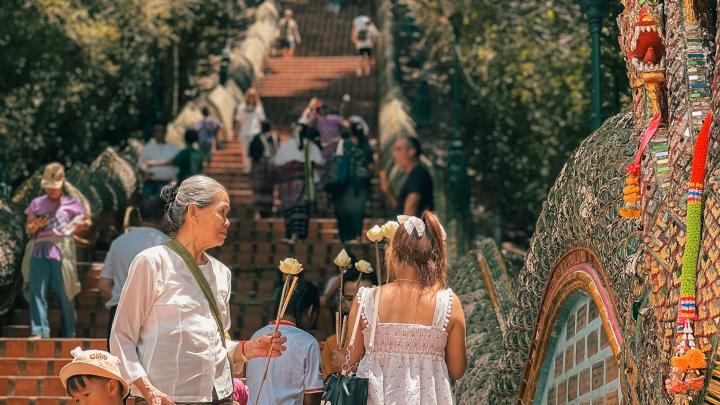
Blue, gold, and the guardian Rahu

The temple's deep blue stands for sky, water, Dharma and wisdom — a visual metaphor for tranquillity and letting go of material attachment, set against gilded nagas and Buddha imagery. At the entrance stands a striking golden figure: Rahu, the asura who swallows the sun and moon in Buddhist cosmology, associated with eclipses and inauspicious fate, placed here as a protective guardian rather than a threat.

Practical information

Baan Dam is open daily 9am-5pm (closed for lunch from noon to 1pm), entrance 80 baht; allow 45-60 minutes. Wat Rong Suea Ten is open 6am-8pm daily, free entry (donations welcome), but shoulders and knees must be covered — sarongs are lent on site for anyone underdressed. Both sites sit roughly 10-13km north of central Chiang Rai and are easily combined in the same half-day by rented car, taxi or songthaew.