
Travel
Wat Rong Khun, the White Temple: the life's work its creator refuses to finish
Last reviewed: 2026-07-18
Written by Ricardo Dos Santos
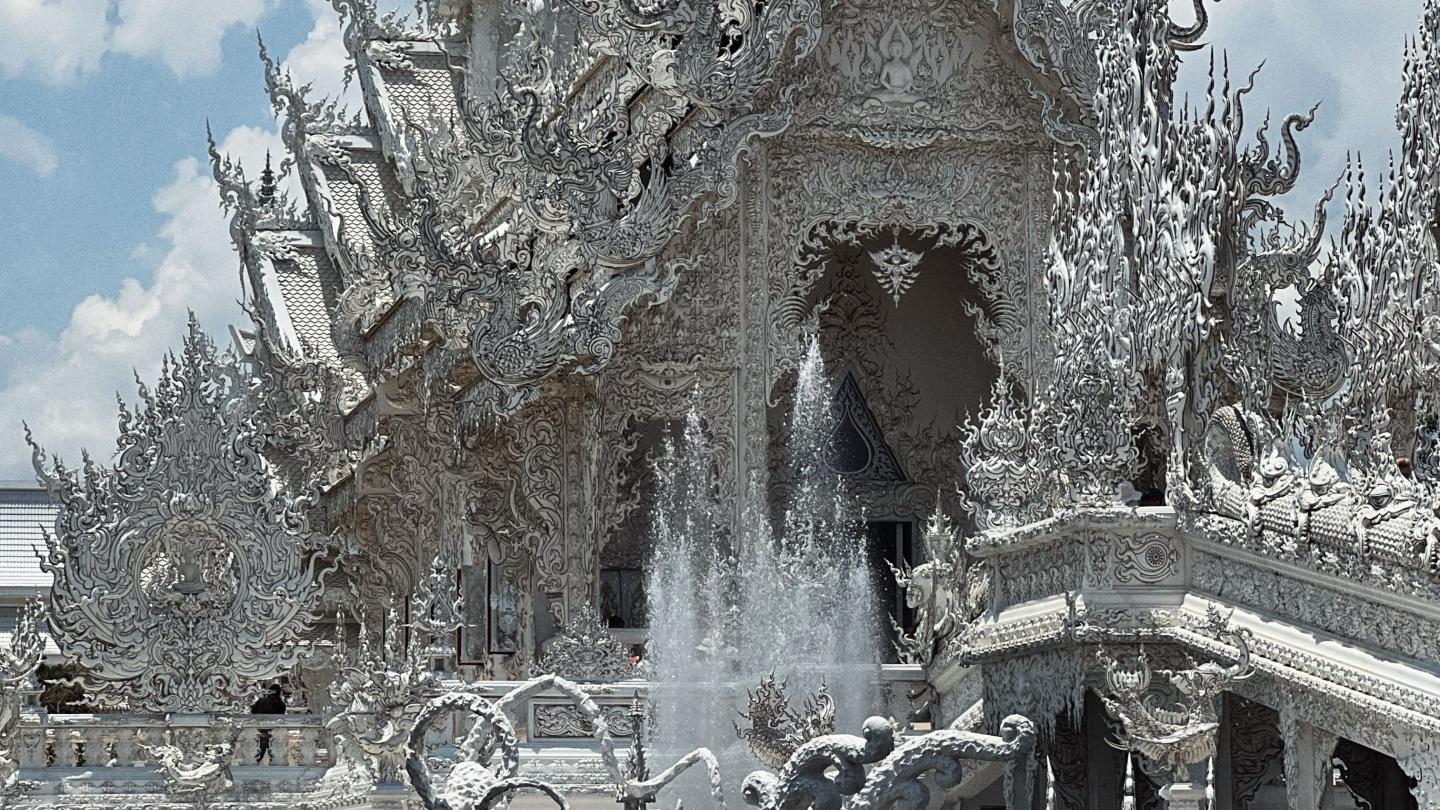
Behind the blinding white and thousands of mirror shards, one artist has been building a manifesto on good and evil since 1997 — and refuses to guarantee an end date.
A temple that isn't an ancient one
Unlike almost every major Buddhist site in Thailand, Wat Rong Khun has no historic pedigree: construction began in 1997, fully funded and designed by Thai artist Chalermchai Kositpipat, who personally poured his own fortune into the project rather than accept outside donations he felt would compromise his artistic vision. The result is a dazzling white architectural complex, inlaid with thousands of mirror fragments that catch the light, conceived as total artwork rather than a conventional place of worship — though it remains a consecrated, functioning Buddhist temple.
The hidden meaning behind white and mirror
The white represents the purity of the Buddha, while the mirror shards stand for his radiant wisdom illuminating the entire universe — a deliberate aesthetic and symbolic choice, not just a style. Crossing the bridge to the main ubosot (ordination hall) means passing over a small chasm filled with hundreds of sculpted hands reaching upward, representing desire and human suffering holding souls back in hell — a deliberately uncomfortable passage before reaching the purity of the main building, where photography is strictly forbidden out of respect for the working place of worship.
The details most rushed visitors miss
Inside the ubosot, the murals don't depict traditional Buddhist scenes but a striking mix of contemporary pop-culture figures — Superman, Batman, planes crashing into twin towers — set against classic religious symbols, a reflection by the artist on good, evil, and the fragility of the modern world, periodically updated. The isolated gold building off to the side of the complex, often mistaken for a treasury or a secondary hall, is actually the public restrooms — gold symbolising the physical body, deliberately set against the spiritual white of the main temple, a contrast Chalermchai made explicit on purpose.
A work that will never be officially finished
Chalermchai Kositpipat has repeatedly stated the complex will never be fully completed in his lifetime, and has arranged for a foundation to continue the project after his death, following a master plan of nine buildings in total. This deliberately unfinished, almost organic design sets Wat Rong Khun apart from every other religious monument in the country: visiting today means seeing a living artistic construction site, not something frozen in time.
When to go to avoid the crowds
The temple usually opens around 8am and draws the bulk of tour groups between 10am and 3pm; arriving at opening time or late afternoon (the site closes around 5:30pm) lets you photograph the bridge and façade without the crush that makes crossing difficult at midday. Wat Rong Khun pairs naturally, in the same day, with artist Thawan Duchanee's Baan Dam (Black House) about thirty minutes north — a deliberately dark counterpoint to the White Temple, designed by another major name in contemporary Thai art.