
Travel
Pattaya: Khao Chi Chan Buddha Mountain
Last reviewed: 2026-07-16
Written by Ricardo Dos Santos
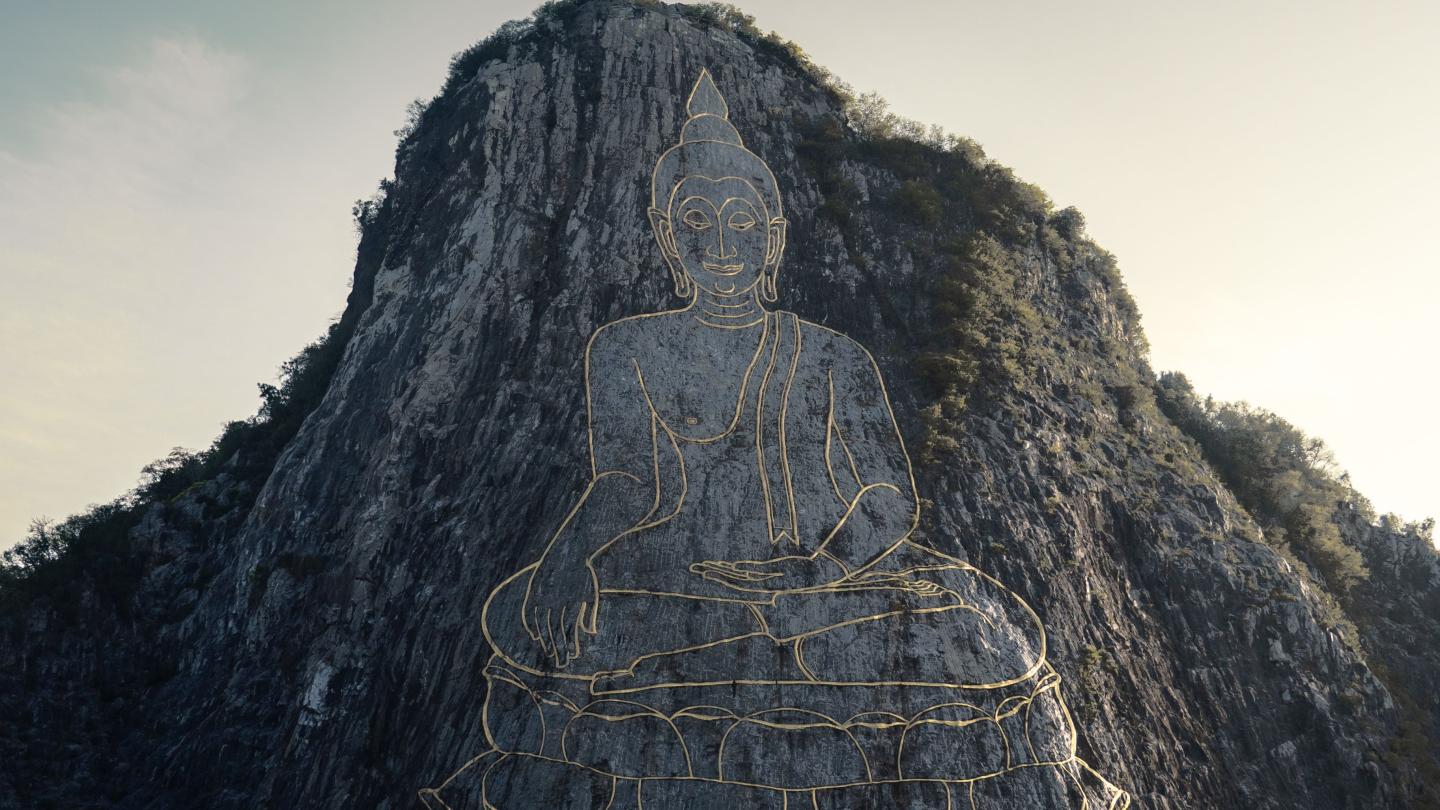
A former quarry fifteen kilometres south of Pattaya carries a 130-metre gold Buddha outline, laser-drawn onto the cliff in two nights in 1996.
A quarry that became a portrait of the king
Fifteen kilometres south of central Pattaya, a limestone hill called Khao Chi Chan carries a 130-metre-high, 70-metre-wide outline of a seated Buddha, drawn in gold leaf directly onto the bare rock. The image, officially named Phra Phuttha Maha Wachira Uttamopat Satsada, was commissioned in 1996 to mark the fiftieth anniversary of King Bhumibol Adulyadej's accession to the throne — the Golden Jubilee. Before that date, the mountain had a much less serene history: quarrying during the Vietnam War supplied stone for the runways of U-Tapao airbase, then in the following decades illegal mining chipped away at the cliff face for construction material, leaving a raw scar that the government decided to consecrate rather than simply close off.
Two nights with a laser, months with gold leaf
What makes Khao Chi Chan unusual isn't its size — Thailand has other giant Buddha images — but how it was made. Engineers projected the outline using a 20-watt argon-ion laser, tracing the contours of a seated Buddha in the Sukhothai style directly onto the cliff. Because the beam only showed up clearly against darkness, the actual marking was done at night; the full engraving was completed in two nights. Only after the lines were cut into the rock did craftsmen begin filling the grooves with gold leaf, a slower process that took several months. It remains, by most accounts, the only Buddha image of this scale ever produced with laser-guided carving.
Reading the pose
The Buddha sits cross-legged, right hand resting open on the right knee, left hand upturned in the lap — the bhumisparsha mudra, the gesture said to mark the exact moment of enlightenment under the Bodhi tree, when Buddha called the earth to witness his awakening. Sukhotho-era proportions give the face a calm, elongated symmetry rather than the more muscular modelling of later Ayutthaya-style images, which is part of why the outline reads so cleanly from a distance despite having almost no three-dimensional relief.
Visiting
Entry to the site is free, and it's open daily from 8am to 5pm. At the base of the mountain, landscaped gardens with lotus ponds and small shrines give the golden outline room to breathe rather than crowding right up to the rock. There's no direct public bus route; most visitors arrive by chartered songthaew or taxi from central Pattaya, a ride of roughly 20–30 minutes depending on traffic, and it's commonly combined with a stop at a nearby temple since the site itself only needs 30–45 minutes to see properly. Come in the late afternoon if you can — the low sun catches the gold leaf and makes the outline noticeably brighter against the darkening limestone.
Why it still matters locally
Beyond the postcard image, Khao Chi Chan is a rare case of a damaged industrial landscape being reclaimed for religious and civic meaning rather than redeveloped or abandoned. For a coastal district built largely around nightlife and beach tourism, the mountain functions as a counterweight: a free, quiet, unmistakably Thai landmark that draws both pilgrims and sightseers without an entrance fee filtering who gets to see it.