
Travel
Chiang Mai: read the Old City through Wat Phra Singh and Wat Chedi Luang
Last reviewed: 2026-07-16
Written by Ricardo Dos Santos
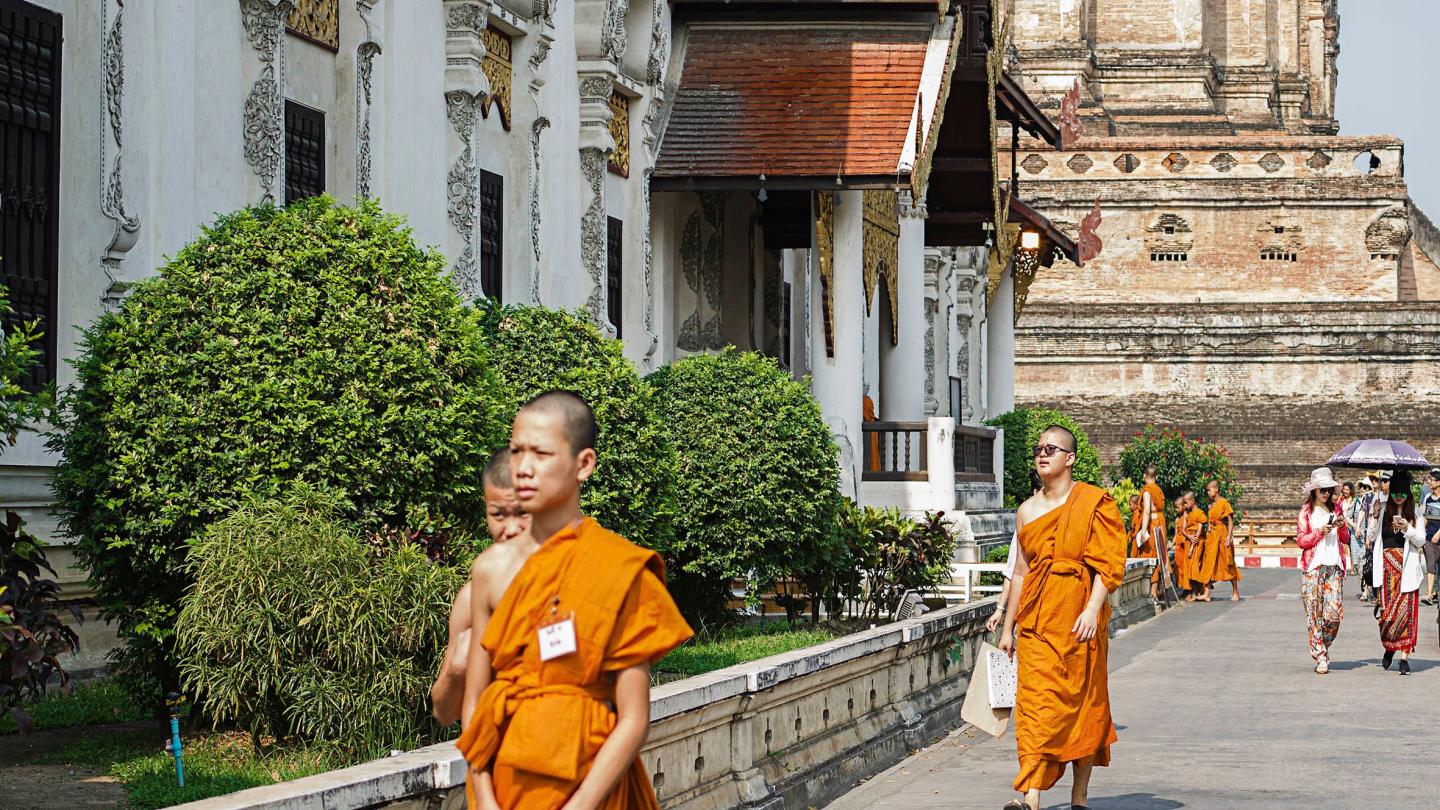
Two 14th-century Lanna temples, ten minutes apart: one holds a Buddha image that sailed from Sri Lanka, the other a 500-year-old earthquake scar left deliberately unrepaired.
Two temples, one dynasty
Both temples trace back to the Mangrai dynasty that founded Chiang Mai in 1296, and walking between them — barely ten minutes on foot inside the moated Old City — is effectively a walk through the first century of Lanna kingship. Wat Phra Singh was founded in 1345 by King Pha Yu to enshrine the ashes of his father, King Kham Fu, under its original name, Wat Lichiang Phra. Wat Chedi Luang rose in the same century a short walk away, and for two hundred years the pair anchored the spiritual geography of a capital built to rival Sukhothai.
A Buddha image that took a decade to arrive
Wat Phra Singh only gained its present name after 1367, when the Phra Buddha Sihing image reached Chiang Mai — legend holds it was originally cast in Sri Lanka and shipped in stages via Nakhon Si Thammarat and Kamphaeng Phet before finally completing its journey north. It remains enshrined in the Wihan Lai Kham, a hall decorated with rare Lanna-style murals depicting the Suphannahong legend that art historians say survive nowhere else in this form — faded, hand-painted narrative scenes rather than the gilded relief work found in most Bangkok temples.
The chedi the earthquake couldn't finish
Wat Chedi Luang's defining feature is damage, not decoration. Its chedi originally rose to roughly 80 metres, making it the tallest structure in the old kingdom, until a massive earthquake in 1545 sheared off its upper section, leaving today's roughly 60-metre ruin. Restoration attempts in the 1990s stopped short of full reconstruction, so what visitors see is genuine 16th-century damage rather than a modern replica — a rare case of a monument being conserved as a wound rather than repaired into looking new. The temple briefly held an even more famous resident: the Emerald Buddha itself was enshrined here between 1468 and 1551, before being moved for safekeeping after the same 1545 quake chipped its housing.
The city's actual foundation stone
Easy to miss on the temple grounds is the Sao Inthakin, Chiang Mai's city pillar — first erected in 1296 at the city's founding and relocated into Wat Chedi Luang's compound around 1800 by King Kawila. It functions as the symbolic anchor of the city itself, and the small shrine housing it is traditionally closed to women, a custom still observed today.
Practical planning
Wat Chedi Luang opens roughly 6am to 6pm, with the main hall closing slightly earlier; entry is 40 THB for adults, 20 THB for children, free for Thai nationals. Wat Phra Singh opens around 8am to 5pm and operates on a donation basis at most entrances, though some access points post a 20-40 THB fee — worth confirming on arrival. Both enforce a standard dress code: shoulders and knees covered, shoes off before entering any hall. They sit an easy walk or short songthaew ride apart inside the Old City's square moat. Allow around 45 minutes at each, more if the Wihan Lai Kham murals or the city pillar shrine interest you.
Source: Tourism Authority of Thailand, tourismthailand.org