
Travel
Koh Samui: approaching Mu Ko Ang Thong Marine National Park responsibly
Last reviewed: 2026-07-16
Written by Ricardo Dos Santos
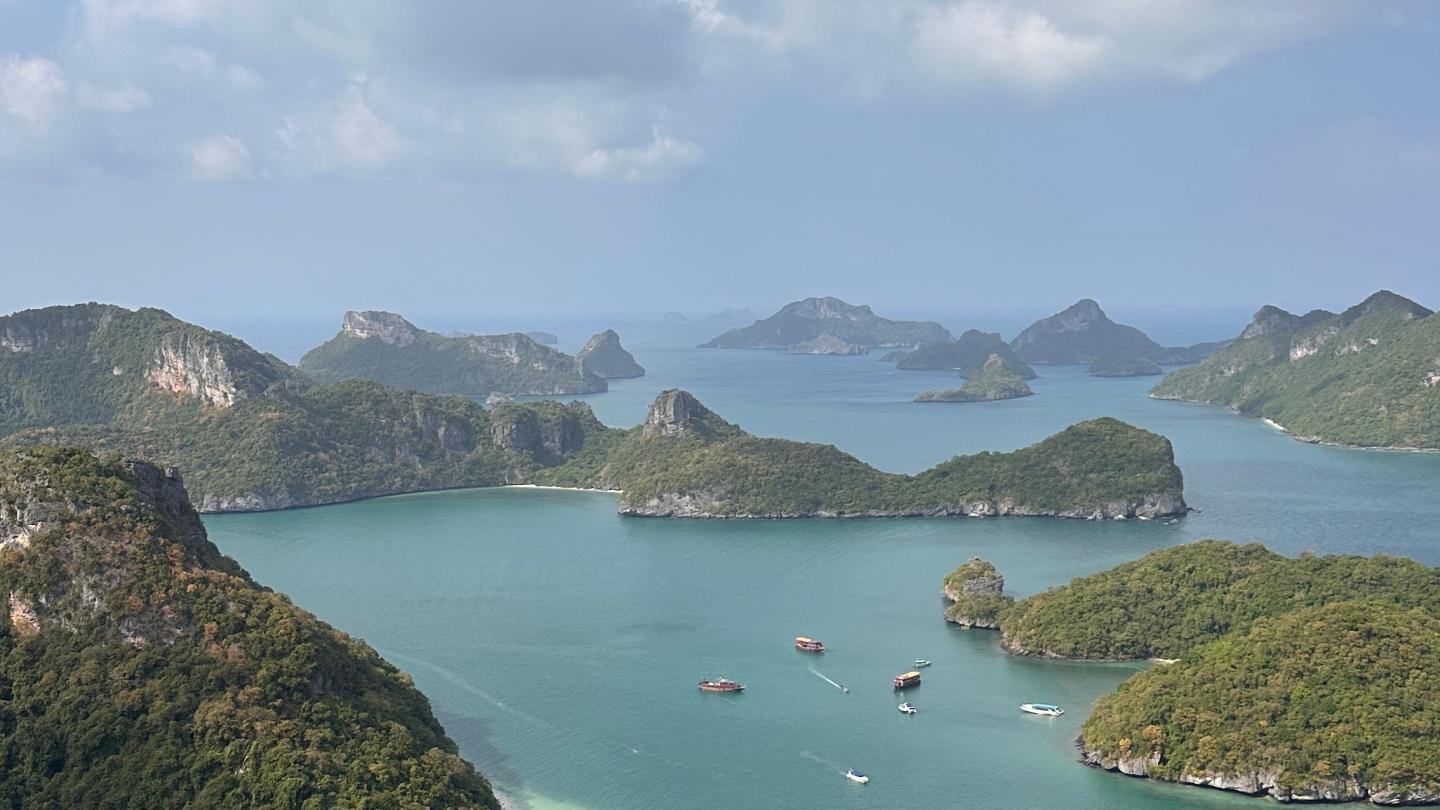
Forty-two limestone islands protected since 1980, reached by boat from the Samui area — a marine park where conditions, fees and low-impact conduct genuinely matter.
A park older than the resorts around it
Mu Ko Ang Thong was declared Thailand's 21st national park on 12 November 1980, following preliminary talks between the Ministry of Defense and the Royal Forest Department that began a few years earlier. It protects 42 islands scattered over roughly 102 square kilometres of the Gulf of Thailand, of which only about half is land — the rest is the shallow, current-swept sea between the limestone outcrops. Since 2002 the whole archipelago has also carried Ramsar Wetland status, a designation reserved for wetlands judged internationally significant. The park predates almost every hotel now operating on Koh Samui's beaches.
The novel it really did inspire — and the film it didn't
Ang Thong has a literary footnote that is often repeated and only half-true. Alex Garland, then a young backpacker, heard about the archipelago's hidden lagoon while on Koh Phangan in the 1990s, and it became a real inspiration for his novel The Beach. What did not happen here is the film: Danny Boyle's 2000 adaptation was shot at Maya Bay on Koh Phi Phi Leh, chosen for easier production logistics. Visitors who arrive expecting a film set are looking in the wrong archipelago — what they find instead is the actual place that seeded the story.
An emerald lake sealed inside a mountain
The park's signature sight is Thale Nai, the "Inland Sea," a saltwater lake inside Ko Mae Ko connected to the open ocean only through unseen limestone caves and fissures beneath the cliffs — not by any visible channel. Reaching the viewpoint above it means a roughly 20-minute walk from the landing point. On neighbouring Ko Wua Talap, the park's tallest viewpoint trail is a genuinely steep 500-metre climb, parts of it rope-assisted, rewarding the effort with a view over the whole scattered archipelago at once.
What actually lives here
Ang Thong is not just scenery. Surveys count roughly 16 mammal species across the islands, including dusky leaf monkeys, long-tailed macaques, and — more elusive — leopard cats and fishing cats, alongside smooth-coated otters working the tidal margins. Around 50 bird species and more than a dozen reptile species round out a park that functions as a real, if compact, wildlife refuge rather than a purely scenic backdrop.
Fees, seasons and getting there
Entry runs about 300 baht for a foreign adult and 150 baht for a foreign child, against 50 baht (adult) and 25 baht (child) for Thai nationals; boat transport is arranged and paid separately through tour operators from Nathon or Bophut piers on Koh Samui, or from Koh Phangan. The park closes to visitors roughly from 1 November to 15 December each year for the monsoon, and the calmest, clearest conditions generally run from January to March. Camping is permitted on a couple of islands for about 80 baht per person per night, with tents rentable on-site for around 450 baht.
Conduct that keeps the park intact
None of this survives casual treatment: no touching or standing on coral, no plastic left behind, no removing shells or rock. Boat operators brief this before departure, but the responsibility to follow it does not end at the briefing — a marine park with this much protected status stays worth visiting only if every visitor treats it that way.