
Travel
Bangkok: Golden Mount and the historic-city skyline
Last reviewed: 2026-07-16
Written by Ricardo Dos Santos
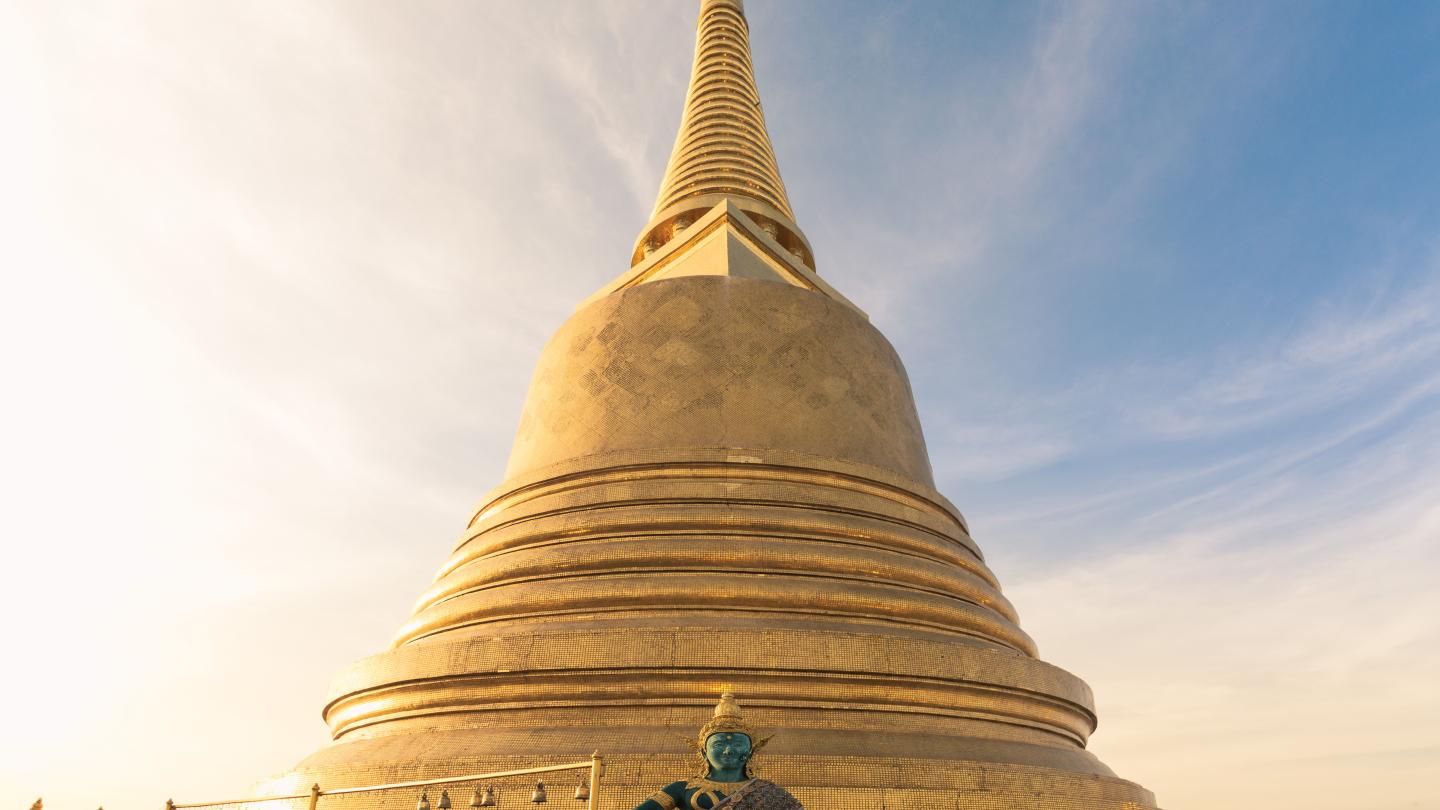
Bangkok's only hill is entirely artificial — built from the rubble of a chedi that collapsed under its own weight, then crowned with a relic and 318 steps of bells.
A monument built from failure
Wat Saket dates to the Ayutthaya era, when it was known simply as Wat Sakae, but the hill that made it famous didn't exist yet. In the early 1800s, King Rama III ordered a giant chedi built on the temple grounds — an ambitious project that outgrew Bangkok's notoriously soft, waterlogged soil. The structure collapsed mid-construction, and rather than clear the debris, the court left it in place. Over decades the rubble mound grew, settled, and became the only real elevation in a city built on a floodplain: an accidental hill made of a failed monument's own ruins.
From rubble pile to relic shrine
Rama IV reinforced the mound with timber piles so it would stop slumping, but it was Rama V who transformed it into what stands today, sometime in the late 19th century. British colonial administrators in India gifted Siam a Buddha relic, and rather than house it in an existing temple, the king chose to finish what his predecessors started: a gilded chedi was finally completed atop the reinforced hill, with the relic sealed inside. What began as an engineering failure ended as one of the most visited pilgrimage points in the old city — Phu Khao Thong, the Golden Mount.
Climbing 318 steps of bells
The ascent is part of the experience, not an obstacle to it. A spiral staircase — sources count between roughly 300 and 344 steps depending on where the count starts — winds up past a collection of bells and gongs that visitors are invited to strike on the way, a Thai Buddhist tradition believed to spread merit with each ring. At the top, a circular terrace wraps around the chedi's base and delivers one of the only unobstructed panoramas over Rattanakosin, the old royal island: temple spires, low tiled rooftops, and the Chao Phraya curling past in the distance, with none of the high-rise skyline that dominates the view from modern Bangkok viewpoints.
What the climb asks of you
Unlike the Grand Palace, there's no ticket booth crowd and no long queue, which makes it an easy add-on to a temple-cluster day rather than a destination requiring its own half-day. But it is a genuine physical climb in tropical heat and humidity, and shoes come off before entering the sanctuary itself, so factor in bare feet on stone and a shawl if shoulders need covering — rentable on-site for roughly 50 THB.
Practical planning
Wat Saket opens daily from around 7:30am to 5:30pm. Entry for foreign visitors is 100 THB; Thai nationals enter free. Dress modestly — knees and shoulders covered — and expect to remove shoes at the sanctuary level near the summit. The temple sits near Phan Fa Lilat, reachable by khlong canal boat to the Phan Fa Lilat pier, by public bus, or by taxi; it pairs naturally with a walk through the nearby Golden Mount fair grounds and Loha Prasat's distinctive metal spires. Allow 45 to 60 minutes including the full climb and a slow look at the view.
Source: Tourism Authority of Thailand, tourismthailand.org