
Travel
Wat Arun, Bangkok: a fleeing king's vow and the broken porcelain that glitters at sunset
Last reviewed: 2026-07-16
Written by Ricardo Dos Santos
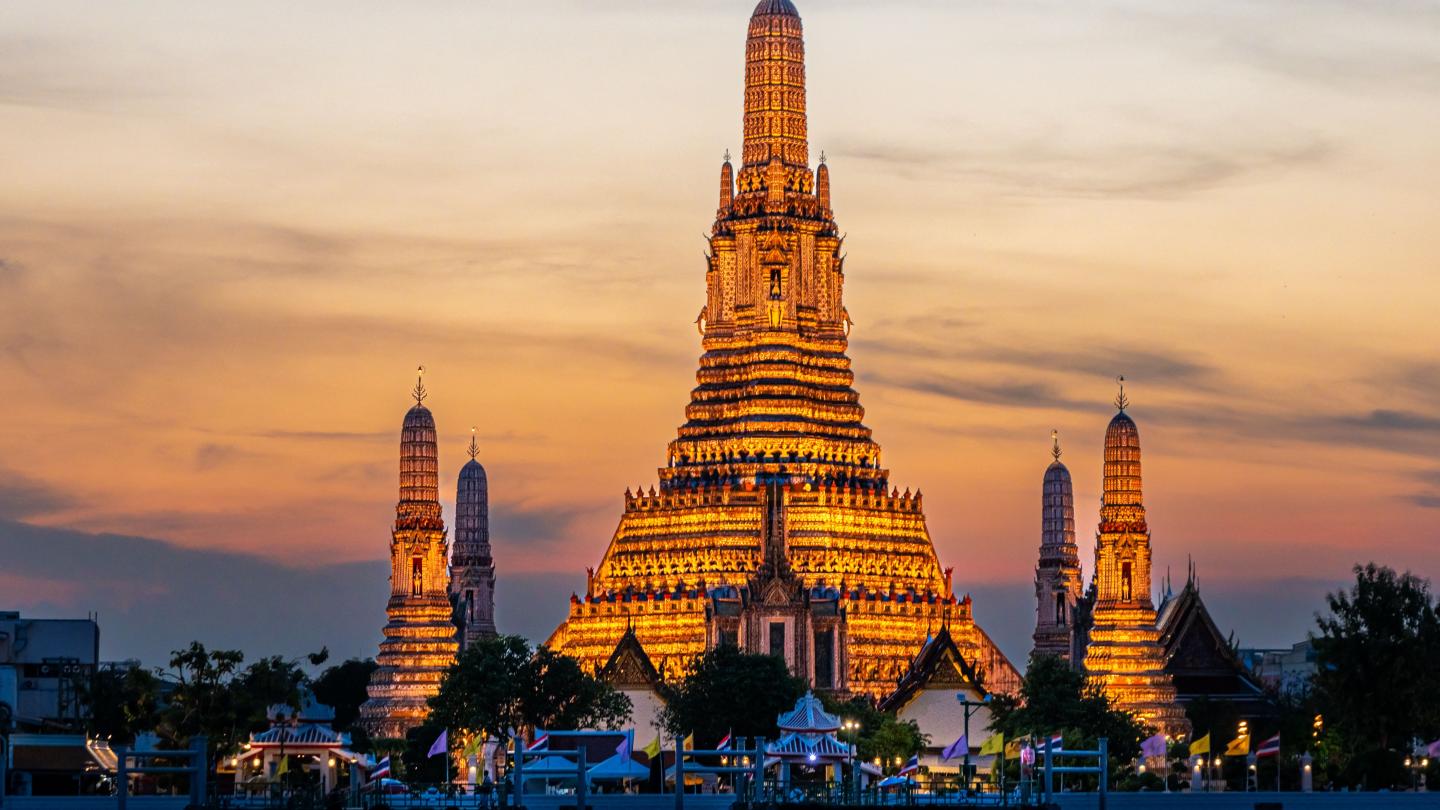
In 1767, a general on the run vows to build a temple at the exact spot where he lands at dawn. Two reigns later, its Khmer spire is clad in broken Chinese crockery — and it's at sunset, not dawn, that it truly comes alive.
A vow made at dawn, after a capital fell
In 1767, the Burmese army sacked Ayutthaya, the Siamese capital for over four centuries. General Taksin, fleeing with what remained of his troops, sailed down the Chao Phraya and landed on the Thonburi riverbank at first light. He vowed to build a temple on that exact spot, naming it Wat Chaeng — the Temple of Dawn — after Aruna, the Hindu god of daybreak. Once crowned king, Taksin briefly housed the Emerald Buddha here, before the relic moved across the river to Wat Phra Kaew inside the Grand Palace compound.
A Khmer spire dressed in broken crockery
The 82-metre central prang was begun under Rama II but only completed in 1851, under Rama III — two generations of work for a single tower. Its shape follows that of a Khmer prasat, representing Mount Meru, the cosmic axis of the Buddhist-Hindu universe; four smaller prangs at the corners complete a layout that literally maps the cosmos. What sets Wat Arun apart from every other Bangkok temple is its skin: not precious stone, but fragments of broken Chinese porcelain, which arrived by the ton as simple ballast in Chinese trading junks, topped up with crockery donated by Bangkok residents. Set into cement as floral mandalas and chrysanthemum chains, these ceramic shards catch and scatter low-angle light — the concrete, not just poetic, reason the temple glitters.
The "Temple of Dawn" paradox
Despite its name, Wat Arun is at its most spectacular at sunset, not dawn — a paradox few visitors expect. The best viewpoint isn't even the temple itself, but the opposite riverbank near Wat Pho's Tha Tien pier, where the prang's silhouette cuts against an orange sky and reflects in the river. Local folklore adds a legendary twist: the guardian giants (yaksha) at Wat Arun's entrance are said to be the very same pair locked in combat with their counterparts at Wat Pho in the Ramakien epic — split between the two riverbanks.
Climbing the prang, step by step
A steep, narrow central staircase leads partway up the prang for a close-up look at its ornamentation and a view over the river below — good shoes and a bit of caution are needed, as the steps are tall and tightly spaced. Allow roughly one to one-and-a-half hours on site if you plan to climb.
Practical details and the best time to go
The temple is open 8am–6pm, with last entry around 5:30pm, for a 200 THB entrance fee. The dress code is strict — shoulders and knees covered — with sarongs available for rent on site for visitors caught unprepared. To dodge the crowds, two windows stand out: early morning between 8 and 10am for quiet, or late afternoon between 4 and 5:30pm for the golden light before sunset. It's reached from the historic centre by a cheap cross-river ferry (3–5 THB) departing from Tha Tien pier.
Pairing it with Wat Pho, right across the water
Wat Arun sits directly across the Chao Phraya from Wat Pho, linked by that same inexpensive ferry. The classic itinerary combines the Grand Palace early in the morning before the crowds, Wat Pho by late morning, a ferry crossing, then Wat Arun in the late afternoon to catch the low light through to sunset.