
Travel
Pattaya: reading the Sanctuary of Truth beyond its silhouette
Last reviewed: 2026-07-16
Written by Ricardo Dos Santos
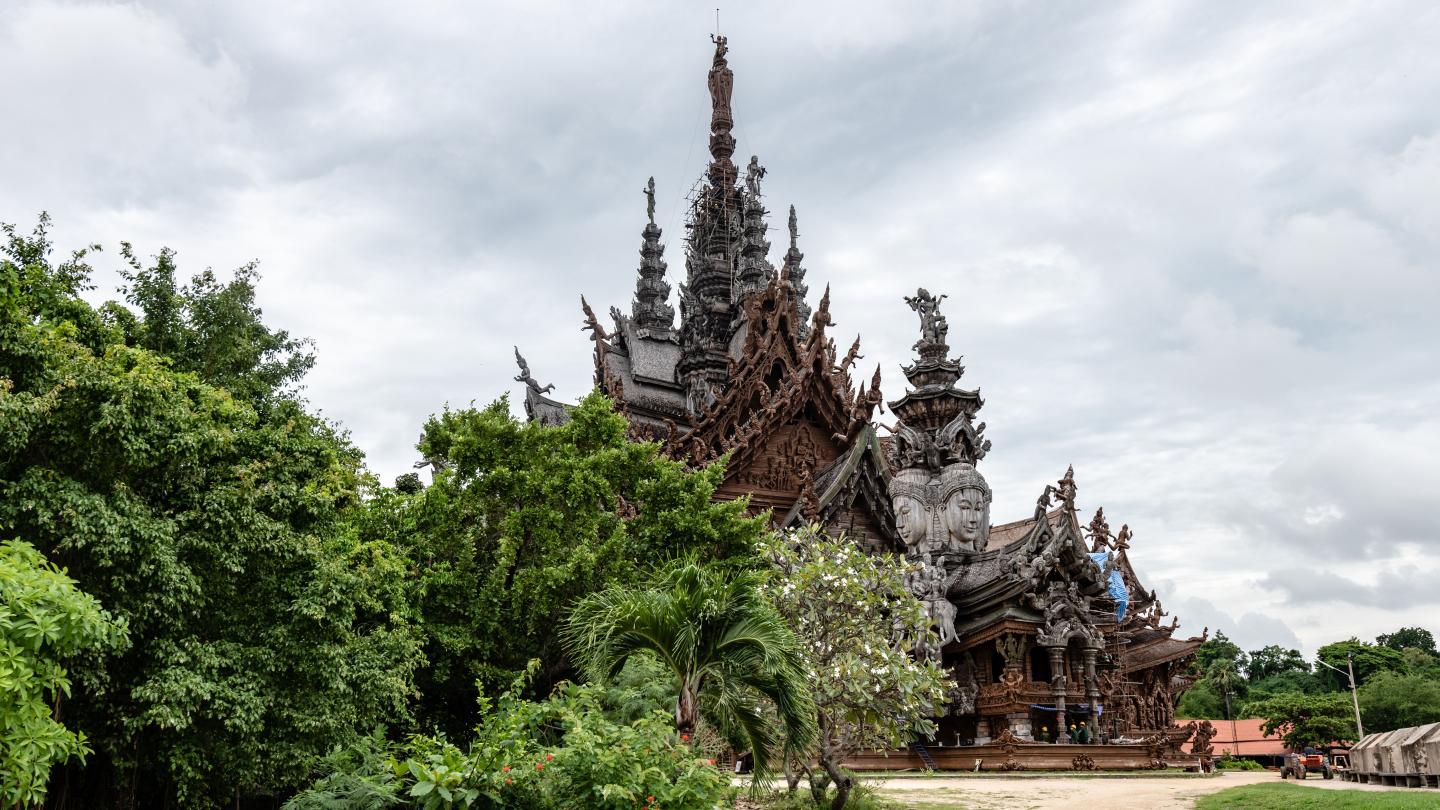
A 105-metre all-teak structure begun in 1981 and still deliberately unfinished, built without nails, concrete or metal supports.
A billionaire's unfinished argument
The Sanctuary of Truth rises 105 metres above the coast at Naklua, a few kilometres north of central Pattaya, built entirely from teak with no nails, no concrete and no metal supports — every joint cut and interlocked using traditional Thai carpentry. It was begun in 1981 by Lek Viriyaphant, a self-made Thai-Chinese businessman who also created the open-air museum Ancient City and the Erawan Elephant Museum near Bangkok. Lek died in 2000, but construction never stopped: admission tickets now fund the ongoing work, and on any given day visitors can watch carvers actively shaping new panels rather than viewing a finished monument. More than four decades in, it's still explicitly unfinished, and that's by design.
Four faces, one argument
The structure is built around four wings, each drawing on a different artistic tradition — Thai, Khmer, Chinese and Indian — fused into a single silhouette that some describe as a kind of cosmic mandala. Every gable, pillar and panel is hand-carved with gods, mythical animals, elephants and human figures pulled from Buddhist and Hindu narratives. Lek's stated intent wasn't decorative: he believed that rapid technological progress was pulling people away from moral reflection, and he built the Sanctuary as a rebuttal in wood, a structure meant to argue that all these traditions converge on the same underlying truths about how to live.
What the carvings actually show
Look past the sheer scale and the carvings reward slow reading — cross-legged deities meditating above doorways, elephants bearing symbolic weight in Hindu cosmology, gods locked in poses drawn straight from temple reliefs in Angkor and Ayutthaya. Because it functions as a living workshop rather than a sealed monument, the wood ages visibly: newer sections show pale, raw teak, while older carvings have weathered to the dark grey-brown seen in most photographs, so a careful look across the building doubles as a rough timeline of forty-plus years of work.
Practical details
The site opens daily from 8am to 6pm, with last entry around 5pm; admission is 500 baht for foreign adults and 250 baht for children under 12 and for Thai nationals, with small discounts for booking online in advance. Shoulders and knees must be covered — sarongs are lent free of charge at the entrance for anyone who arrives underdressed. It's roughly 4 kilometres from central Pattaya: a Grab or taxi runs 80–120 baht and takes about 15 minutes, while a songthaew from Beach Road costs 10–20 baht but leaves a 1.5-kilometre walk or motorbike-taxi hop to the gate. Budget at least 2–3 hours, with 45–60 minutes for the main structure alone and the rest for the grounds, cultural shows and simply watching the carvers work.
Why "unfinished" is the point
Most landmarks are visited as completed objects; the Sanctuary of Truth asks to be seen mid-sentence. Scaffolding, active tools and half-carved beams aren't signs of neglect here — they're the clearest evidence that Lek's original argument about craft, patience and continuity is still being made, decades after the man who started it died.