
Travel
Doi Suthep, Chiang Mai: the white elephant that picked a temple's location
Last reviewed: 2026-07-18
Written by Ricardo Dos Santos
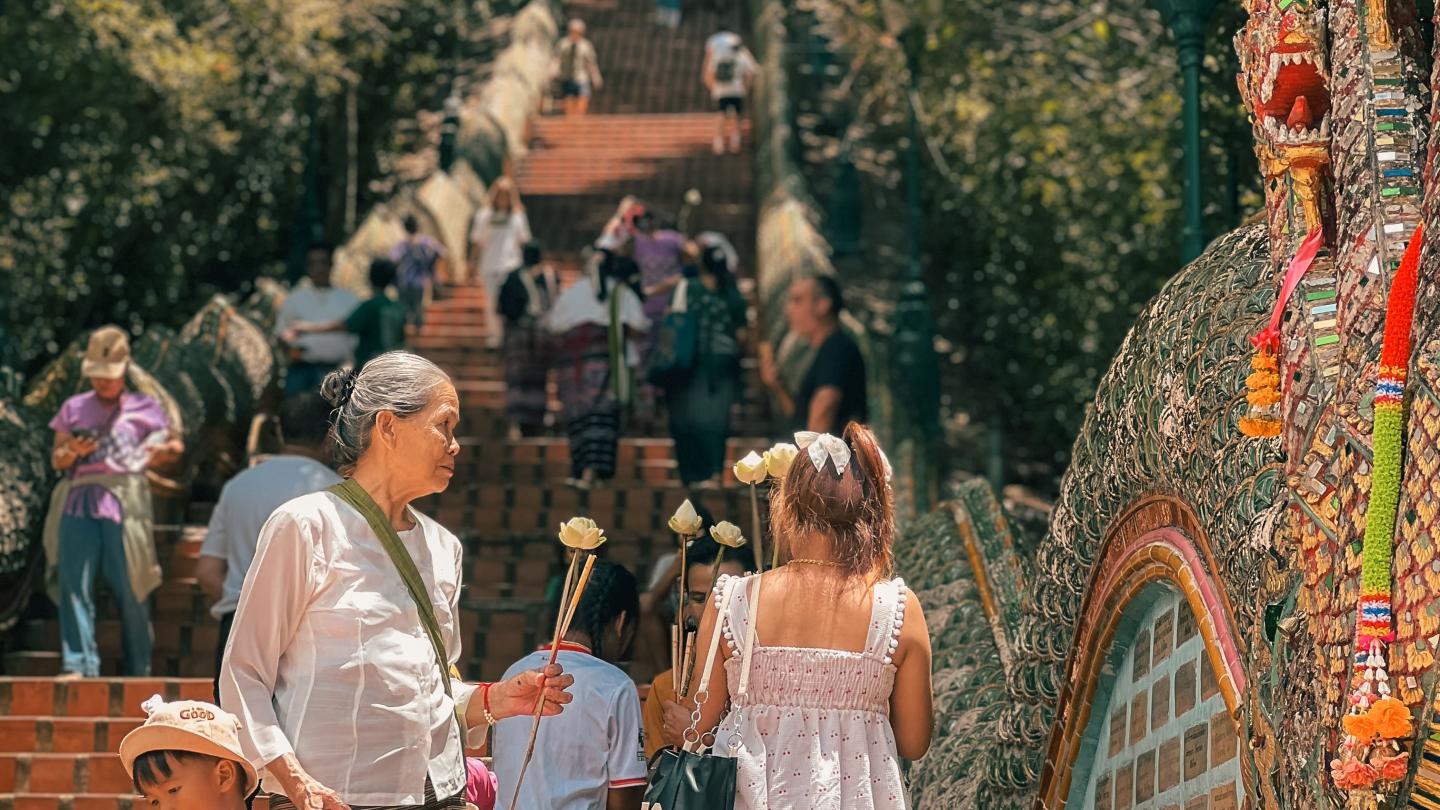
A relic carried by an elephant, 309 naga-flanked steps, and a view over the whole Chiang Mai valley: the founding legend of Wat Phra That Doi Suthep, and how to visit without the crowds.
A legend that literally drew the route
According to the 14th-century founding legend, a monk received a dream instructing that a Buddha relic be placed on the mountain, without knowing exactly where. King Kuena's solution was to load the relic onto a sacred white elephant and let it walk freely: the animal climbed the mountain, trumpeted three times at the summit, turned in a circle, then collapsed and died on that exact spot — taken ever since as the place the spirits intended. The temple was built precisely where the elephant stopped, which explains a location that, from a purely practical standpoint, makes no obvious sense.
The naga staircase: 309 steps as a symbolic threshold
Climbing to the temple via the historic staircase flanked by two seven-headed mosaic nagas (mythical serpents) means ascending 309 steps, conceived as spiritual progress rather than mere practical access — a funicular exists for those who can't or don't want to climb, but taking the stairs remains the closest experience to what pilgrims have done for centuries. At the top, the central gold chedi, visible from much of the Chiang Mai valley on a clear day, holds the relic itself — direct access is restricted, but visitors circle it clockwise, as tradition requires.
Summit etiquette: what sets this site apart from lowland temples
Doi Suthep remains an active pilgrimage site, not just a scenic overlook: shoulders and knees must be covered to enter the chedi enclosure (sarongs are lent free at the entrance if needed), shoes come off before certain sanctuary areas, and the relative quiet around the gold chedi contrasts with the bustle of the car park and stalls below. The bells hung around the enclosure can be rung by visitors as a gesture of good fortune — one of the few ritual acts openly extended to non-Buddhists.
When to climb to avoid the afternoon crush
Air-conditioned buses and tour taxis arrive mostly between 10am and 3pm, when groups combine Doi Suthep with a half-day city loop; climbing early morning (the temple usually opens around 6am) lets you watch the monks' morning rituals and see the valley still veiled in mist before the heat burns it off. The drive from Chiang Mai takes about 30-45 minutes by shared red songthaew or private taxi, along a winding but well-maintained mountain road.
Beyond the temple: the summit keeps going
Few visitors continue past the temple car park to Phuping Palace, a royal summer residence open to the public on certain days with rose gardens blooming December to February, or to the Hmong village of Doi Pui a few kilometres further up — two simple extensions that turn a temple visit into a full half-day in the hills above Chiang Mai.