
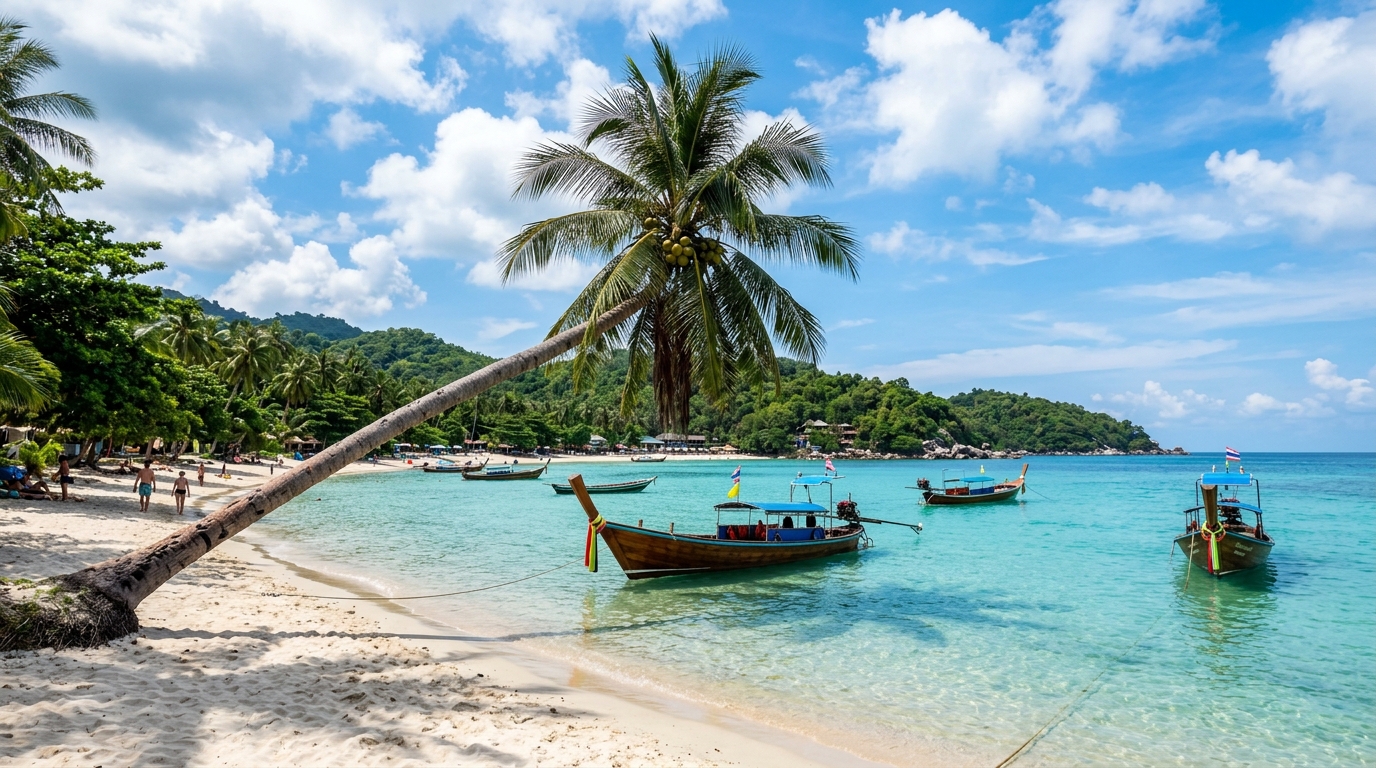
Must-See
Koh Tao is a small, steep-terrain island built around diving. Its economy, social life and daily rhythm revolve around dive schools, boat traffic and a compact visitor population, which makes it appealing for divers and remote workers who want a tight community, but limiting for anyone who needs broader services, easy family logistics or a fallback plan when something goes wrong.
The island runs on diving, not on general infrastructure
Sairee and Mae Haad host most shops, restaurants and dive operators; Chalok Baan Kao and the east-coast bays are quieter. Choose a base by proximity to the specific dive school, workspace or community you intend to use daily, not by beach photos. Roads are steep and often unpaved once away from the main strip, so a stay in a hillside bungalow can mean a longer daily commute than it appears on a map.
Ferry dependency is the defining constraint
Koh Tao has no airport; every arrival and departure is by boat via Chumphon or Koh Samui/Koh Phangan. Services are reduced or suspended during rough weather, and connections can be tight around the Gulf's stormier months. Anyone planning fixed appointments, flight connections or medical follow-ups on the mainland should build in a wide margin and check live schedules rather than assuming a boat will run on a given day.
Healthcare reach is genuinely limited
Local clinics handle common issues and diving-related injuries (including a recompression chamber presence tied to the dive industry), but anything serious means transfer to Koh Samui or the mainland. Confirm your dive and travel insurance actually covers evacuation, and do not treat the island as suitable for ongoing or complex medical needs.
Before choosing Koh Tao
- Confirm which coast puts you near the dive school, work setup or community you actually plan to use.
- Check current boat schedules and weather risk before booking anything time-sensitive around your stay.
- Verify your insurance covers medical evacuation, not just routine clinic visits.
- Test internet speed and hillside road access at the specific property before committing to it.
Sources and review
This original SawaLife planning guide was reviewed on 14 July 2026. The links below are context sources, not endorsements of a personal decision. Service hours, routes, weather, prices and local conditions can change.
Things to See & Visit
Must-See Places & Recommendations in Koh Tao
Explore iconic landmarks, revered temples, pristine natural wonders, and cultural gems curated by SawaLife.
Local weather
Weather in Koh Tao
Local weather
26 °C
Cloudy · Feels like: 28.6 °C
Provider observation: 2026-09-25T03:00 (Asia/Bangkok)
Source: Open-Meteo
View weather sourceModelled AQI
AQI 24
Good · PM2.5: 4.9 µg/m³
Updated by SawaLife: 2026-09-24 20:00:50 UTC
Modelled source: Open-Meteo / CAMS Global
View air-quality sourceThis is a modelled air-quality estimate, not a local sensor measurement or health alert. Follow official local guidance.
City profile
Source-backed city profile
These nine planning signals are separate, reviewed criteria. They do not produce an overall rank or a personal recommendation.
9 of 9 current criteria are available.
How these city signals are produced
SawaLife city context methodology
- Purpose
- Nine independent planning signals describe relative city context. They are never combined into a total, ranking, winner or personal recommendation.
- Scale interpretation
- Each whole-number value uses a 0–100 contextual scale defined for its own criterion. A higher value means a stronger presence of that named context; it is not a percentage, probability, live measurement or guarantee.
- Source policy
- Every published value keeps its identifiable primary source, supporting source bundle, capture date and staff review. Volatile weather and air-quality readings stay separate. Unsupported commercial indexes and inferred values are excluded.
- Version
- city-score-v2
- Effective from
- 2026-07-14
- Staff reviewed
- 2026-07-15